


"I saw the video" used to settle every argument.
For nearly a century, camera footage served as our ultimate anchor for truth. If a news broadcast aired a clip, a security camera captured a break-in, or a bystander filmed an event on a smartphone, the debate was over. Seeing was believing.
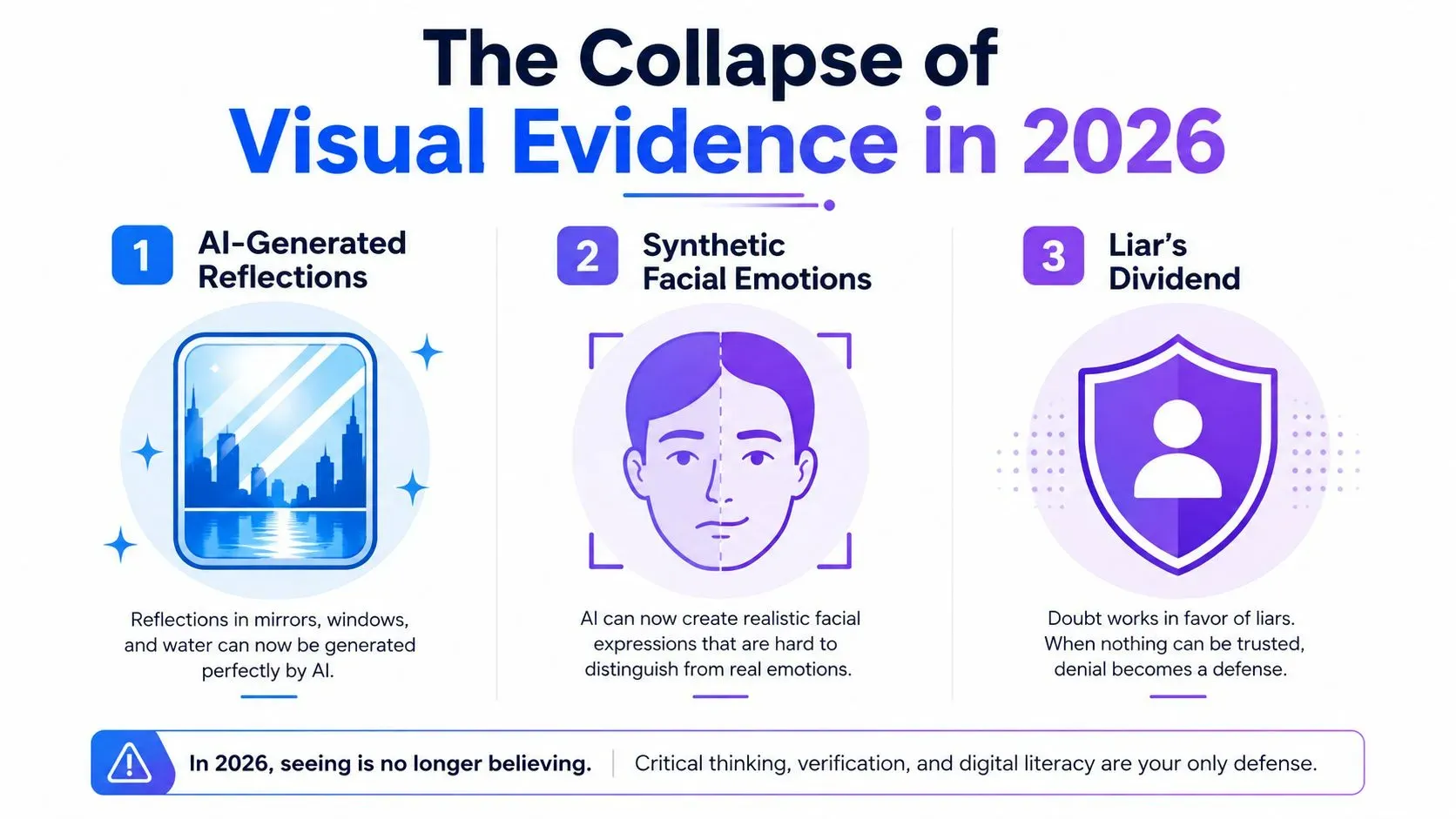
In 2026, that rule has collapsed.
Generative video models have reached a level of realism where visual observation can no longer serve as a reliable filter. Synthetic media is no longer limited to awkward face swaps or glitchy background textures. It now generates fluid motion, accurate physical reflections, and subtle facial emotions.
The real danger is not just that fake clips look real. The greater threat is that real video footage is losing its power as reliable proof.
The Moment Visual Proof Broke
For years, people looked for obvious visual tells in fake videos: distorted hands, missing eye blinks, warped earlobes, or audio delays. Those early generation flaws gave the public a false sense of security. People assumed they could always spot a generated clip with enough attention.
That confidence is gone.
Hani Farid, a computer science professor at the University of California, Berkeley, and a leading digital forensics expert, recently said he no longer trusts his own eyes. He warns that "the entire visual system" could become useless within a year or two if the current pace continues.
On July 30, 2026, deepfake specialist Sam Gregory, Executive Director at WITNESS, addressed this shift directly. Gregory noted that modern synthetic media has become so convincing that even analysts who spend their careers studying manipulated video struggle to distinguish real footage from synthetic creations. When seasoned specialists cannot separate fact from fiction through visual inspection alone, ordinary users scrolling through social feeds have virtually no chance.
This is no longer a future prediction. It is happening across every major social platform right now.
What the Data Shows: The CVPR 2026 Video Detection Benchmark
Recent empirical research confirms how severe this challenge has become. At the IEEE/CVF Computer Vision and Pattern Recognition Conference (CVPR) 2026, researchers presented findings from extensive human testing with modern AI-generated video models.
The researchers tested ordinary viewers across various synthetic video clips and measured their ability to identify generated footage:
- AI-Video Detection Accuracy: Viewers scored between roughly 58% and 75% accuracy, with detection rates shifting based on video clip duration.
- Authentic Video Recognition: Viewers correctly recognized real, unmanipulated videos only about 60% of the time.
Those numbers reveal a startling reality. When four out of ten people mistake a genuine recording for a computer-generated fake, the foundation of visual evidence has eroded on both sides.
To address this challenge, the CVPR 2026 research team built a benchmark containing over 1 million synthetic media samples specifically targeting social media deepfakes. Their work demonstrated that verifying image, audio, and video authenticity is now one of the most critical challenges in computer science.
The researchers reached an important conclusion: better synthetic media does not just make deceptive clips harder to catch. It actively weakens public trust in real-world recordings.
What Happens to the Internet When Video Stops Being Evidence?
When video loses its status as reliable evidence, the structure of online communication changes completely. The consequences extend far beyond harmless viral pranks.
1. The Rise of the "Liar's Dividend"
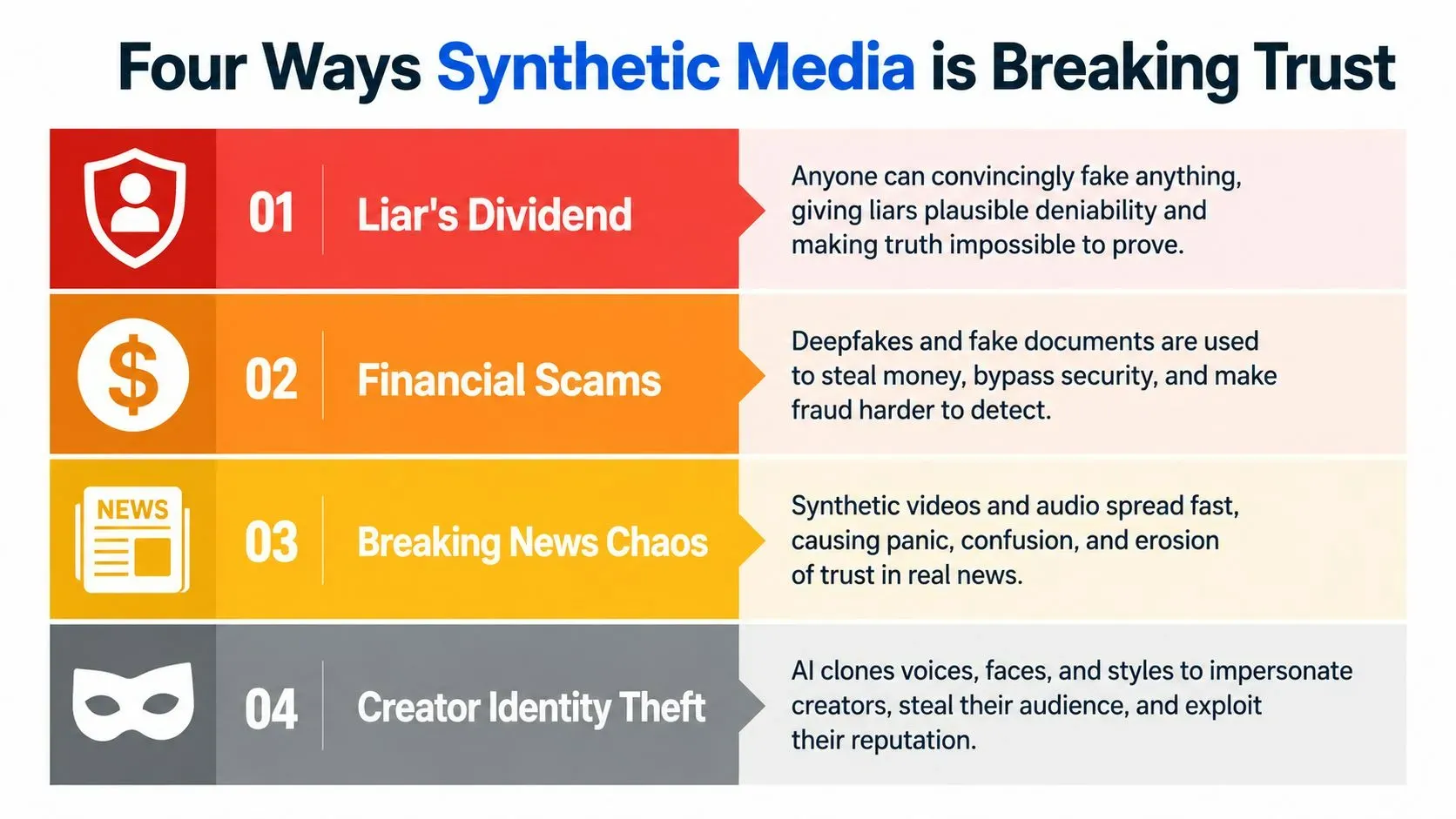
The most damaging consequence of synthetic video is what legal scholars call the liar's dividend.
When the public learns that any video can be faked, anyone caught doing something illegal or unethical gains a universal excuse. A politician caught taking a bribe or a public figure caught making offensive remarks no longer needs to apologize. They simply claim, "That video is an AI-generated deepfake."
Because the public knows fakes exist everywhere, doubt works in favor of the wrongdoer. As Sam Gregory explains, "you just need to cast doubt." The mere existence of synthetic media is enough to undermine trust in truth itself.
A powerful example comes from Minneapolis, where after a police killing, AI-altered images based on real footage circulated online. The enhanced versions became a tool for discrediting authentic evidence, showing how even modified versions of genuine recordings can poison public perception.
2. High-Stakes Financial and Personal Scams
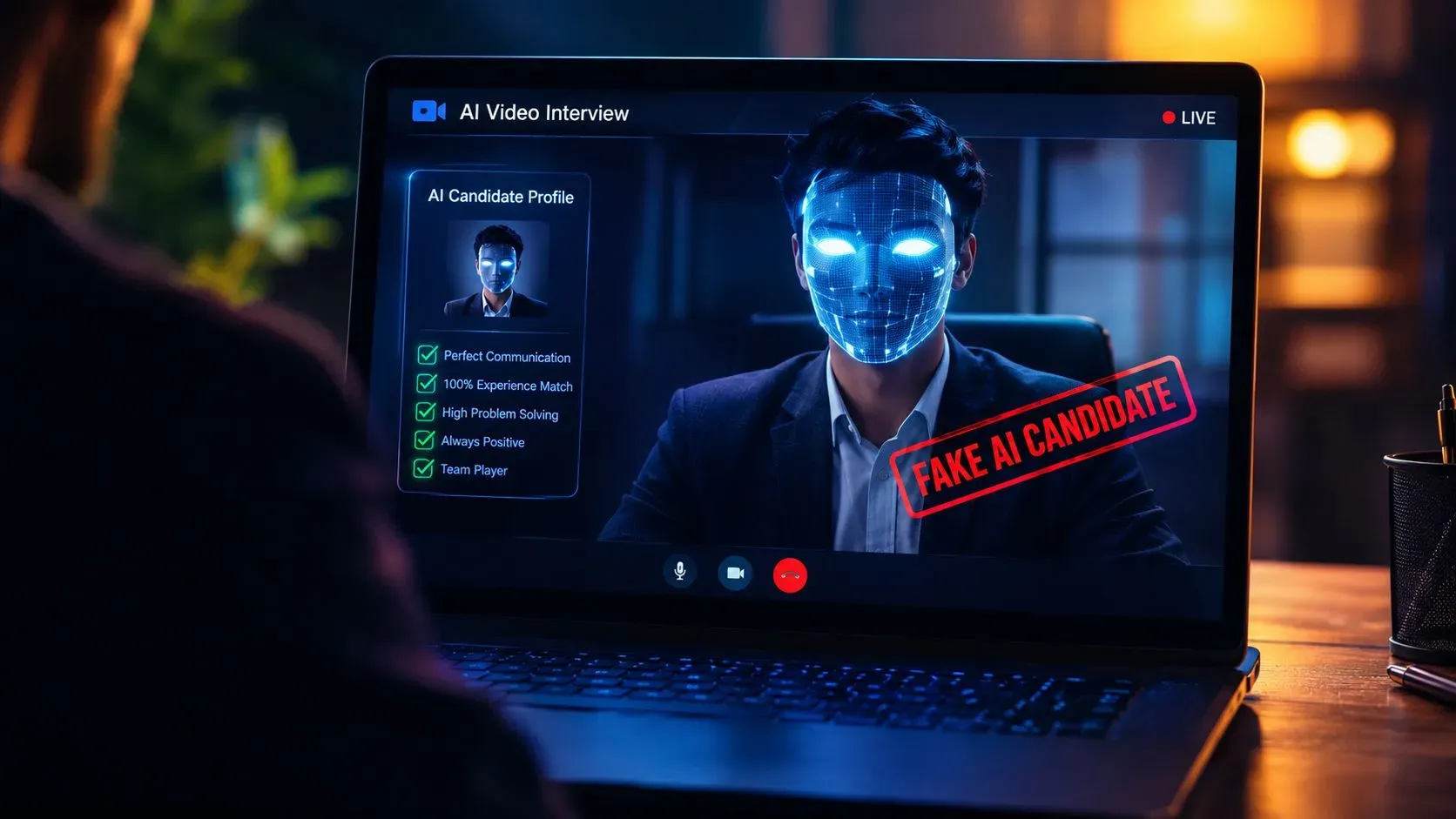
Scammers no longer rely on poorly written emails. Criminals now combine cloned audio with real-time video generation to target families and businesses.
A parent receives a short video call showing their child in distress, or a corporate finance team receives a video message from their executive authorizing a wire transfer. When visual and vocal familiarities can be simulated, traditional trust cues fail.
In 2024, a Hong Kong company lost $25 million after fraudsters used deepfake technology to pose as the CFO and colleagues during a video conference. The entire meeting showed faces that were "highly consistent" with the real employees.
3. Breaking News Chaos
During elections, natural disasters, or geopolitical conflicts, the first few minutes of a news cycle decide the public narrative. Bad actors can flood social networks with synthetic video clips showing fake protests, altered speeches, or simulated accidents.
By the time verification teams analyze the file headers, the video has already gathered millions of views and shaped public perception. In 2023, an AI-generated image of an explosion near the Pentagon briefly caused a stock market dip before it was debunked. The misinformation spread faster than the truth.
4. Creator Identity Theft
Independent content creators and small brands face constant impersonation. Automated systems clone creator likenesses and voices to sell unauthorized products or promote financial schemes.
Audiences who have spent years building loyalty with a creator can be misled in seconds by a convincing synthetic duplicate.
The ITU Warning: Synthetic Media in Daily Communication
This transformation is not isolated to malicious actors. In July 2026, the International Telecommunication Union (ITU) highlighted that AI-generated and AI-edited media has integrated directly into consumer tools and daily communication.
Filters now alter facial features in real time during live streams. Camera software automatically replaces backgrounds, relights faces, and synthesizes missing frames. Generative video tools allow anyone to produce realistic clips from simple text prompts in seconds.
Because synthetic tools are built into everyday software, the boundary between an "edited video" and a "completely fabricated video" is disappearing. The ITU emphasized that this widespread adoption forces a fundamental question: when every piece of media contains synthetic modifications, how do we establish what is authentic online?
The default assumption has reversed. In the past, people assumed a video was authentic until someone proved it was edited. In 2026, cautious internet users must assume an unverified video could be synthetic until proven authentic.
How to Navigate Video Content Without Getting Tricked
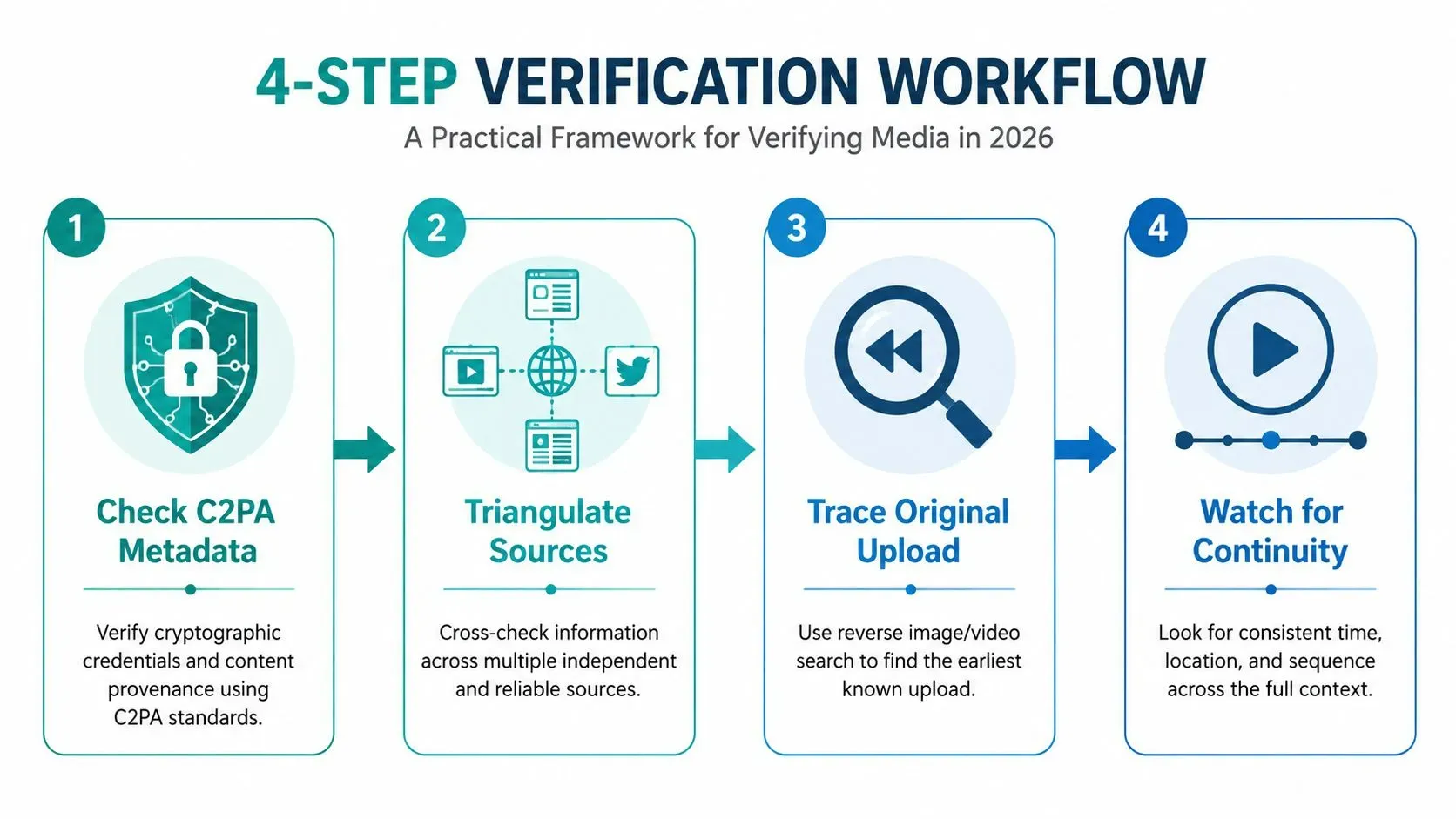
You can no longer rely on visual cues alone to judge whether a video is authentic. Navigating online media requires a shift toward structural verification and source tracking.
1. Check for Cryptographic Provenance
Look for digital signature standards such as C2PA (Coalition for Content Provenance and Authenticity) and Content Credentials. Major camera manufacturers and software platforms have begun embedding cryptographic metadata at the moment of capture.
Sony's PXW-Z300 news camcorder now embeds Content Credentials directly into footage at the moment of capture. Adobe Premiere preserves these credentials through the editing process, and broadcasters like WDR have built players that surface provenance information to viewers.
Google has also expanded verification tools, making Pixel 10 the first smartphone to offer Content Credentials for camera images, with video integration planned for Pixel 8, 9, and 10.
While metadata can still be stripped when files are re-uploaded to social platforms, signed provenance offers the clearest technical confirmation of authenticity.
2. Triangulate Across Multiple Sources
Never rely on a single video clip posted by an anonymous social media account. If a major event actually occurred, multiple independent bystanders, journalists, and local news organizations will have captured it from different angles.
Look for corroborating footage and reporting from established sources before sharing. Open-source investigation (OSINT) practices that check whether something is corroborated by other information remain essential.
3. Trace the Original Upload
Use reverse video and image search tools to locate the earliest instance of a clip. Synthetic campaigns often take old footage, alter key details with AI, and repost it with a misleading caption.
Finding the original upload date and context quickly reveals whether a video has been repurposed or fabricated.
4. Watch for Temporal and Physical Continuity
While short clips can look flawless, longer synthetic videos often reveal inconsistencies. Watch for irregular shadow angles, unnatural eye contact during conversations, inconsistent hair motion, and unnatural audio acoustics that do not match the physical room.
The Path Forward: What Can Be Done
While the challenge of AI video detection grows, there are real efforts underway to preserve trust in visual evidence.
AI Detection Tools
AI detection tools are improving but remain imperfect. WITNESS's TRIED framework evaluates whether these tools are trustworthy, robust, interpretable, effective, and deployable in real-world conditions. Even in the best circumstances, detection tools are only about 85-90% accurate, and they work best with high-quality content in major languages.
At CVPR 2026, teams competed in the Robust Deepfake Detection Challenge. A team from National Yang Ming Chiao Tung University achieved a top-five ranking using a single model with approximately 500 million parameters—one-tenth the size of competing systems. Their "Co-Insight AI Eye" platform remains effective even when content has been compressed or reposted.
Verification Tools
The ContentLens C2PA Validator extension allows users to detect AI-generated content, deepfakes, and voice clones by inspecting C2PA metadata in images and videos.
Google's SynthID verification tools for image, video, and audio have already been used 50 million times worldwide.
The ITU's Approach
The ITU's AI and Multimedia Authenticity Standards Collaboration (AMAS) is bringing together technical standards, policy frameworks, and media literacy initiatives. Their Young Research Programme showcases projects like STOP&SCAN, which promotes critical thinking, and AMITO, which analyzes suspicious images and videos through messaging apps.
Media literacy is emerging as a critical safeguard. As the ITU notes, empowering individuals to understand, question, and verify digital content builds a resilient public square.




Leave a Comment
Your comment is completely private and secure. We never publish comments publicly on our website. Your message will be sent directly to our team.