


The phone rings at 2:15 PM on a Tuesday.
Your mother picks up. On the other end, she hears your voice. You sound terrified, out of breath, and crying.
"Mom, please don't be mad. I got into an accident. My phone is broken and they took me to the police station. I need you to send money for bail right now, please don't tell dad yet."
Before she can process the shock, another man takes the phone. He introduces himself as an attorney or an officer, demanding an immediate cash transfer or digital wire to release you.
Your mother's heart races. Every maternal instinct screams at her to pay immediately. The voice was unmistakable. It had your pitch, your cadence, and your exact way of saying "Mom."
Except you are sitting at your desk at work, sipping coffee, completely unaware.
You never made that call.
What Is an AI Voice-Cloning Scam?
An AI voice-cloning scam is a type of impersonation fraud where criminals use artificial intelligence software to generate a near-perfect digital replica of a person's voice.
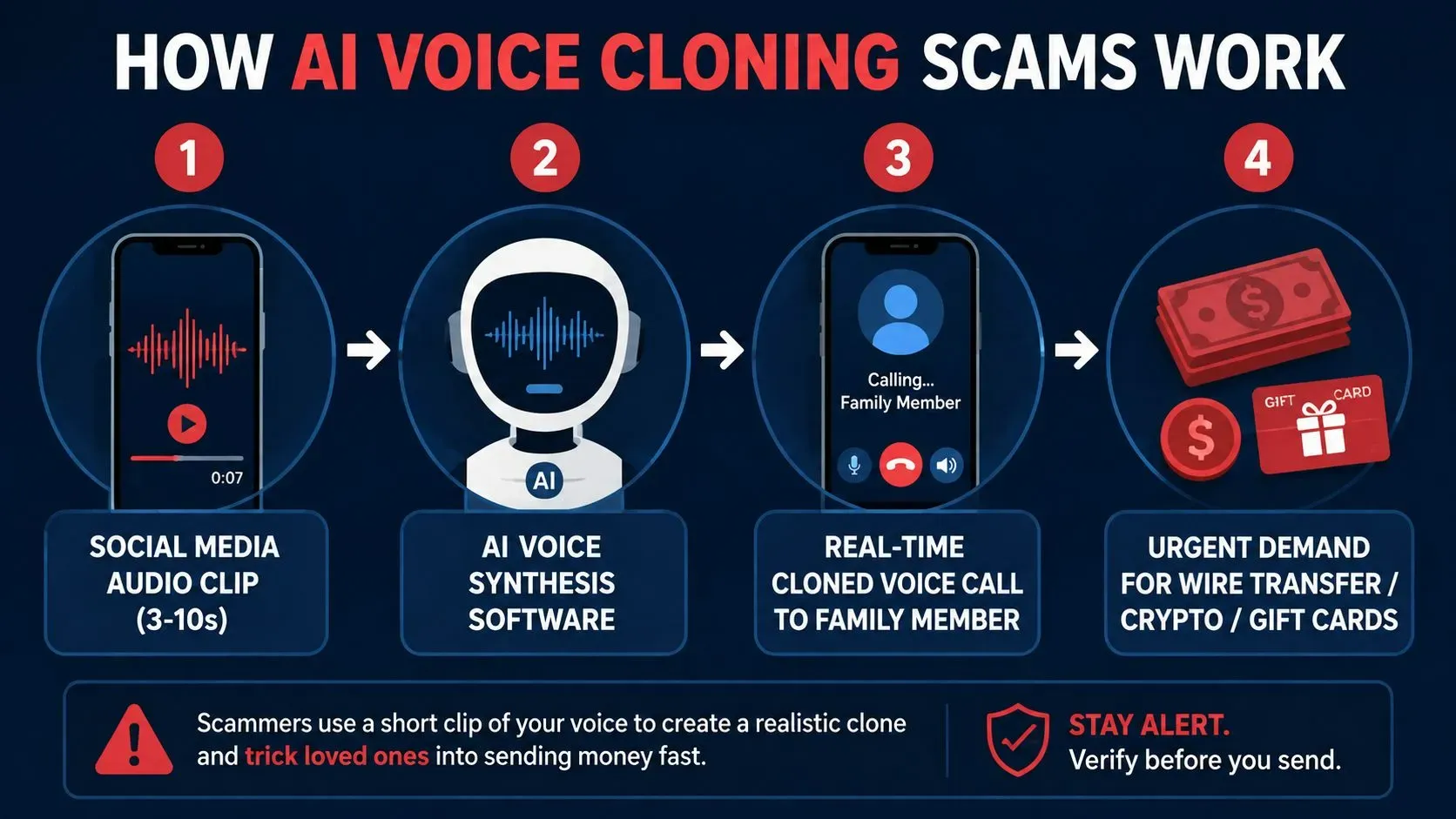
[Social Media Audio Clip (3-10s)]
│
▼
[AI Voice Synthesis Software]
│
▼
[Real-Time Cloned Voice Call to Family Member]
│
▼
[Urgent Demand for Wire Transfer / Crypto / Gift Cards]
Scammers use these clones in live phone calls to trick parents, grandparents, and spouses into believing a family member is in immediate danger.
In earlier phone schemes, fraudsters relied on generic scripts, background static, and actors pretending to have a cold to explain why their voice sounded strange. Modern voice-synthesis software can generate realistic speech with natural pauses, emotional inflections, and authentic breathing sounds using only a brief sample of original audio.
How Social Media Clips Create the Cloning Risk
AI cloning tools need very little source audio to build a working voice model. In many cases, 3 to 10 seconds of clear, isolated speech provides enough acoustic data to capture:
- Your vocal pitch and baseline frequency
- Your accent and pronunciation style
- Your natural speech pacing and cadence
Every time you post an Instagram Reel, a TikTok video, a YouTube Short, or a public story talking to the camera, you provide clean audio samples. Scammers gather these audio files directly from public profiles.
They also collect context from your social media activity. By viewing public posts, a scammer can identify:
- Family Relationships: Who your parents, siblings, or grandparents are.
- Current Locations: When you are traveling, at school, or away on a flight.
- Personal Nicknames: Specific phrases or names you use for family members.
When a criminal combines your real voice with personal details from your timeline, the resulting emergency call sounds terrifyingly authentic.
Real Official Warnings and Reported Data
Consumer protection agencies and law enforcement organizations have issued formal warnings regarding the growth of AI-assisted impersonation fraud.
- Federal Trade Commission (FTC): The Federal Trade Commission Consumer Alerts warn that scammers harvest short audio clips posted online to impersonate loved ones in distress. The FTC emphasizes that families should never rely on caller ID or vocal recognition alone when money is requested.
- FBI Internet Crime Complaint Center (IC3): The FBI Internet Crime Complaint Center (IC3) tracks impersonation schemes and distress fraud. Americans lost more than $893 million to AI-related scams last year, including voice cloning attacks along with AI-generated phishing emails, romance scams, and other hoaxes.
- Independent Consumer Surveys: A global consumer study by McAfee found that one in four adults has either experienced an AI voice scam or knows someone who has, with a majority of targeted individuals experiencing financial losses when no verification protocol was in place.
- Police Advisories: The Saskatoon Police Service Economic Crime Section has issued a public advisory about the Family/Grandparent Emergency Scam, warning that fraudsters demand payment in cash or cryptocurrency for bail and legal fees. Boise Police Detective Brad Thorne called scams "an epidemic," noting that Idaho alone lost $54 million to fraud last year.
7 Warning Signs of a Cloned Voice Emergency Call
While cloned audio can sound identical to a loved one, the structure of the scam follows recognizable patterns. Watch for these seven red flags:
| Warning Sign | How It Appears | Why the Scammer Does It |
|---|---|---|
| Extreme Emotional Urgency | The caller cries, screams, or begs for immediate help without pausing. | High stress blocks logical thinking and prevents you from checking facts. |
| Demands for Secrecy | "Don't tell mom," or "Don't call anyone else, it will make things worse." | Stops you from contacting other family members who know the person is safe. |
| Unusual Payment Methods | Demands for wire transfers, cryptocurrency, payment apps, or gift cards. | These transactions are instant, untraceable, and cannot be reversed. |
| Rapid Handoff to an "Authority" | The loved one speaks for only 10–15 seconds before handing the phone to a "lawyer" or "officer." | Keeps the AI voice sample short to prevent speech glitches from showing up. |
| Unnatural Call Flow | Slight pauses before responding, or dodging direct personal questions. | The scammer may be typing text into an audio generator in real time. |
| Unknown or Spoofed Numbers | The call comes from an unknown number or a spoofed local area code. | Scammers claim the original phone was lost, stolen, or broken in the incident. |
| Refusal to Hang Up | The caller insists you stay on the line until the transaction is completed. | Prevents you from placing a separate outbound call to verify their location. |
The 60-Second Callback Verification Rule
The most effective defense against a voice-cloning scam is a strict communication protocol:
[Incoming Emergency Call Received]
│
▼
[DO NOT Send Funds — Say: "I am calling you back right now."]
│
▼
[Hang Up the Phone Immediately]
│
▼
[Dial Saved Contact Number / Message Secondary Family Member]
│
▼
[Verify Safety Before Taking Any Financial Action]
- Pause and Breathe: Recognize that panic is the scammer's primary tool. Take five seconds to slow your reaction.
- End the Call: State clearly: "I am hanging up and calling your direct number right now." Hang up immediately, even if the caller protests.
- Dial the Trusted Number: Open your contacts and call the known, saved phone number for that person. Do not use redial or call back the incoming number displayed on your screen.
- Use Out-of-Band Verification: If the person does not answer their phone, call their roommate, spouse, workplace, school office, or a close friend who can confirm their physical whereabouts.
A legitimate emergency will still be an emergency two minutes later. Taking 60 seconds to verify will not cause harm, but sending unverified money cannot be undone.
How to Set Up a Family Secret-Word System
A family secret-word system provides instant verification when an unexpected emergency occurs.
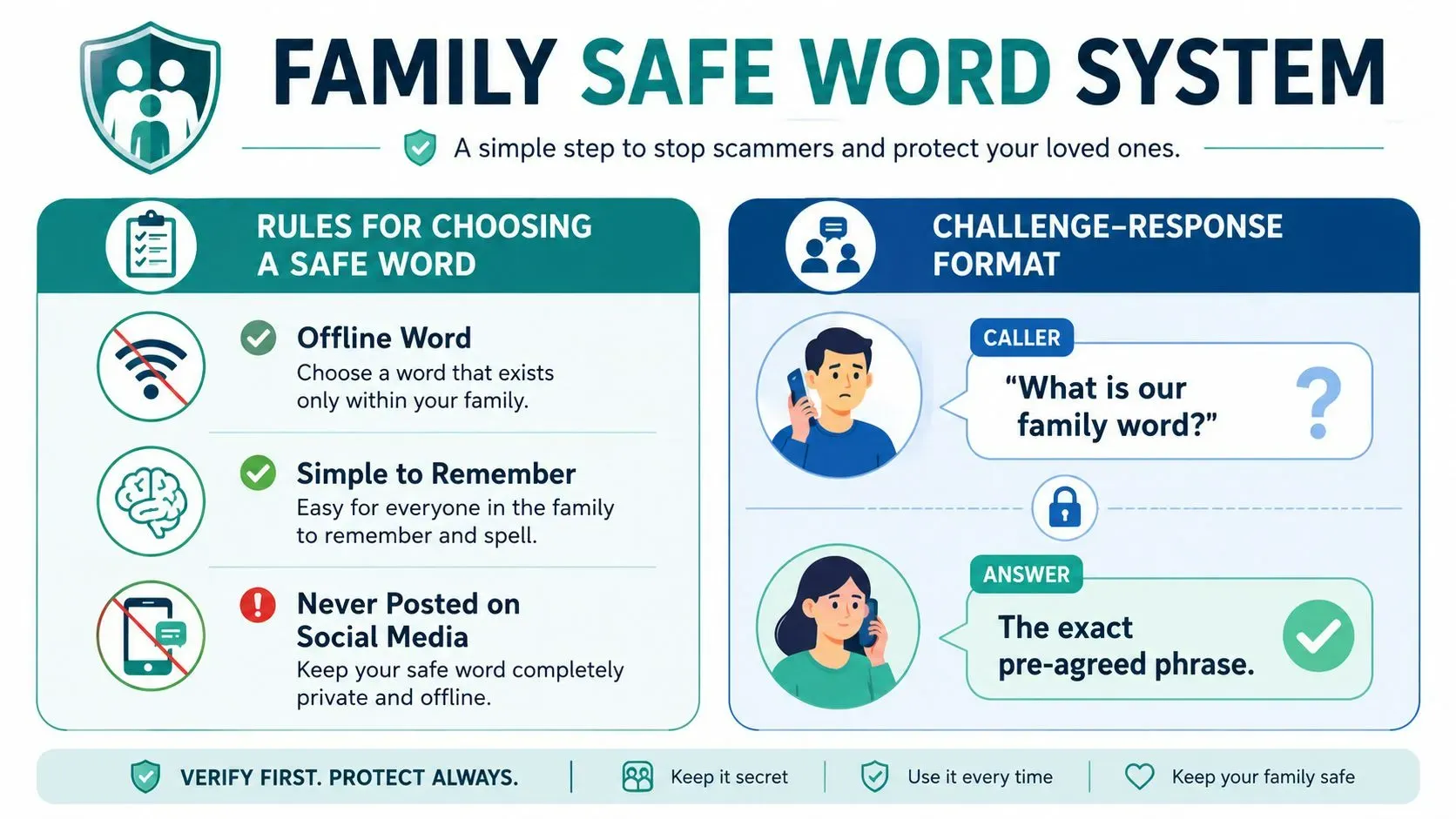
Rules for Choosing a Family Safe Word:
- Pick an Offline Word: Choose a word or phrase that has never appeared on social media, in text messages, or in public conversations.
- Keep It Simple: Select a word that children and elderly grandparents can easily remember under stress (e.g., "Blue Falcon" or "Pineapple Tree").
- Define Its Exact Use: The safe word is strictly used to confirm identity during unusual phone calls, unexpected pickup requests, or urgent financial claims.
Establish a Challenge-Response Format:
Caller Question: "What is our family word?"
Required Answer: The exact pre-agreed phrase. If the caller hesitates, makes an excuse, or guesses incorrectly, hang up immediately.
What to Do Immediately If You Receive a Suspicious Call
If you receive a suspicious emergency call claiming to be a family member, follow these concrete steps:
- Do not send money or share personal data: Never transfer cryptocurrency, buy retail gift cards, or provide bank details over the phone.
- Ask a question only the real person can answer: Ask a specific question based on an unshared memory (e.g., "What did we eat for dinner last Sunday?" or "What is our dog's middle name?").
- Hang up and call local authorities if needed: If you cannot reach your loved one and have genuine safety concerns, call your local police department directly rather than sending money to an unknown third party.
- Alert your bank immediately: If you sent money before realizing it was a scam, contact your bank or wire service right away to request a transaction stop.
- File official reports: Report the incident to the FTC Fraud Reporting Portal and file a complaint with the FBI Internet Crime Complaint Center (IC3).
How Content Creators Can Protect Their Voice and Identity
Public content creators cannot eliminate their audio footprint entirely, but they can reduce their risk profile:
┌─────────────────────────────────────────────────────────────┐
│ Creator Defense Checklist │
├─────────────────────────────────────────────────────────────┤
│ [ ] Educate immediate family members about voice cloning │
│ [ ] Establish a strict family safe-word protocol │
│ [ ] Avoid posting real-time travel locations │
│ [ ] Separate personal contact info from public channels │
│ [ ] Use watermark disclaimers for AI-generated voice work │
└─────────────────────────────────────────────────────────────┘
- Brief Your Inner Circle: Inform parents, grandparents, and close friends that your voice is widely available online and could be cloned. Instruct them never to act on emergency calls without direct verification.
- Delay Travel Posts: Avoid posting your exact flight schedules or hotel locations in real time. Scammers use travel windows to target relatives when they know you are unreachable on an airplane.
- Separate Public and Private Numbers: Never publish the phone numbers that your family uses to contact you on public creator portfolios, domain registrations, or social media bios.
Quick Family Safety Checklist
Keep this checklist accessible for every member of your household:
[ ] Family Safe Word: Our agreed secret phrase is: __________________
[ ] Emergency Contact 1: Name: ______________ Phone: ______________
[ ] Emergency Contact 2: Name: ______________ Phone: ______________
[ ] Primary Verification Rule: Always hang up and dial the saved number directly.
[ ] Financial Rule: Never pay via wire, gift cards, or crypto for an unverified call.
[ ] Official Reporting Hubs: FTC Fraud Reporting Portal & FBI IC3 Portal






Leave a Comment
Your comment is completely private and secure. We never publish comments publicly on our website. Your message will be sent directly to our team.