


Most developer portfolios are filled with the exact same tutorial clones: basic to-do apps, generic blogs, and simple weather dashboards. Hiring managers and clients see hundreds of these every week and routinely skip past them.
To stand out, you need django project ideas that solve actual business problems and demonstrate production-grade engineering patterns.
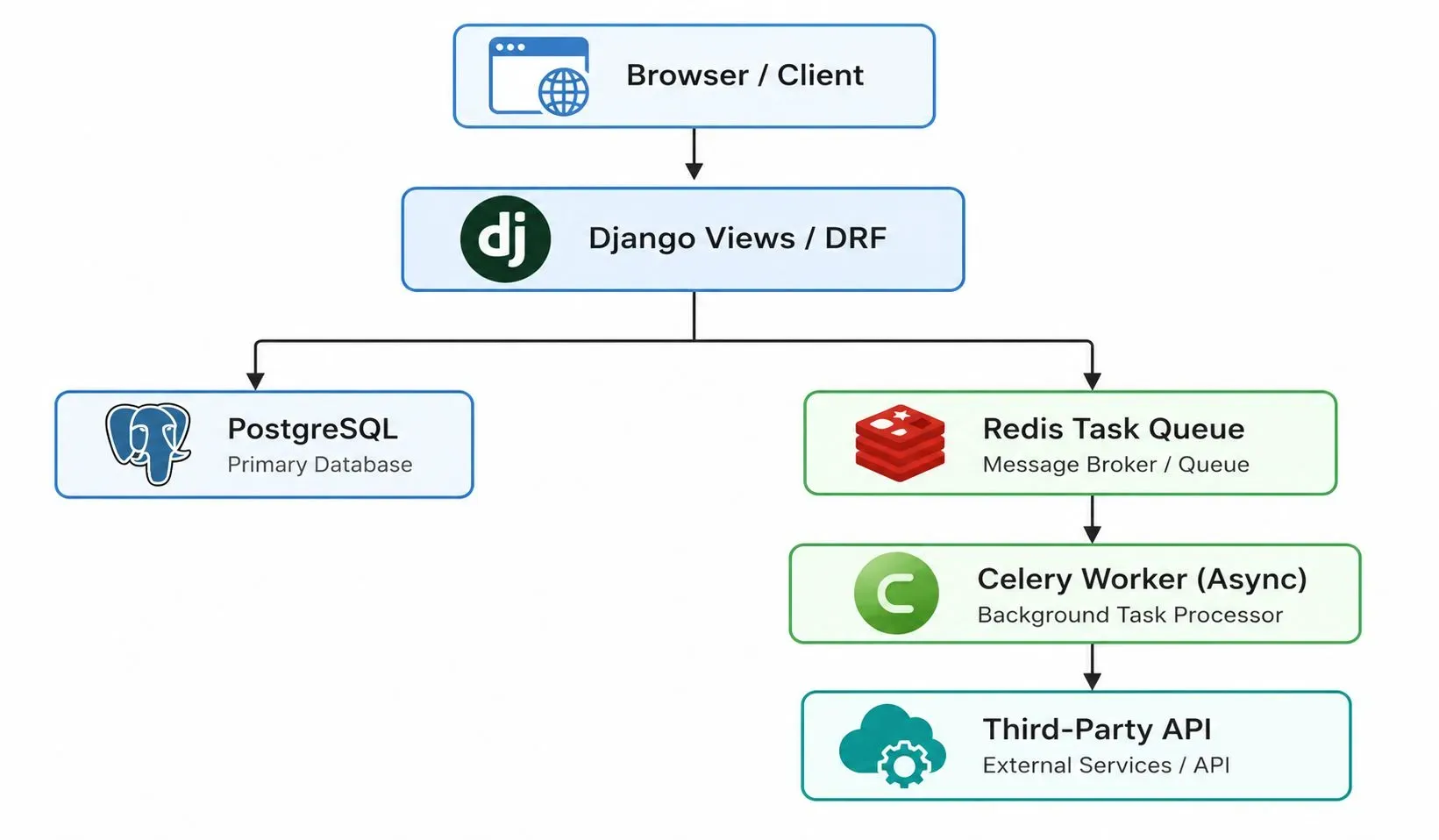
A strong portfolio project proves you understand critical backend challenges: managing database relationships in PostgreSQL, running background workers with Celery and Redis, handling real-time events through Django Channels, and securing payment integrations.
Below is a curated breakdown of unique, problem-solving Django project ideas grouped by complexity, complete with architectural blueprints and real-world use cases.
Django Project Ideas at a Glance
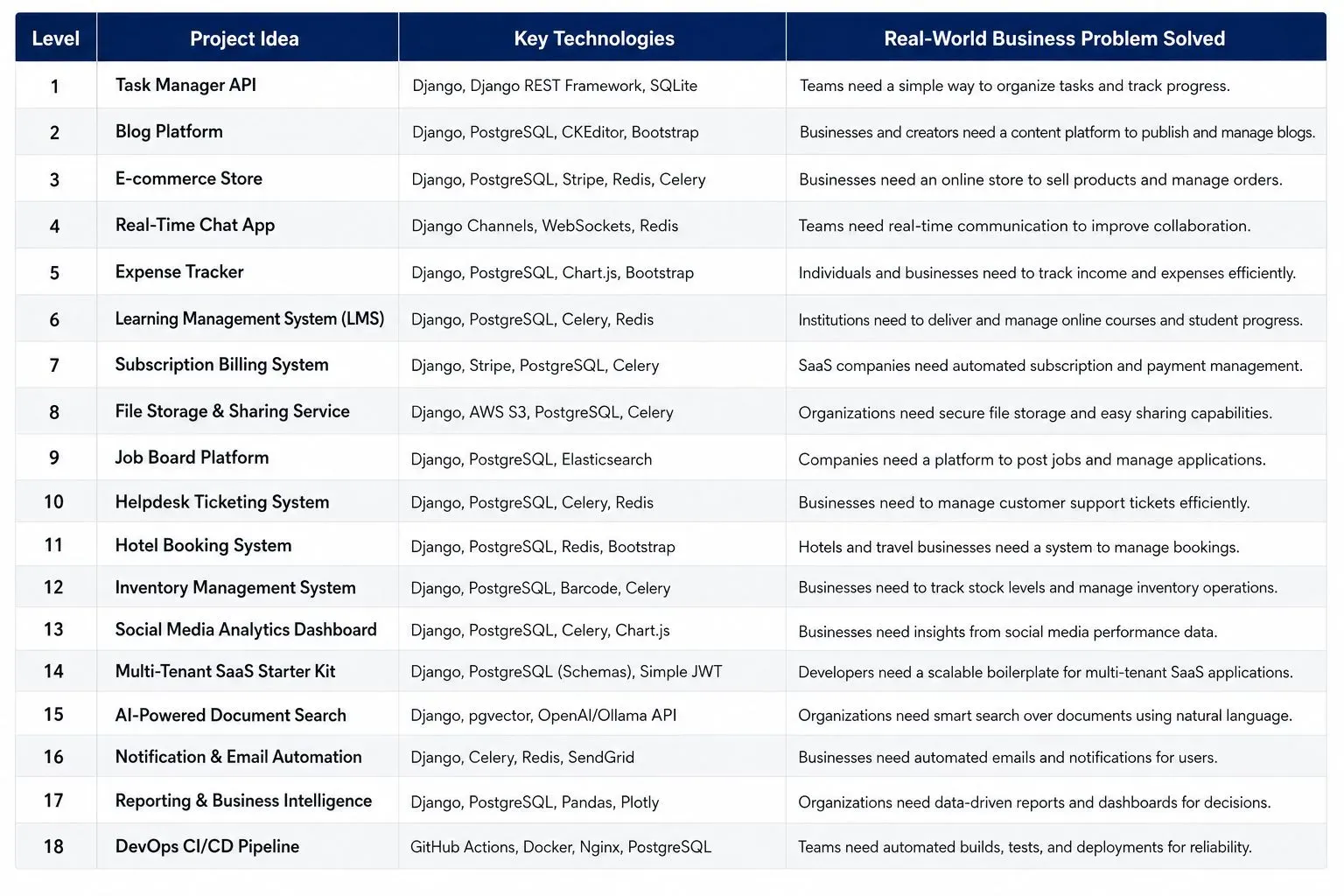
Tier 1: Practical Intermediate Django Projects
These projects move past simple CRUD tutorials by introducing asynchronous workers, third-party APIs, and custom relational schemas.
1. Automated Invoice & Recurring Tax Calculation Engine
Business Problem: Small agencies waste hours manually drafting PDF invoices, calculating localized sales tax, and tracking unpaid accounts.
Core Architecture: Models for Client, Invoice, LineItem, TaxRate, and PaymentRecord. Asynchronous PDF generation using WeasyPrint or ReportLab inside Celery workers. Automated email dispatch with PDF attachments when invoices transition to ISSUED.
Key Learning Outcome: Generating binary file assets asynchronously without freezing web request worker threads.
2. Clinical Appointment & Automated SMS Triage Portal
Business Problem: Medical clinics experience high revenue loss from missed patient consultations and manual telephone rescheduling.
Core Architecture: Doctor availability matrices with time slot collision detection in the Django ORM. Scheduled reminders via Celery Beat dispatched 24 hours and 2 hours prior to appointments. Twilio webhook integration to handle two-way SMS replies (e.g., reply "1" to confirm, "2" to cancel).
Key Learning Outcome: Managing scheduled recurring tasks and handling inbound external webhooks safely.
3. Multi-Vendor Equipment Rental Marketplace
Business Problem: Tool and construction equipment owners need a platform to list hardware for rent with security deposits and availability windows.
Core Architecture: Date-range overlap checks using PostgreSQL DateRangeField and exclusion constraints. Stripe Connect custom account integration to hold funds in escrow until return inspections clear. Late-return penalty calculation engine executed via nightly automated scripts.
Key Learning Outcome: Designing non-overlapping booking queries and handling multi-party financial splits.
4. Granular Feature-Flag & Remote Configuration Service
Business Problem: Software teams need to release features to 5% of users or specific email domains without deploying new code.
Core Architecture: Evaluation engine checking user IDs, geographical locations, and percentage rollouts. High-speed Redis caching layer to evaluate flag rules in under 5 milliseconds. REST API endpoints consumed by frontend clients or mobile applications.
Key Learning Outcome: Designing high-throughput, read-heavy APIs with aggressive Redis caching strategies.
5. Dynamic Form Builder & Survey Analytics Engine
Business Problem: Non-technical staff need to create custom multi-page questionnaires with conditional logic without requesting developer assistance.
Core Architecture: PostgreSQL JSONField to store arbitrary form schemas and submission payloads. Form rendering layer built with HTMX for responsive conditional field display. Real-time aggregation queries computing completion rates and field drop-offs.
Key Learning Outcome: Working with semi-structured JSON documents inside relational database models.
6. Media Asset Vault with Expiring Pre-Signed URLs
Business Problem: Digital creators selling video courses need to prevent direct link sharing and unauthorized file downloads.
Core Architecture: Django storage backends communicating with Amazon S3 or Cloudflare R2 via Boto3. Custom permission classes generating short-lived (e.g., 15-minute) pre-signed download URLs. Asynchronous video thumbnail extraction using FFmpeg inside background workers.
Key Learning Outcome: Managing cloud object storage security and offloading large binary transfers from web application servers.
Tier 2: Real-World Business Platforms & SaaS
These projects solve complex commercial challenges and show employers that you can design systems capable of generating revenue.
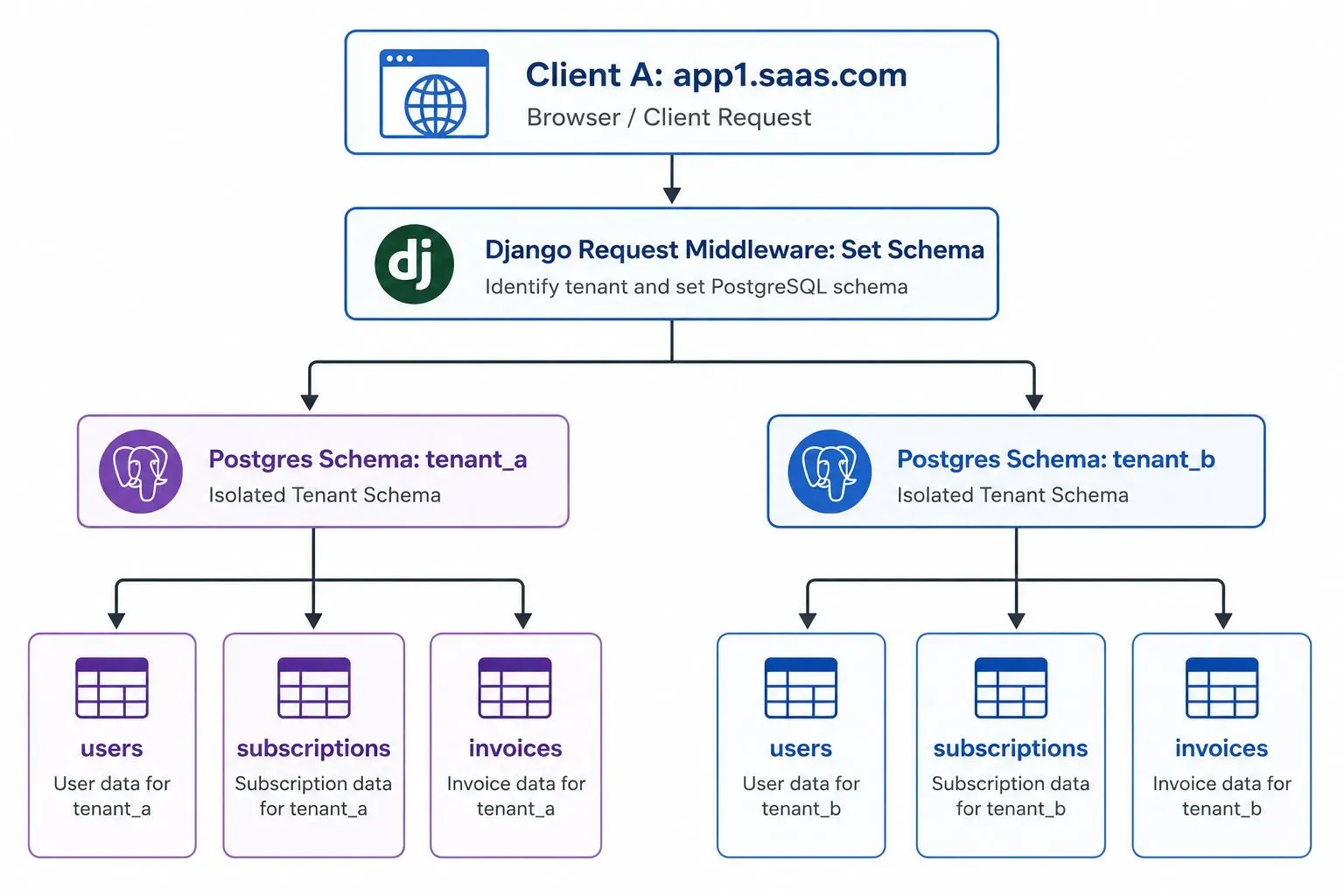
7. Multi-Tenant B2B SaaS Platform (Isolated Schemas)
Business Problem: Enterprise customers refuse to share database tables with other companies due to strict regulatory and privacy requirements.
Core Architecture: Tenant routing via subdomain detection (acme.platform.com) in custom middleware. PostgreSQL schema-level isolation using django-tenants, giving each company its own database schema. Shared public schema managing global user authentication, billing plans, and tenant registration.
Key Learning Outcome: Managing database migrations across dozens of isolated schemas simultaneously.
8. Webhook Ingestion & Event Dispatch Gateway
Business Problem: Companies receive webhooks from payment gateways and shipping providers that can fail during traffic spikes, losing critical data.
Core Architecture: Rapid webhook ingestion endpoints that validate HMAC SHA-256 signatures and dump payloads to Redis in under 20ms. Asynchronous background consumers that process events from the queue with exponential retry backoff. Outbound webhook dispatcher letting third parties subscribe to internal events with delivery tracking.
Key Learning Outcome: Building reliable event-driven systems that absorb sudden traffic surges without dropping payloads.
9. High-Concurrency Flash Sale & Inventory Lock Engine
Business Problem: When concert tickets or limited sneaker runs launch, simultaneous checkout requests lead to overselling stock.
Core Architecture: Atomic stock reservation using Redis distributed locks and Lua scripts. Database-level concurrency control via select_for_update() within atomic database transactions. 10-minute cart expiration window managed via background task expirations.
Key Learning Outcome: Preventing race conditions, database deadlocks, and inventory inconsistencies under heavy write loads.
10. API Usage Metering & Usage-Based Subscription Engine
Business Problem: Developer tool providers need to track millions of API hits and bill customers based on exact usage tiers each month.
Core Architecture: Lightweight Django middleware incrementing user request counters directly in Redis memory. Celery Beat jobs aggregating Redis usage counts into PostgreSQL hourly time-bucket records. Stripe Metered Billing synchronization reporting invoice line items automatically at the end of each billing cycle.
Key Learning Outcome: Tracking high-volume operational metrics efficiently without introducing database bottlenecks.
Tier 3: Advanced Distributed Systems
These projects demonstrate mastery over real-time communication, vector embeddings, geospatial indexing, and complex data pipelines.
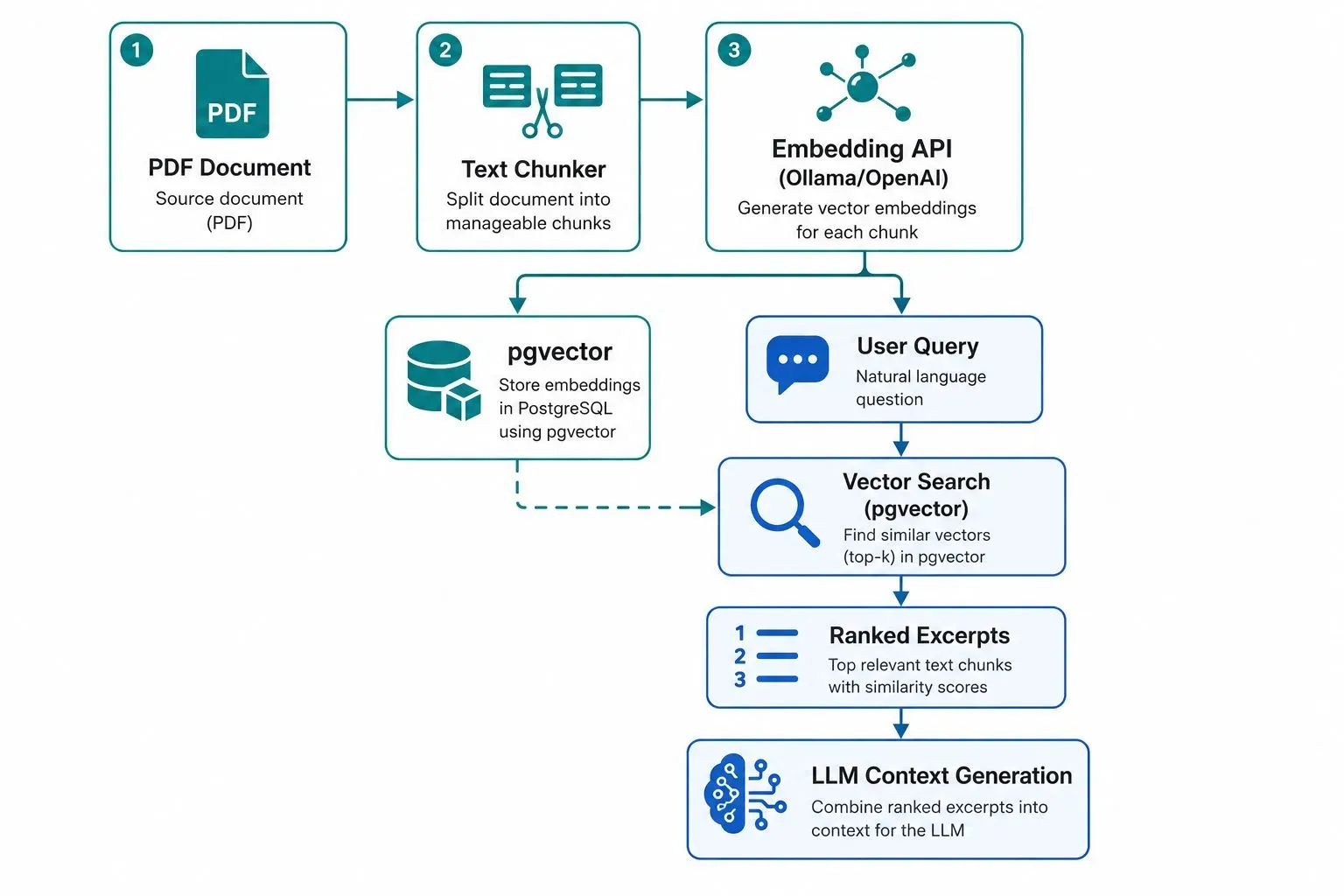
11. Semantic Knowledge Base with Vector Search (pgvector)
Business Problem: Keyword search fails when employees search for concepts using different words than those written in company policy manuals.
Core Architecture: Document ingestion pipeline splitting uploaded PDFs into text chunks. Vector embeddings generated via local Ollama models or OpenAI APIs. PostgreSQL vector storage and similarity searches using pgvector (CosineDistance queries).
Key Learning Outcome: Integrating vector search and similarity ranking natively into Django ORM queries.
12. Real-Time Collaborative Document Review Board
Business Problem: Remote legal teams need to review contracts, highlight clauses, and see colleague annotations live without page refreshes.
Core Architecture: Asynchronous WebSocket consumers built using Django Channels and ASGI servers (Daphne/Uvicorn). Redis Channel Layer broadcasting cursor movements and comment additions to connected room participants. Complete operational transformation (OT) or document revision histories stored in PostgreSQL.
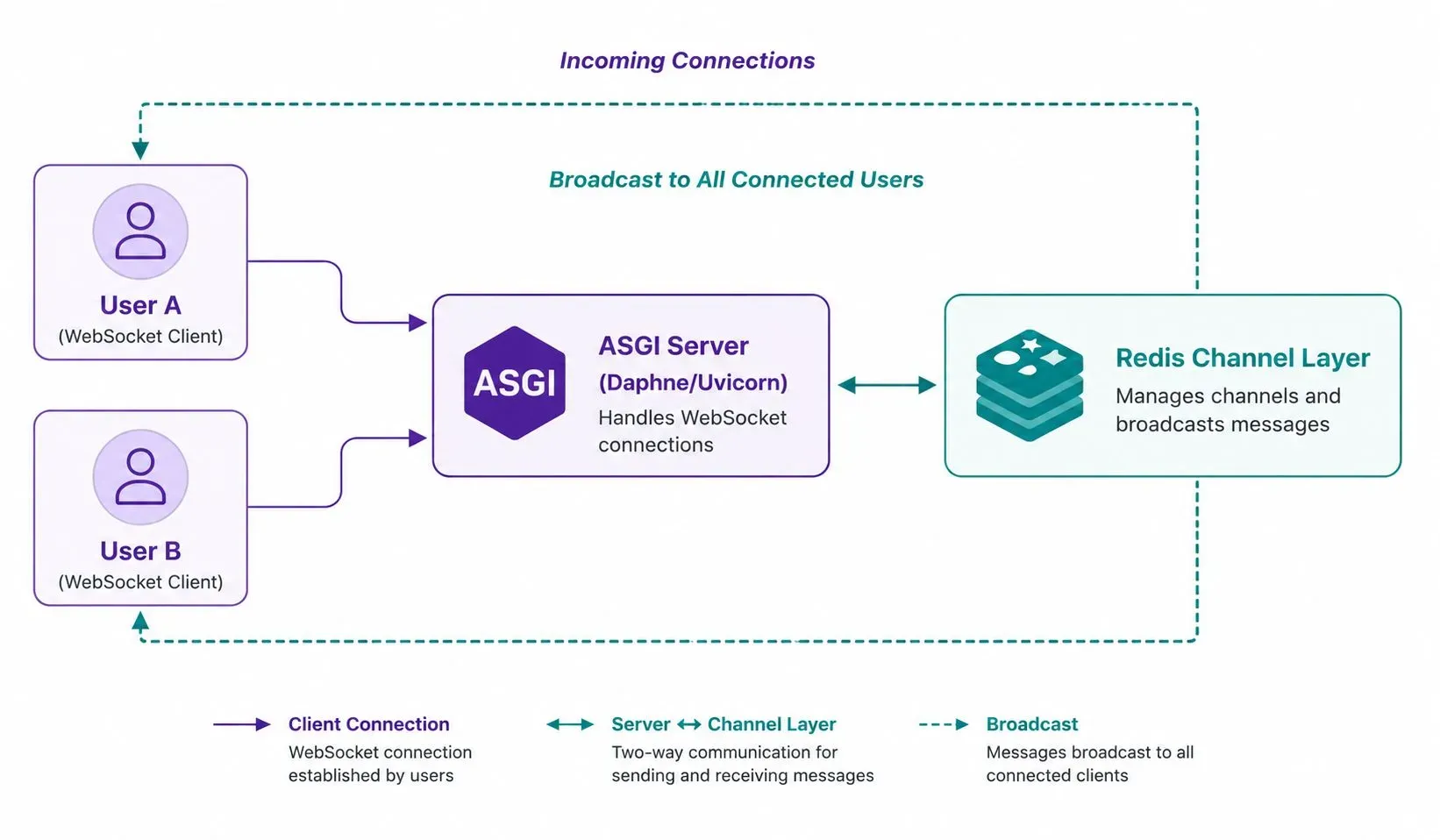
Key Learning Outcome: Managing stateful WebSocket connections and handling real-time data broadcasting at scale.
13. Fleet Telemetry & Dynamic Geo-Fencing System
Business Problem: Logistics managers must monitor delivery trucks in real time and receive instant alerts when a driver deviates from an assigned route.
Core Architecture: GeoDjango paired with a PostGIS spatial database backend. Geospatial queries checking ST_Contains and ST_Distance on truck GPS coordinates. Real-time map dashboard built with Leaflet.js rendering live vehicle positions.
Key Learning Outcome: Storing, indexing, and querying spatial polygons and GPS coordinates.
14. Automated Resume Screening & Parsing Pipeline
Business Problem: Corporate HR teams receive thousands of PDF applications and waste days manually copying qualifications into recruitment spreadsheets.
Core Architecture: File processing pipeline reading PDF and DOCX text via pdfplumber. Entity extraction isolating candidate email addresses, phone numbers, universities, and work durations. Automated scoring matrix comparing candidate skill vectors against job requirements.
Key Learning Outcome: Managing multi-step document processing pipelines with validation error boundaries.
15. IoT Sensor Time-Series Monitor with Anomaly Alerting
Business Problem: Industrial facilities must track temperature, humidity, and vibration sensors across machines to prevent equipment burnout.
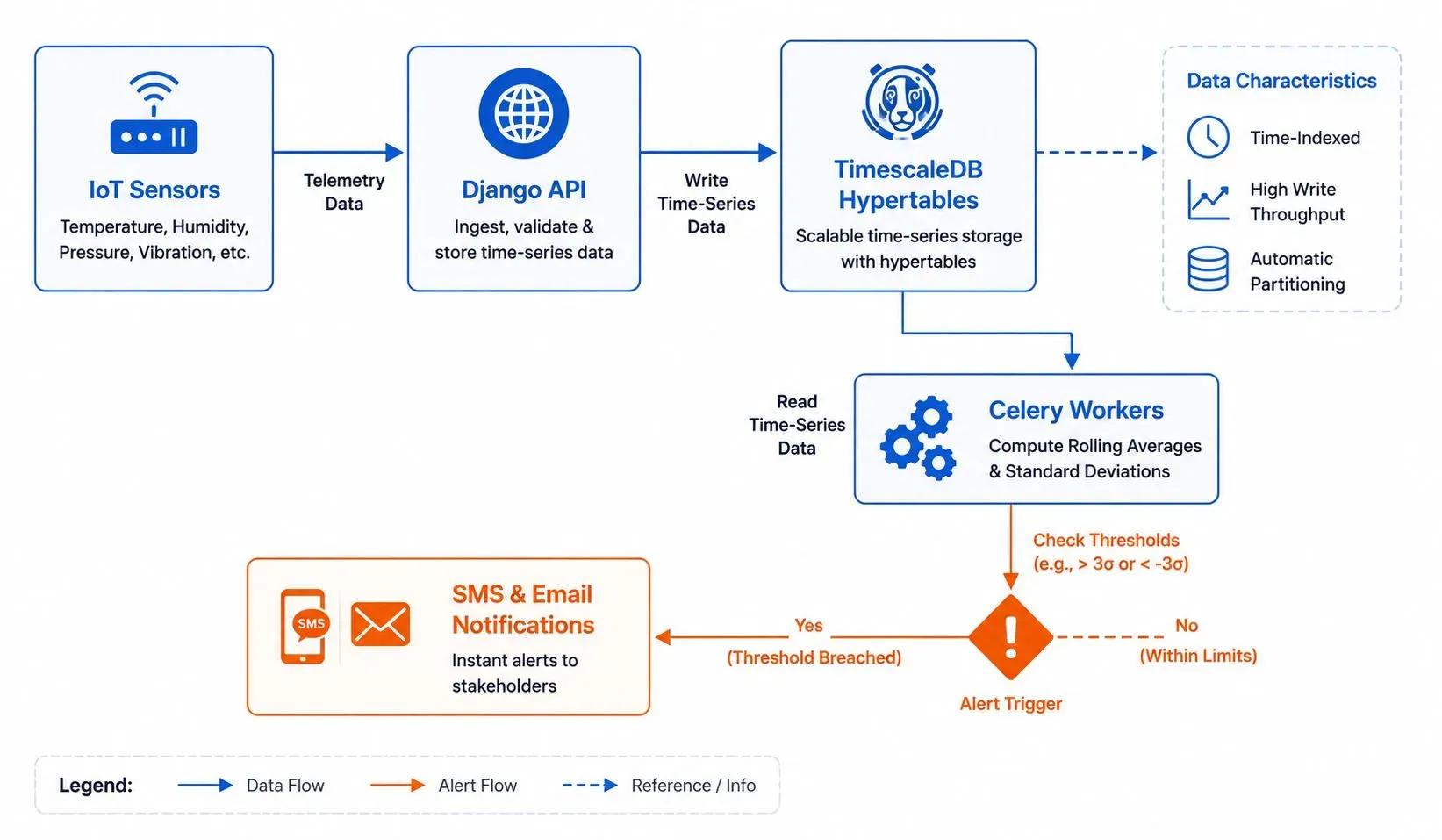
Core Architecture: Django database integration with TimescaleDB hypertables for time-series data storage. Continuous aggregate views calculating rolling five-minute averages and standard deviations. Automated alerting workers triggering SMS and email notifications when readings breach safety thresholds.
Key Learning Outcome: Structuring relational databases to handle rapid, write-heavy time-series telemetry.
Production Architecture Blueprint for Portfolio Projects
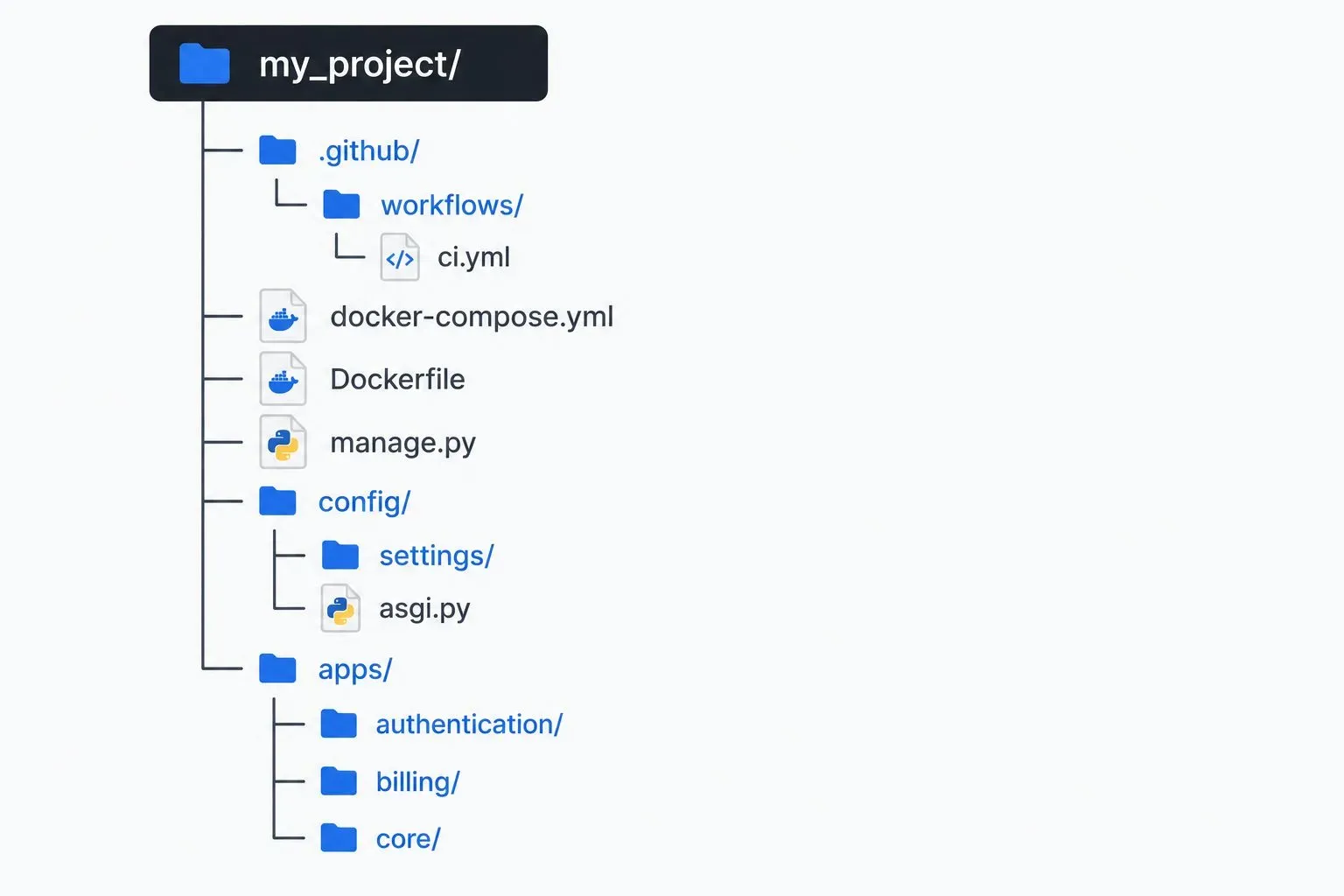
To make a project look professional to engineering leads, structure your repository using standard production conventions:
Essential Quality Standards
- Dockerize Everything: Provide a clean docker-compose.yml so anyone reviewing your code can run docker compose up and test the application instantly.
- Automated Testing Suite: Include unit tests for business logic and integration tests for API endpoints using pytest-django.
- Database Indexing & Query Optimization: Use select_related() and prefetch_related() to eliminate N+1 query problems. Use django-debug-toolbar to verify query efficiency.
- Environment Security: Keep all secret keys, database credentials, and third-party API tokens in .env files using django-environ.



Leave a Comment
Your comment is completely private and secure. We never publish comments publicly on our website. Your message will be sent directly to our team.