


You open your favorite social feed. You scroll past a comment section where dozens of accounts leave strangely generic replies. You search Google, and an AI overview summarizes four different websites before you even click a link.
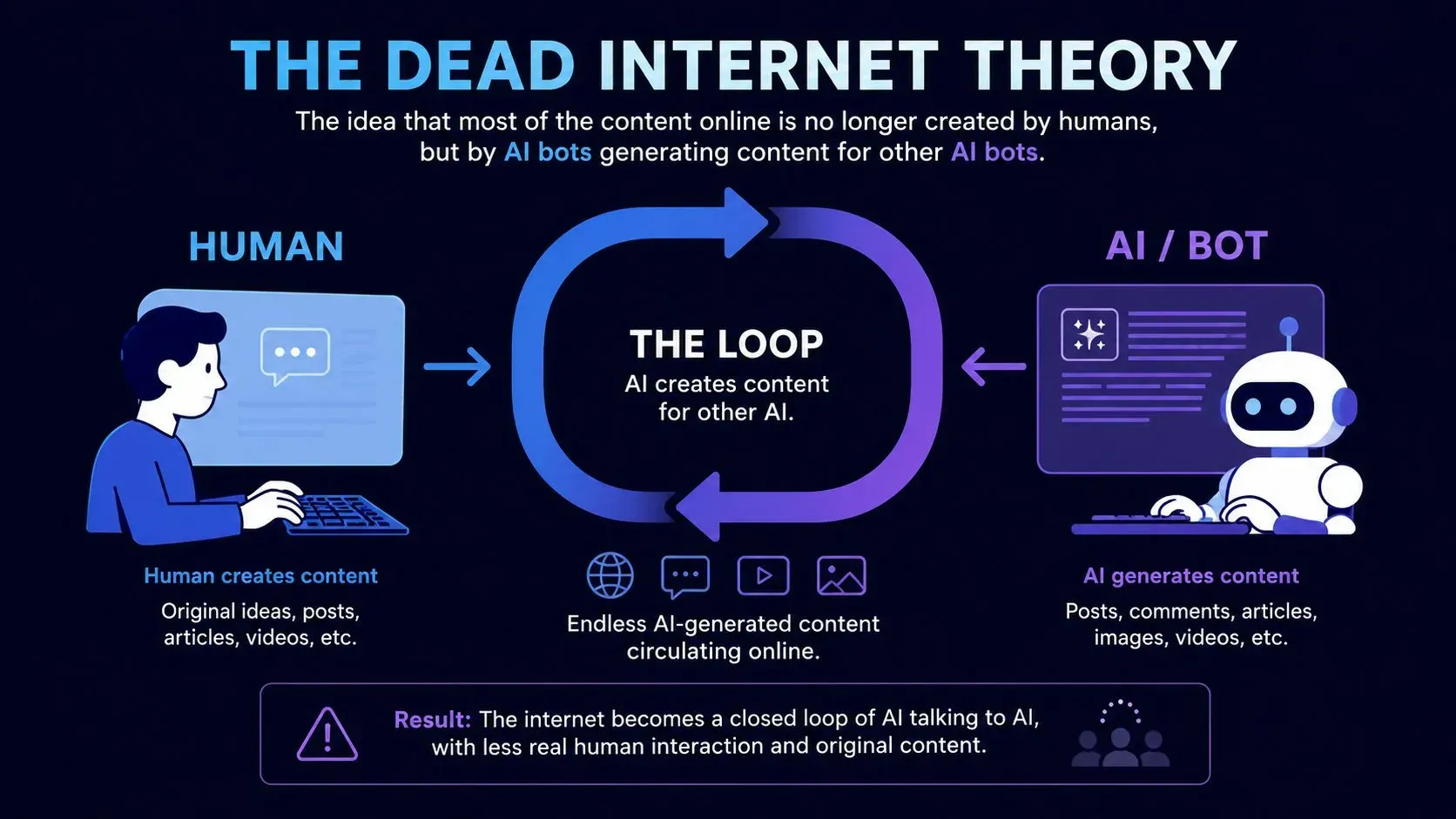
For years, people treated the "Dead Internet Theory" as an exaggerated internet myth. The idea claimed that organic human activity online was being replaced by automated scripts, artificial posts, and algorithms talking to algorithms.
In 2026, network data proved that the underlying trend is very real. Automated bots now generate more web requests than human beings across the global internet.
Understanding how this happened—and what it actually means for creators, publishers, and everyday users—reveals how quickly the web is changing.
1. What Is the Dead Internet Theory?
The Dead Internet Theory is the concept that a large portion of online content, accounts, and interactions are generated automatically by artificial intelligence and automated scripts rather than real human beings.
The theory first appeared on internet forums around 2021. Back then, it sounded like pure science fiction. People argued that most social media accounts were fake, that search results were filled with auto-generated text, and that humans were slowly becoming a minority on the web.
While the extreme version of the conspiracy claimed that human activity was secretly wiped out, the practical reality in 2026 looks surprisingly close: automated software now dominates the technical activity of the web.
2. The Statistic That Changed the Conversation
In mid-2026, the discussion shifted from internet speculation to hard engineering data.
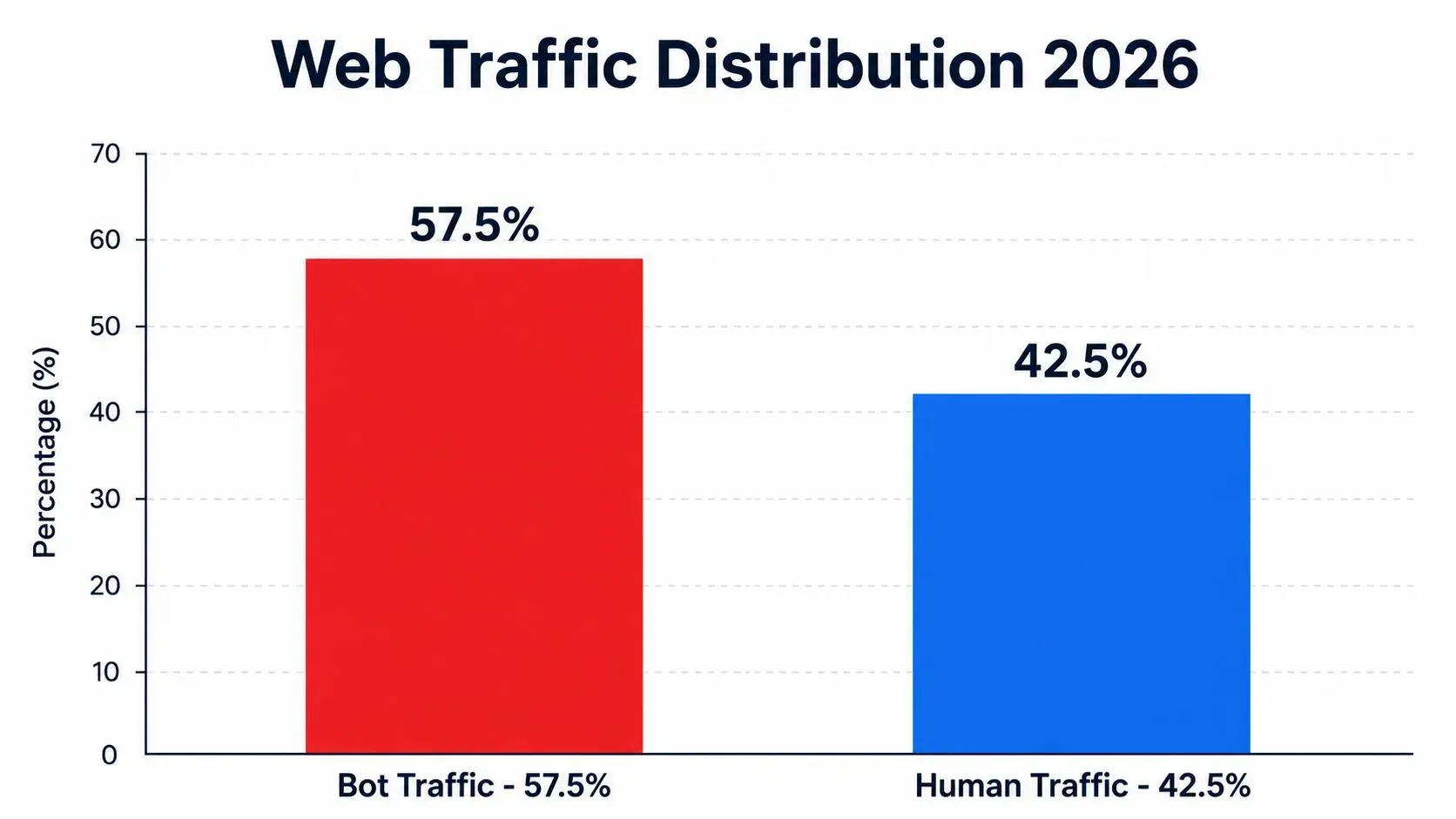
Network intelligence metrics published on Cloudflare Radar revealed a historic milestone: automated bots accounted for 57.5% of all worldwide HTTP requests to HTML webpages, leaving human traffic at 42.5%.
Data reported by Search Engine Land and covered across technical publications confirmed that automated traffic had officially crossed the 50% threshold ahead of previous industry forecasts.
Cloudflare CEO Matthew Prince admitted the timing caught even him off guard. He had predicted in March 2026 that bots wouldn't cross the halfway mark until the end of 2027. Instead, the crossover arrived more than a year early. Prince wrote on X: "Welp, that happened faster than I predicted. Thought it would be end of 2027, then early 2027, but agentic traffic growing so fast that bots have now passed human traffic online for the first time in the Internet's history."
Understanding the Technical Distinction
This data does not mean that 57% of real people vanished from the internet. It also does not mean that 57% of all accounts on Instagram or X are fake.
Instead, the measurement tracks HTTP requests—the individual requests sent to web servers whenever a webpage, document, or piece of data is fetched.
A human user might visit 10 web pages in 15 minutes, generating 10 page requests. A single automated AI web scraper can scan 10,000 pages in the same 15 minutes.
Because software operates continuously at machine speed, automated programs now generate the majority of physical requests traveling across the global web. A person typically visits around five websites before making an online purchase, while an AI chatbot can compare information from thousands of pages in a much shorter period of time.
3. Are All of These Bots AI Chatbots?
No, automated bots come in many different categories. Not every bot is an intelligent AI assistant like ChatGPT or Claude.
To understand why automated requests are so high, look at the six main types of bots active on the internet today:
| Bot Category | Primary Purpose | Example Operators |
|---|---|---|
| Search Engine Crawlers | Index web content so users can find pages in search results | Googlebot, Bingbot |
| AI Training Scrapers | Download massive archives of text and images to train AI models | Common Crawl, GPTBot, ClaudeBot |
| AI Search & Retrieval Bots | Fetch live webpage information to answer user prompts in real time | PerplexityBot, ChatGPT Search, Gemini Live Fetch |
| Autonomous AI Agents | Navigate websites to execute actions like booking tickets or comparing prices | Browser automation agents, coding agents |
| Operational & Monitoring Bots | Check website uptime, verify server health, and monitor APIs | Pingdom, UptimeRobot, Datadog |
| Malicious Bots | Attempt password attacks, scrape private pricing, or send spam | Credential stuffers, form spammers, scrapers |
While traditional search crawlers have existed for decades, the massive spike in 2025 and 2026 comes directly from AI training scrapers and autonomous agents.
Fastly's research identified two distinct categories of AI traffic. AI crawlers are bulk, schedule-driven crawlers that systematically read the open web to assemble training corpora for large language models. AI fetchers are agents acting on behalf of users, pulling information to answer a question, compare options, check availability, or handle a transaction.
4. Why Is Bot Traffic Growing So Fast?
Bot traffic expanded rapidly because artificial intelligence platforms changed how computers interact with websites.
In the past, a search engine like Google sent a crawler to index a page once every few days or weeks. Today, hundreds of different AI companies, research labs, and independent developers deploy scrapers that continuously crawl the web 24 hours a day.
Three specific drivers caused this surge:
- Continuous Model Training: AI organizations need fresh data every day to prevent their models from becoming outdated.
- Real-Time Web Retrieval: Modern AI chatbots do not rely solely on static memory. When you ask a question, they send real-time fetch requests to multiple websites simultaneously to gather sources.
- Automated Business Workflows: Companies now deploy automated scripts to track competitors, monitor prices, and summarize industry news automatically.
Fastly's data showed that AI-generated traffic on its network grew about 30% between January and May 2026 — approximately 6.5 times faster than human traffic over the same period. The growth of agentic AI traffic is even more dramatic.
5. AI Is No Longer Just Answering Questions: The Rise of Agentic Traffic
The biggest change in web traffic is the transition to "agentic" software.
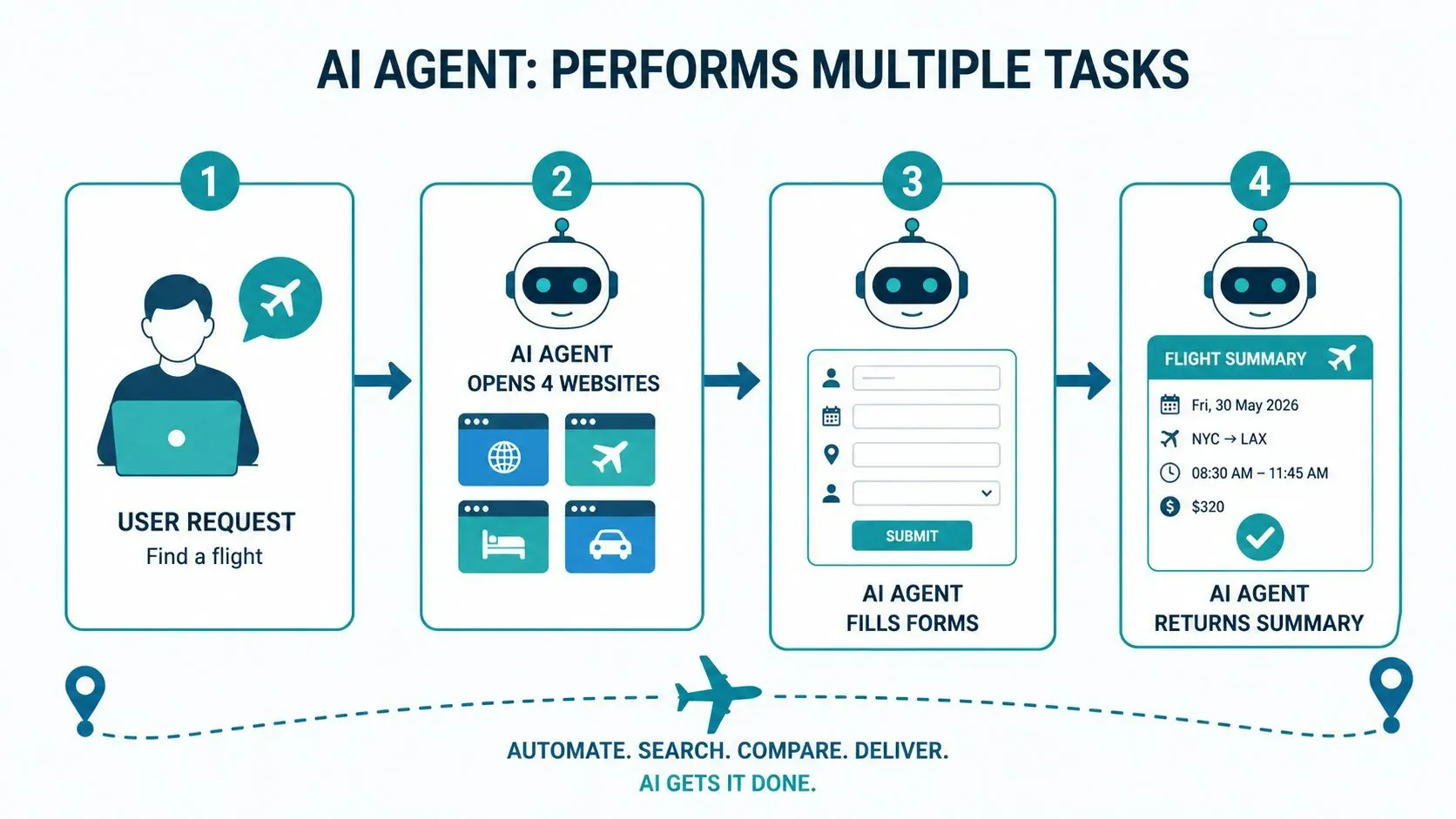
An AI agent does not just retrieve a paragraph of text. An agent receives a goal from a human user and executes multiple steps online to complete it.
Traffic generated by agents that actually take action on the web—like clicking links and filling out forms—grew 7,851% year over year, according to cybersecurity firm HUMAN Security's 2026 State of AI Traffic & Cyberthreat Benchmark Report. Scraper traffic, by comparison, grew 597% over the same stretch.
A Real-World Example of Agentic Browsing
Consider what happens when a user asks an AI assistant to find the best flight deal:
[User Request]
└─ "Find a direct flight from New York to London next Friday under $600."
│
├─► [AI Agent Step 1]: Opens 4 airline booking websites simultaneously
├─► [AI Agent Step 2]: Fills out origin, destination, and dates
├─► [AI Agent Step 3]: Triggers search requests across multiple filters
├─► [AI Agent Step 4]: Parses baggage policy pages on 3 airline domains
└─► [AI Agent Step 5]: Returns 1 concise summary to the user
A human completing that search manually might load 4 or 5 pages. The AI agent, working through multiple steps in the background, generates dozens of server requests in seconds. As millions of people adopt autonomous assistants, agentic traffic continues to multiply.

6. The Loop: Bots Creating Content for Other Bots
The most fascinating part of the modern web is the closed loop between content creation and content consumption.
A significant portion of web content is now produced by AI, indexed by AI, summarized by AI, and delivered to AI assistants—without a human ever viewing the original page.
Research from the Pew Research Center found that 35 percent of web pages published since ChatGPT's launch show significant signs of AI editing or authorship. The study tracked writing quirks tied to AI. Em dashes have roughly doubled, Oxford commas are up 63 percent, and words like "delve" and "interplay" have more than doubled in use.
This cycle creates a strange paradox: servers consume electricity and bandwidth to serve articles that no human eye will ever read word-for-word.
+-------------------------------------------------------------------+
| The Machine-to-Machine Content Loop |
+-------------------------------------------------------------------+
| 1. AI Tool generates a 2,000-word blog article |
| │ |
| 2. Publisher uploads it to a website |
| │ |
| 3. AI Crawler visits the site and scrapes the entire article |
| │ |
| 4. AI Search Engine indexes and compresses the text into vectors |
| │ |
| 5. An AI Agent reads the summary to answer a user prompt |
| │ |
| 6. The end user reads a 2-sentence answer on an AI interface |
| |
| * The original webpage receives server load, but 0 human readers. * |
+-------------------------------------------------------------------+
7. Is Social Media Becoming Artificial Too?
Beyond server requests, the social web shows similar patterns.
Automated accounts on platforms like X, Facebook, Instagram, and LinkedIn have become more sophisticated. In the past, simple spam bots were easy to identify because they repeated identical text strings or posted broken links.
Modern social bots use large language models to generate context-aware comments, engage with popular discussions, and build believable profile histories.
Common Signs of Automated Social Activity
- Repetitive Sentiment Loops: Comments that agree enthusiastically with a post using slightly altered phrases without adding specific facts.
- AI-Generated Profile Personas: Accounts using computer-generated portrait photos combined with generic bios and automated posting schedules.
- Engagement Rings: Bot networks programmed to like, repost, and reply to each other to manipulate algorithmic visibility.
Platforms are taking notice. Facebook has acknowledged that about 40% of its posts are now generated by bots. Music streaming service Deezer reported that 44% of newly uploaded songs are AI-generated. Entirely AI-focused online ecosystems are emerging, including Moltbook, a platform designed exclusively for AI agents that attracted 1.6 million autonomous agents in its first week.
8. How to Tell What Is Human Online
Even with advanced automation, human behavior leaves distinct patterns that automated scripts struggle to duplicate.
| Evaluation Factor | Automated Bot Content | Genuine Human Content |
|---|---|---|
| Perspective | Generic, safe summaries that compile common opinions | Personal viewpoint, specific anecdotes, and admitted mistakes |
| Tone & Style | Predictable paragraph length, perfectly balanced transitions | Varied rhythm, conversational quirks, and natural humor |
| Contextual Details | High-level overviews without specific real-world friction | Concrete numbers, exact tool setups, and troubleshooting notes |
| Interaction Style | Instant replies, formal language, or generic praise | Nuanced opinions, direct answers, and contextual follow-ups |
When reading an article or social thread, look for specific, grounded details. Writers who share tangible experiences and verifiable facts stand out immediately from synthetic summaries.
9. What This Shift Means for Content Creators
For independent creators, publishers, and writers, the growth of automated traffic changes how success is measured.
Relying on raw pageview numbers is no longer reliable. If 60% of your website hits come from AI scrapers and automated bots, your analytics can give you a false sense of growth.
How Creators Can Adapt
- Focus on Community and Direct Channels: Build email newsletters, direct messaging channels, and private forums where real people interact.
- Double Down on Original Voice: AI tools excel at summarizing established facts, but they cannot share original human experiences, interviews, or on-the-ground reporting.
- Monitor Human Engagement Metrics: Pay closer attention to newsletter replies, verified comments, and direct subscriber interactions rather than raw server hits.
Graphite, an SEO firm, estimated that artificial intelligence now produces more than half of new English-language articles online.
10. What This Shift Means for Website Owners
If you manage a website, high bot traffic creates real operational challenges.
According to Fastly's data, more than 51% of AI requests require direct access to origin infrastructure, compared with less than 9% of human traffic. That matters because origin requests are typically more expensive and can put more strain on websites, applications, and APIs.
Key Considerations for Site Owners
- Hosting Costs: Aggressive scraping bots repeatedly download heavy HTML pages, inflating hosting bandwidth bills.
- Skewed Analytics: Bot visits distort conversion rates and bounce rates if your analytics tool does not filter out automated traffic.
- Ad Revenue Disconnect: Advertising networks pay for human views and clicks. A million bot visits generate zero advertising revenue.
Automated traffic creates a secondary problem for publishers and small websites: it can pound their infrastructure without supporting their business model. Many of those sites rely on human visits and ad impressions to pay for servers, writers, editors, and upkeep.
11. Will Websites Start Charging AI Bots?
Because websites bear the cost of server bandwidth while AI platforms benefit from the data, the business model of the web is actively shifting.
Infrastructure providers and major publishers have begun implementing new controls:
- Automated Crawler Blocking: Web security platforms now offer one-click features that allow site owners to block unauthorized AI training scrapers.
- Content Licensing Agreements: Major news publishers are signing multi-million dollar deals with AI companies for direct access to their content archives.
- Machine-Readable Paywalls: New protocols are emerging that allow AI agents to pay fractions of a cent per page request to retrieve verified data legally.
The open web, where any bot could freely scrape unlimited data without compensation, is rapidly being replaced by gated, metered access.
12. The Future: When Machines Talk to Machines
The internet began as a network designed for human beings to share documents and communicate with one another.
Today, it has evolved into a dual-layer network:
- The Human Web: A space for discussion, creative expression, relationships, and genuine community.
- The Machine Web: A fast, automated infrastructure where AI agents, scrapers, and servers exchange data continuously.
The Dead Internet Theory was not entirely right—real humans are still here, reading, writing, and creating every day. But the data from 2026 makes one fact undeniable: in terms of technical volume, the machines have taken the lead.
The creators and website owners who thrive in this new environment will be the ones who focus on genuine human connection while protecting their digital platforms from unchecked automation.







Leave a Comment
Your comment is completely private and secure. We never publish comments publicly on our website. Your message will be sent directly to our team.