


Enterprises are spending billions of dollars deploying artificial intelligence across customer service, finance, operations, and software engineering. Yet, despite massive investments, a growing number of corporate initiatives stall out in perpetual pilot stages or create unexpected compliance risks that stall production rollouts.
The breakdown is rarely technical. The models work, the data pipelines connect, and the APIs respond. Instead, ai transformation is a problem of governance.
When an organization launches autonomous systems without defining who approves outputs, who owns model risk, who audits for drift, and who intervenes when an error occurs, technical progress quickly turns into organizational friction.
Understanding why ai transformation is a problem of governance—and how to build a governance framework to solve it—is what separates companies achieving sustainable business value from those stuck in pilot paralysis.
What "AI Transformation Is a Problem of Governance" Really Means
AI transformation is fundamentally different from traditional software adoption. When software runs a fixed script, it follows predefined rules programmed by human developers. When an organization deploys advanced AI systems, it delegates decision-making authority to probabilistic models.
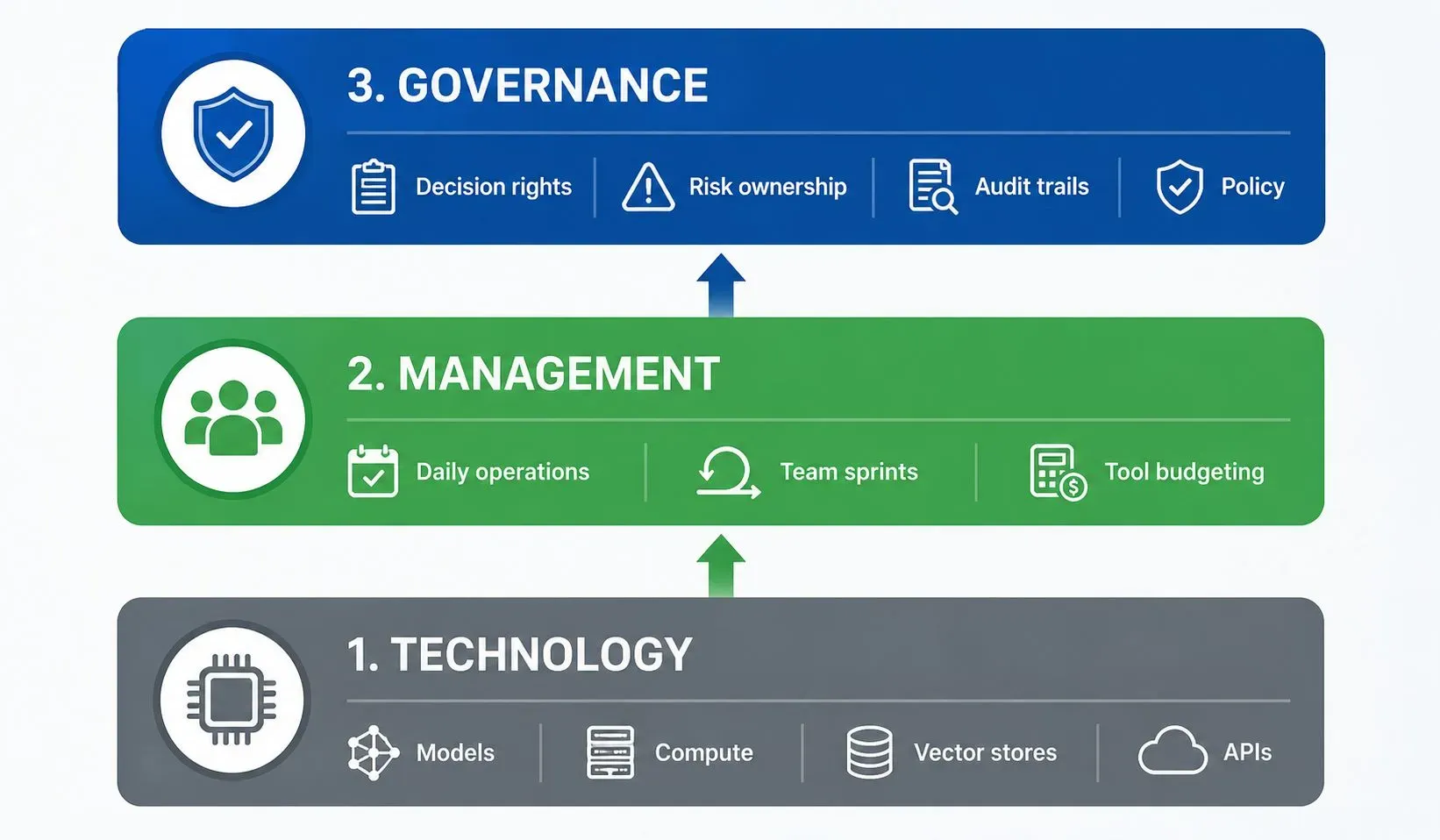
As the diagram illustrates, technology provides the functional engine, management directs daily workflows, but governance defines the rules of authority.
When an AI model reviews a loan application, evaluates candidate resumes, or sets dynamic pricing, it takes actions that once belonged entirely to designated managers. If that automated decision produces a biased or inaccurate outcome, the core question is not "why did the model generate that output?" but "who is legally and operationally accountable for that decision?"
Without clear decision rights, accountability diffuses across teams. Data scientists blame product managers, product managers point to third-party vendors, and legal teams freeze projects. AI transformation fails without structured governance because unmanaged autonomy creates risks no single team owns.
Why the Governance Gap Became a Crisis in 2026
Several structural forces have turned AI governance from a theoretical best practice into an urgent boardroom priority.
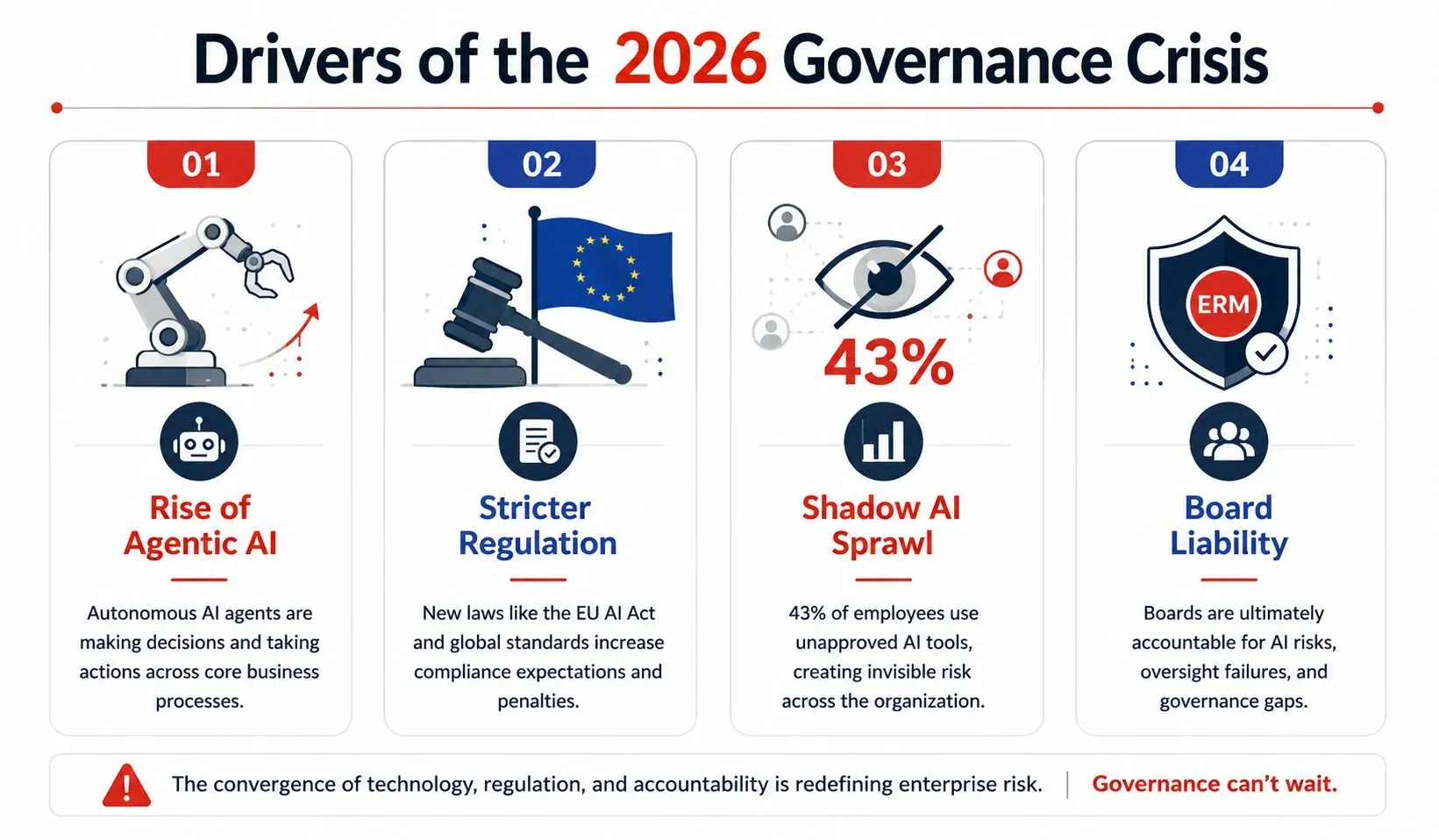
1. The Rise of Agentic AI
Earlier deployments focused on passive generative AI assistants where a human read the text and made the final call. In 2026, enterprises are deploying agentic AI—autonomous systems designed to plan multi-step tasks, call external APIs, query databases, and execute actions without human intervention at every step.
According to Deloitte’s 2026 AI report, nearly 3 in 4 companies (74%) plan to deploy agentic AI within the next two years. However, only 21% report having a mature enterprise AI governance model in place. This readiness gap creates an operational hazard: autonomous agents can trigger thousands of actions per second, drastically expanding the blast radius of any single algorithmic failure.
2. Regulatory Enforcement and the EU AI Act
The regulatory grace period for artificial intelligence is over. With high-risk classification deadlines under the EU AI Act taking full effect in August 2026, organizations face mandatory documentation, strict logging obligations (Article 12), continuous risk assessments, and severe financial penalties for non-compliance. Regulatory exposure now directly threatens corporate balance sheets if systems operate without verifiable audit trails.
3. Shadow AI and Data Fragmentation
Employees adopt consumer AI tools on their own to boost daily productivity. Without enterprise guardrails, sensitive customer records, proprietary source code, and internal financial figures are routinely pasted into third-party tools. This fragmented adoption exposes companies to data leaks, intellectual property disputes, and compliance breaches.
Why AI Governance Differs from Traditional IT Governance
Applying standard IT governance frameworks like ITIL or COBIT directly to AI programs creates immediate blind spots. Traditional IT controls were designed for deterministic, static software, whereas machine learning systems behave differently.
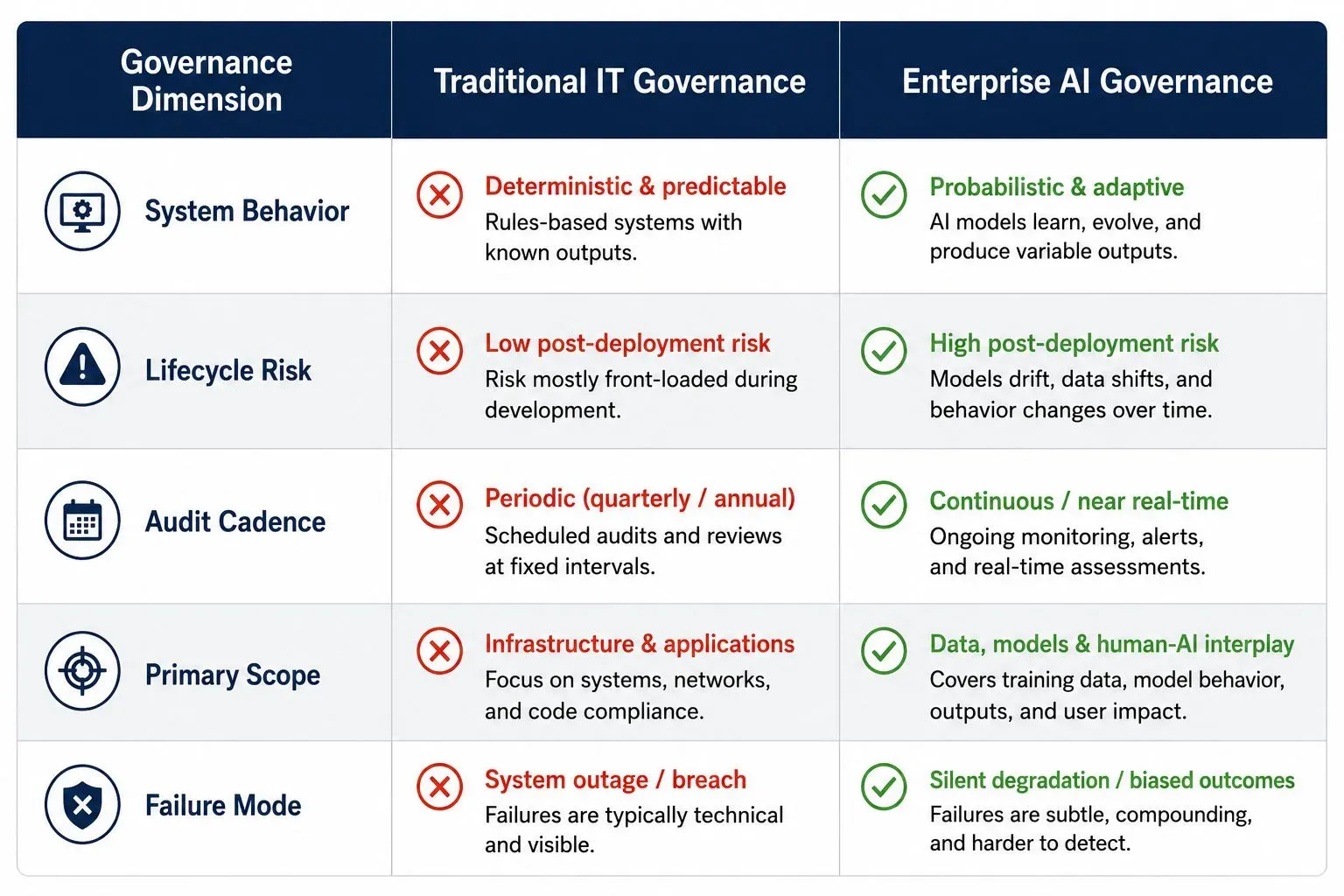
AI introduces new failure modes that require active oversight rather than passive IT support. An enterprise cannot simply inspect software code once and assume it will remain safe six months later.
Six Governance Gaps That Cause AI Projects to Fail
When AI initiatives fail, the post-mortem almost always traces back to one of six structural weaknesses:
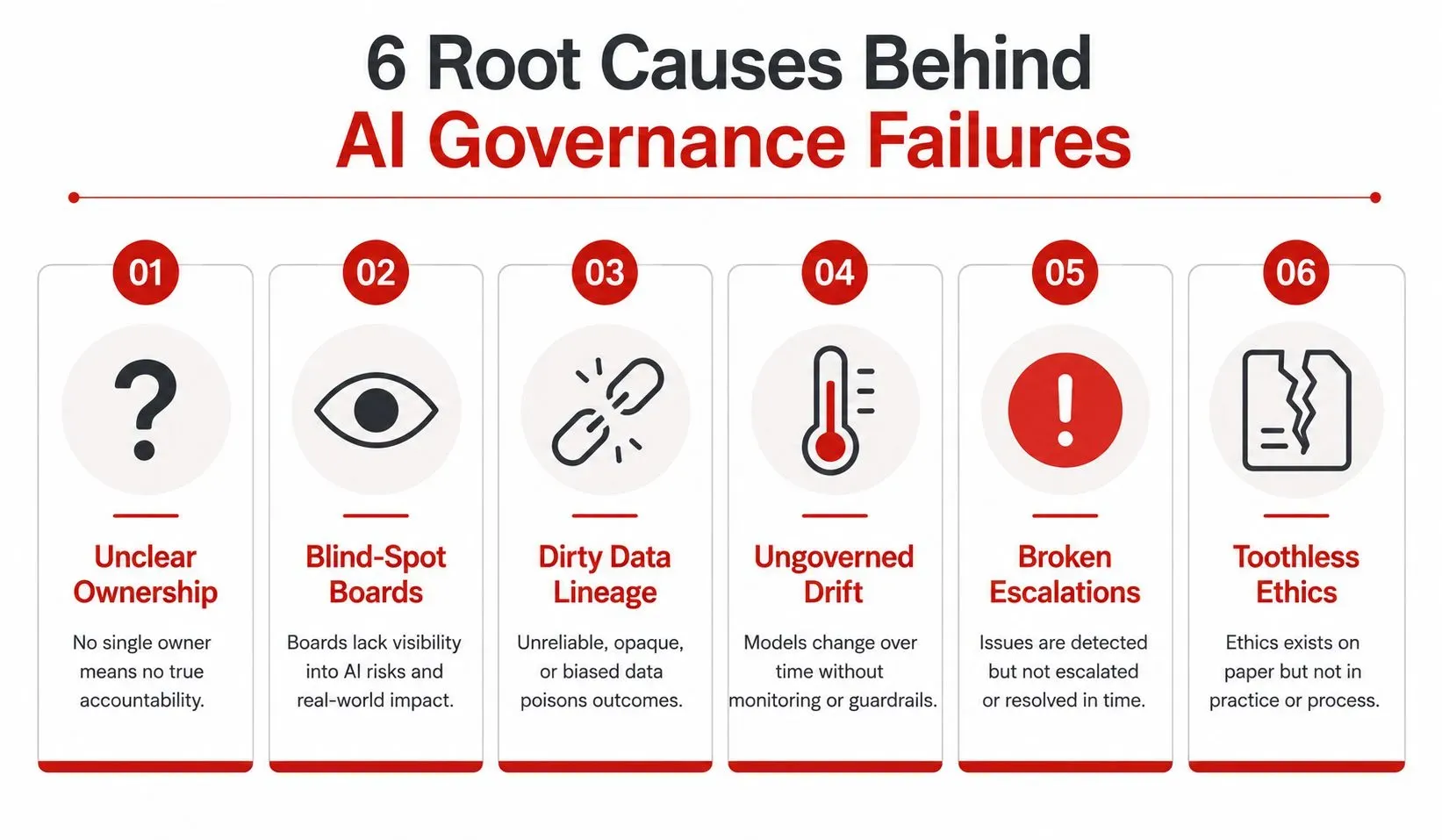
Diffused Strategy Ownership: When an enterprise creates an AI committee without operational authority, departments launch disconnected tools that duplicate costs and split data access.
Low AI Literacy at the Board Level: While boards are discussing AI more frequently, actual board-level technical expertise remains limited. Directors often view AI as an IT line item rather than a fundamental operational risk factor.
Inconsistent Data Standards: Feeding disparate internal databases into retrieval-augmented generation (RAG) models creates contradictory responses. Poor data quality directly causes poor model outputs.
Lack of Lifecycle Accountability: Models are often shipped like static projects without defined owners for post-launch drift detection, bias auditing, or scheduled retirement.
Undefined Escalation Protocols: When an automated system flags an edge case or produces erratic recommendations, employees lack clear guidelines on when and how to override the algorithm.
Abstract Principles Without Runtime Enforcement: Publishing a corporate statement on "ethical AI" does nothing if engineering teams lack technical guardrails, rate limiters, and approval gates in the actual software architecture.
The Core Pillars of an Effective AI Governance Framework
Effective AI governance requires a structured operational system that integrates policy, engineering controls, and executive oversight.
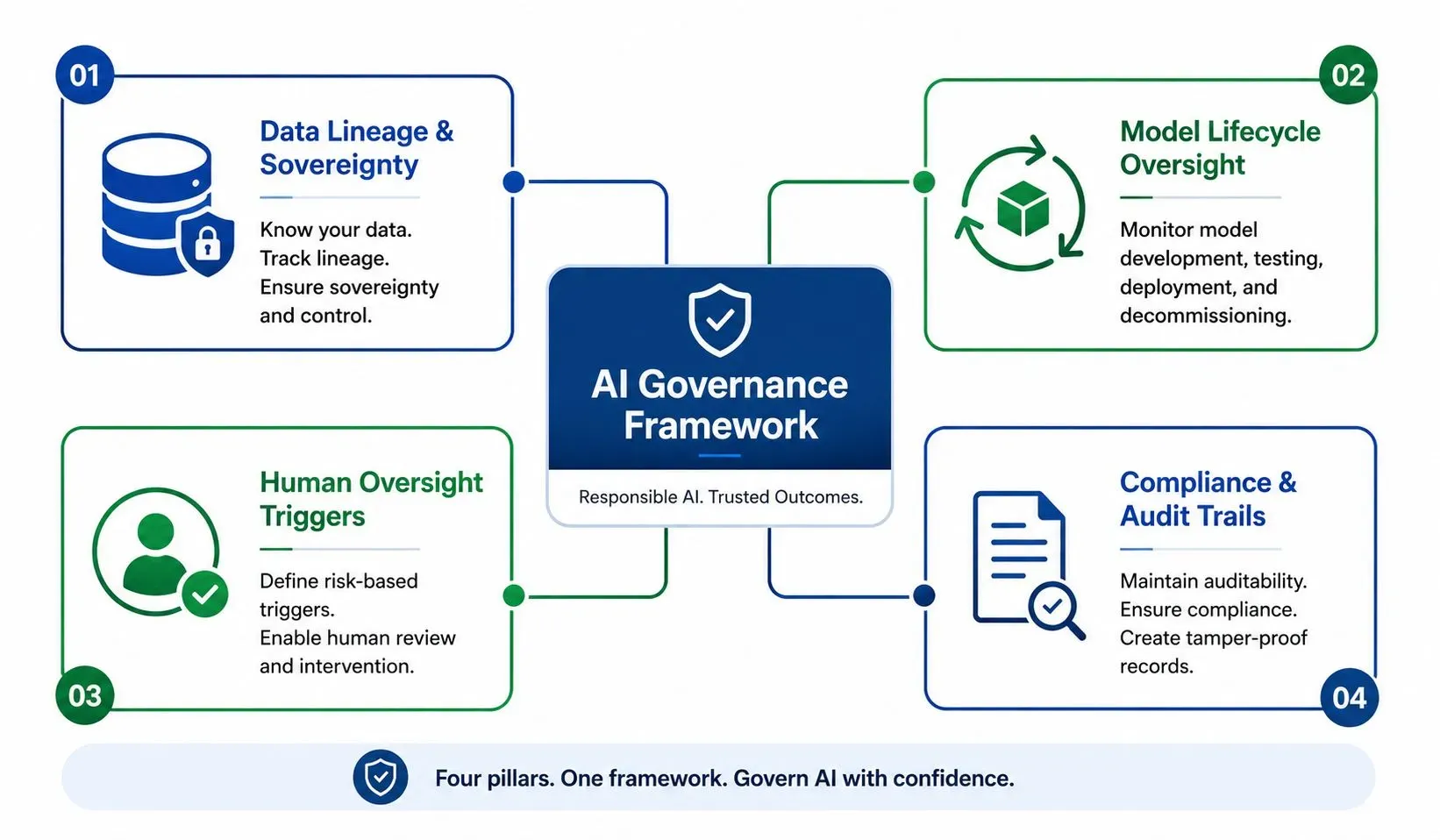
1. Data Governance and Lineage
Data integrity is the bedrock of machine learning. Enterprises must track the exact origin, classification, and permissions of data used to train models or feed retrieval pipelines. Enforcing role-based access control (RBAC) and OAuth-authenticated connectors ensures models never process restricted records.
2. Model Lifecycle Oversight
Every AI system in production requires a standardized validation pipeline:
- Pre-Deployment: Rigorous stress testing, bias detection, and accuracy benchmarking against historical baselines.
- Production: Real-time telemetry tracking latency, error rates, and semantic drift.
- Retirement: Clear trigger conditions for decommissioning models when performance thresholds drop.
3. Human Oversight and Decision Rights
Practical AI governance establishes exact thresholds for human intervention. For low-risk administrative tasks, autonomous execution may be acceptable. For high-consequence decisions—such as credit denials, medical assessments, or employment evaluations—human review must be mandatory.
4. Continuous Auditability and Explainability
Regulators, auditors, and executive teams must be able to inspect how an AI model arrived at a specific conclusion. Maintaining immutable, tamper-evident logs of model inputs, prompts, context retrievals, and outputs ensures full regulatory compliance under frameworks like the EU AI Act and NIST AI RMF.
The AI Governance Maturity Model
Organizations progress through five distinct stages of governance capability:
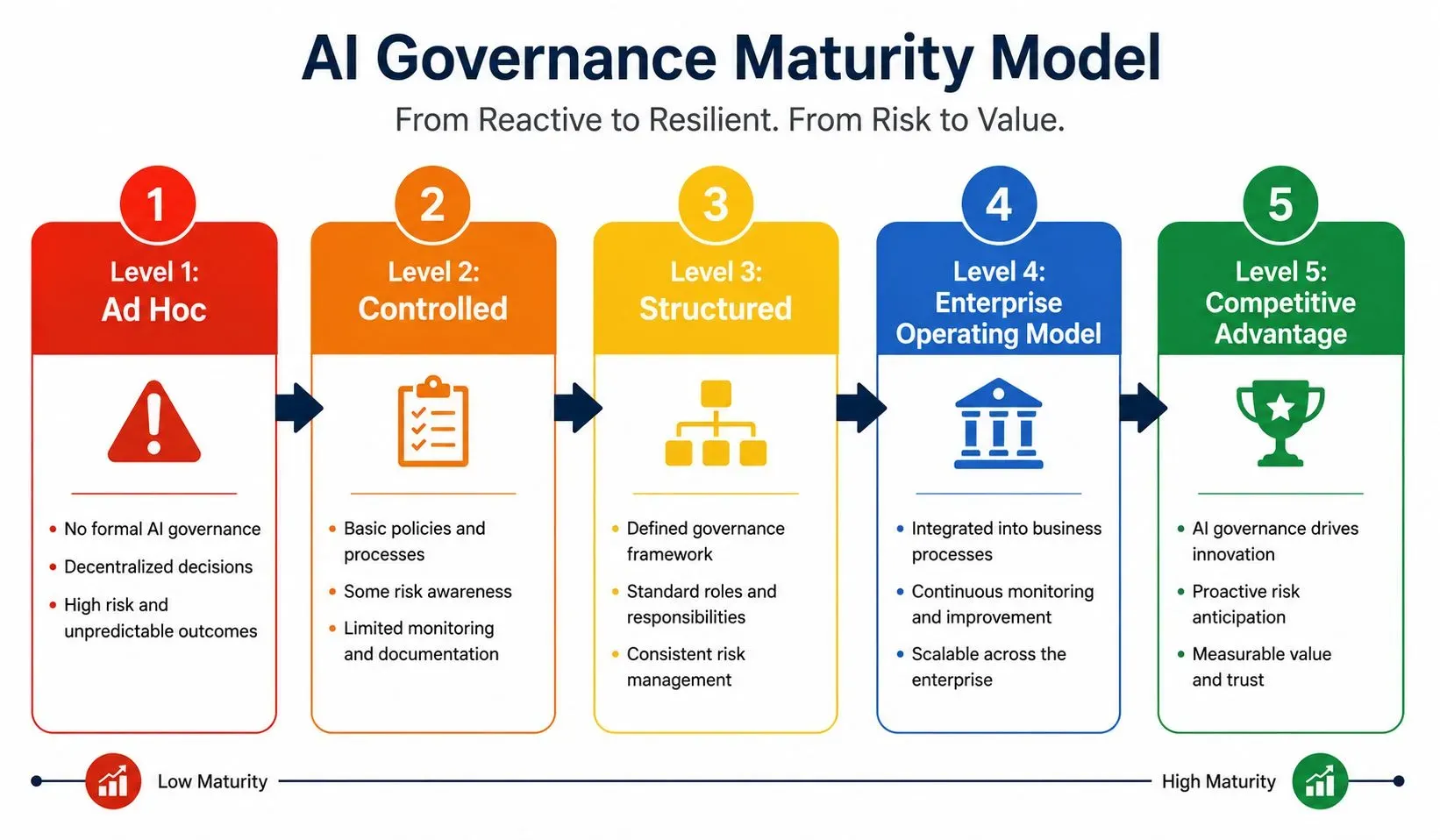
Level 1 (Ad Hoc): Individual employees use public AI tools independently. No central inventory, zero documentation, high exposure to data leakage.
Level 2 (Controlled Experimentation): Department-level pilots emerge with basic security checks, but there is no shared framework across business units.
Level 3 (Structured Policies): Formal AI usage policies exist, but enforcement remains manual and dependent on periodic committee reviews.
Level 4 (Enterprise Operating Model): Centralized inventory, automated drift tracking, automated API gateways, and standardized risk classification applied across all teams.
Level 5 (Competitive Advantage): Strong governance becomes a market differentiator. High customer trust, zero regulatory friction, and rapid deployment of production-grade AI agents.
Step-by-Step Roadmap to Build a Governance Framework
Enterprises that want to scale AI safely can follow this practical seven-step roadmap:
- Step 1: Inventory Assets: Catalog Every AI Tool in Use: Run internal audits to identify approved enterprise tools as well as unapproved shadow AI instances. You cannot govern what you have not mapped.
- Step 2: Assign Ownership: Assign Single-Point Executive Ownership: Appoint a Chief AI Officer, AI Risk Lead, or dedicated steering committee with the authority to approve, halt, or retire AI projects across departments.
- Step 3: Classify Risks: Classify Use Cases by Risk Tier: Group projects into low, medium, and high risk based on data sensitivity and operational impact. Apply rigorous oversight exclusively where errors carry financial or legal consequences.
- Step 4: Clean Data Lineage: Establish Data Lineage and Privacy Rules: Define strict policies regarding which internal datasets can be accessed by large language models and external APIs.
- Step 5: Enforce Guardrails: Embed Guardrails into Code: Implement technical guardrails—such as rate limits, input sanitation, prompt filtering, and automated output evaluations—directly into application architectures.
- Step 6: Real-Time Alerts: Deploy Continuous Monitoring Dashboards: Implement automated telemetry that alerts operations teams to model drift, abnormal token usage, or policy breaches in real time.
- Step 7: Board Reporting: Integrate AI Metrics into Board Oversight: Provide regular, data-driven AI oversight reports to the board of directors, linking AI risk management directly to enterprise risk management (ERM) frameworks.
Why Strong Governance Creates a Competitive Advantage
Many leaders mistakenly view governance as a bureaucratic roadblock that slows down development. In practice, the opposite is true.
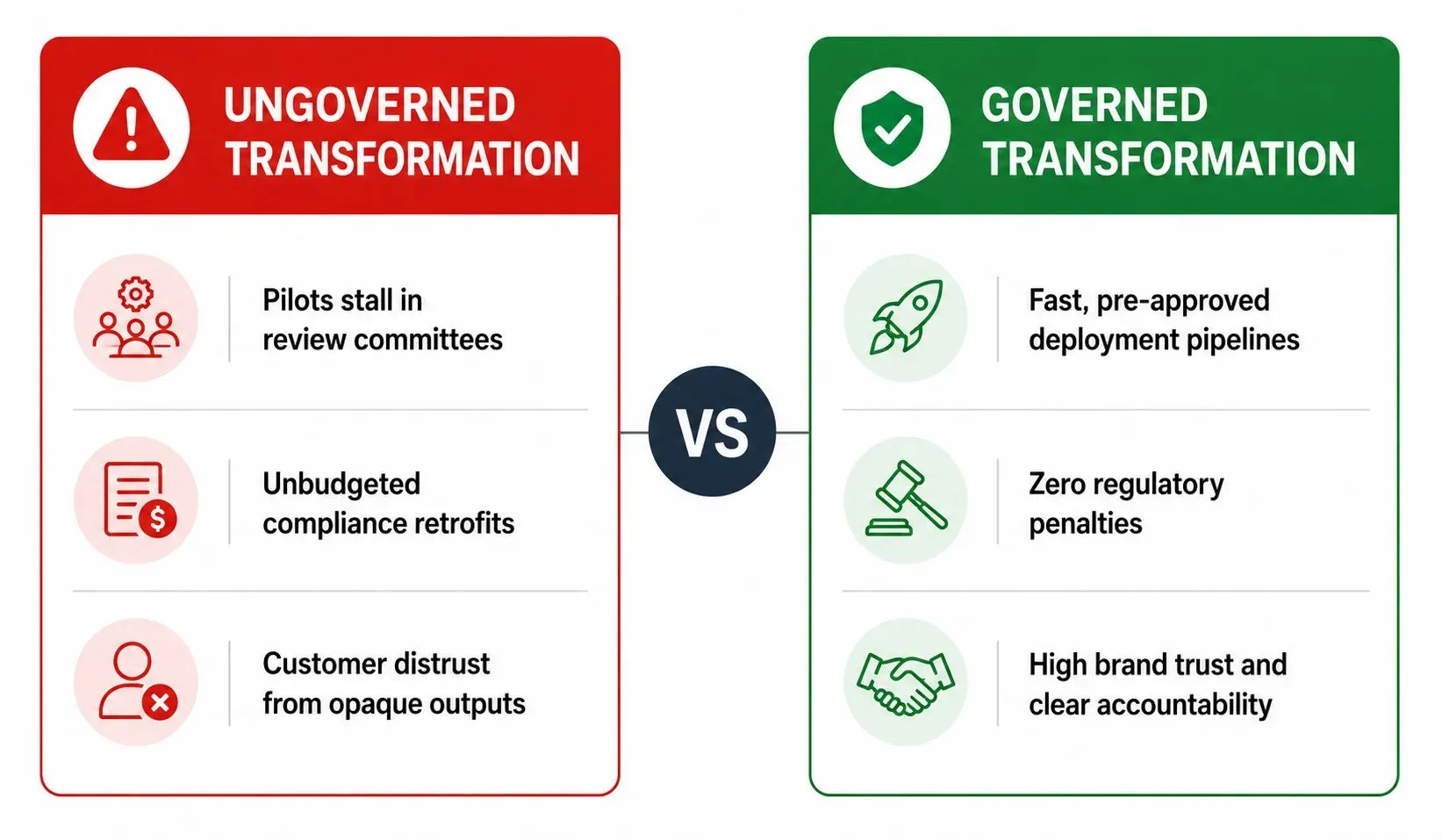
When engineering teams have clear rules, approved data sources, and automated security controls, they ship products faster because they do not have to pause for lengthy legal reviews at every step. Governance provides the guardrails that allow innovation to scale safely across the enterprise.
Over the next decade, market leadership will not belong to the companies that deployed models fastest without oversight. It will belong to organizations that built reliable, transparent, and governable AI systems that customers, regulators, and boards can trust.




Leave a Comment
Your comment is completely private and secure. We never publish comments publicly on our website. Your message will be sent directly to our team.