


You scroll past dozens of faces, voices, and reviews every day. Most look authentic at first glance. Yet, synthetic media has reached a level of detail where human instinct alone often fails.
In a controlled study conducted by psychologists and computer scientists at the University of Florida, human participants performed at chance level—getting only about 50% right—when trying to distinguish real human faces from synthetic photos. While human brains still catch unnatural movement in videos roughly 63% of the time, still pictures, cloned voices, and synthetic text slip past basic intuition.
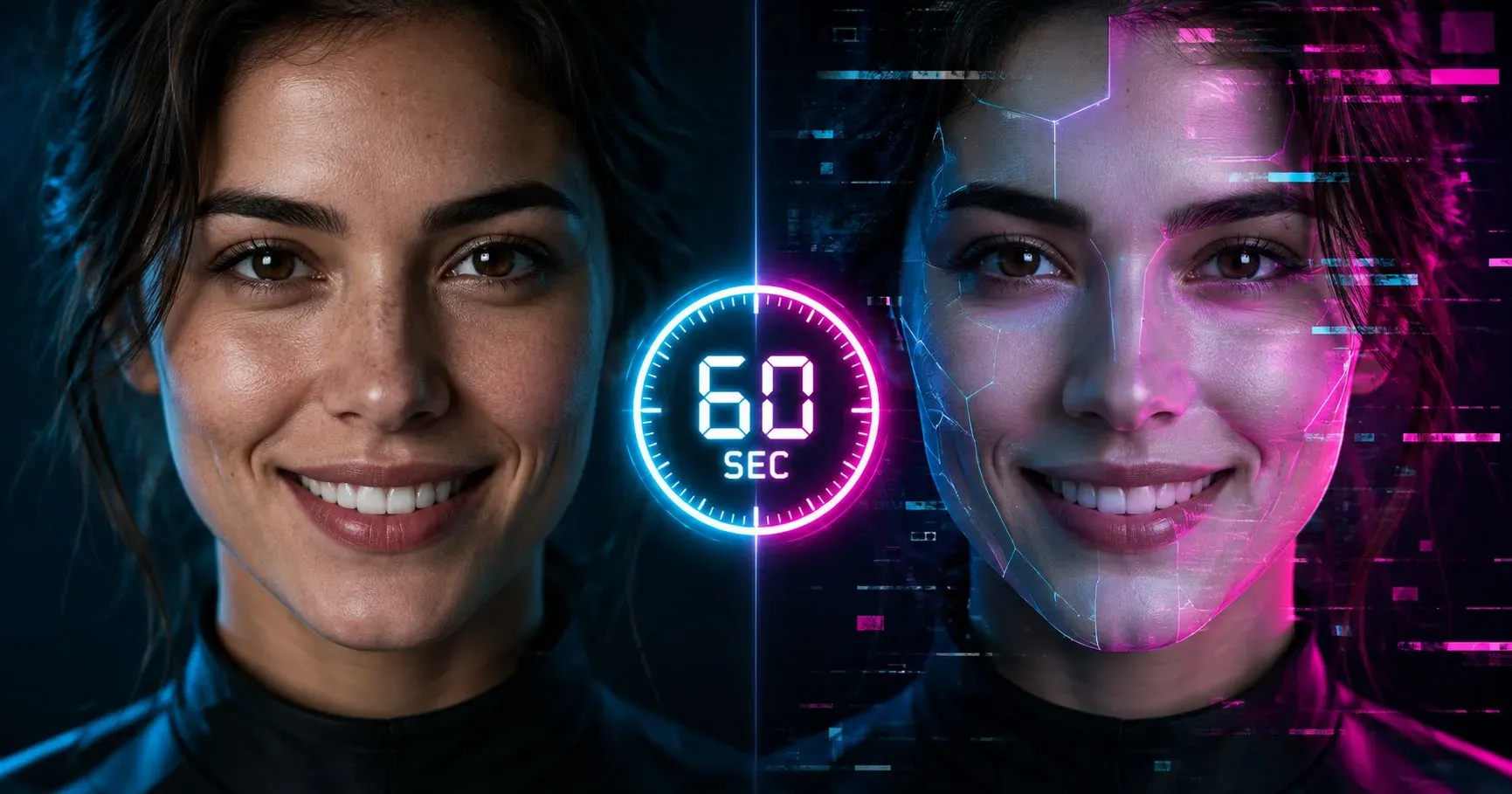
Can you beat the average and spot the synthetic media before the timer runs out? Take this 10-round challenge, calculate your score, and learn the exact inspection markers to check every time.
How This Test Works
- Total Rounds: 10 media comparisons.
- Time Limit: 60 seconds total (roughly 6 seconds per question).
- Rule: Pick your answer before expanding the explanation.
- Goal: Reach a score of 8 or higher to earn the AI Spotter badge.

Round 1: Real Person vs. AI-Generated Face
Scenario: You are reviewing two headshots for a speaker panel.
Option A: A portrait with distinct asymmetric light reflections in both eyes, sharp flyaway hairs against the collar, and natural skin pores.
Option B: A portrait with ultra-smooth cheek texture, perfectly centered pupils, and an earring that fades softly into the neck skin on the right side.
Which portrait is the real person?
Correct Answer: Option A is Real (Option B is AI).
Why Option B is AI:
- Earring and Jewelry Merging: Generative image models frequently struggle with small accessories. Notice how the earring in Option B loses definition and merges into the skin tissue.
- Corneal Reflections: Real cameras capture identical specular light patterns in both pupils. Synthetic faces often show mismatched light sources across the left and right eyes.
- Skin Texture Uniformity: Real skin contains irregular pores, slight blemishes, and natural depth variations rather than smooth ceramic perfection.
Round 2: Real Influencer vs. Virtual Influencer
Scenario: Two fashion accounts post lifestyle photos wearing a new jacket brand.
Option A: The creator posts daily stories from different lighting setups, holds physical garments with fabric tension around the thumbs, and features distinct background room clutter.
Option B: The account posts polished feed images where the subject has identical facial geometry in every post, pristine hand postures with zero knuckle creasing, and hands tucked away inside pockets across 80% of photos.
Which creator is the synthetic virtual influencer?
Correct Answer: Option B is the Virtual Influencer.
Key Clues:
- The "Pocket" Habit: Creators running virtual models often prompt the model to place hands in pockets or hold objects behind their backs to avoid rendering complex finger anatomy.
- Lighting Disconnect: Virtual influencers often show flat studio lighting on their skin that does not match the natural shadows or color temperature of the background scenery.
- Repetitive Geometry: Synthetic profiles maintain identical facial angles across weeks of content because they reuse specific seed faces.
Round 3: Human Voice vs. AI Cloned Voice
Scenario: You receive a 15-second voice note requesting an urgent password reset for an internal software account.
Option A: The speaker speaks with occasional breathing pauses, subtle microphone hiss, and varying syllable pitch when emphasizing key words.
Option B: The speaker delivers a steady sentence with clean acoustics, zero audible inhalations, and a uniform cadence across punctuation marks.
Which voice clip is AI-generated?
Correct Answer: Option B is AI-Generated.
Key Clues:
- Missing Inhalations: Human speech naturally includes micro-breaths before long phrases. Synthetic audio synthesis models often omit natural breathing cycles unless explicitly scripted.
- Flat Emotional Inflection: Cloned voices often hold a continuous pitch cadence even when reading questions or urgent requests.
- Acoustic Sterility: Synthetic clips usually lack authentic ambient room noise, floor reflections, or microphone proximity effect.
Round 4: Real Photograph vs. AI Image
Scenario: Two photos showcase a busy street market in Tokyo at dusk.
Option A: A photograph where background store signs have legible Japanese characters, neon reflections form straight geometric lines on wet pavement, and pedestrian silhouettes retain distinct limbs.
Option B: A vibrant photo with dramatic color contrast, but the background shop signs display illegible squiggles, bicycle spokes bend into odd curves, and an umbrella handle disappears into a coat sleeve.
Which image was produced by an AI generator?
Correct Answer: Option B is the AI Image.
Key Clues:
- Pseudo-Text: Generative diffusion models often assemble characters that resemble text from a distance but turn into nonsense symbols under close inspection.
- Mechanical Inconsistencies: Look closely at repetitive mechanical items like bicycle spokes, window grids, and stair railings. AI models often warp straight lines into wavy curves.
- Object Blending: Notice where separate objects touch—such as umbrella handles and coats. Synthetic renders often blend them into one continuous shape.
Round 5: Real News Headline vs. Fabricated AI Headline
Scenario: You encounter two viral news posts on a social feed.
Option A: "City Council Approves 3% Transit Budget Adjustment Following Tuesday Public Hearing."
Option B: "BREAKING: Global Aviation Authority Bans All Jet Engines Effective Midnight Tonight After Secret Whistleblower Report."
Which headline is fabricated?
Correct Answer: Option B is Fabricated.
Key Clues:
- Extreme Scope Without Primary Sources: Large regulatory bans never happen overnight without official documentation, press conferences, and verifiable government notices.
- Urgency Triggers: Fabricated headlines rely on words like "BREAKING," "SECRET," and "BANNED" to bypass critical reasoning and trigger fast shares.
- Absence of Corroboration: When a major claim appears exclusively on social cards without coverage from established news wires, it indicates synthetic fabrication.
Round 6: Genuine Product Review vs. AI-Written Review
Scenario: You read two reviews for a noise-canceling headphone on a shopping site.
Option A: "The ear cushions stay comfortable for 4-hour flights, but the companion app crashed twice on my Pixel 8 during setup. Solid sound, average microphone."
Option B: "This product offers remarkable versatility and exceptional quality. It fulfills all requirements, works splendidly, and represents an ideal choice for every discerning consumer seeking excellence."
Which review was generated by an AI assistant?
Correct Answer: Option B is AI-Generated.
Key Clues:
- Vague Praise Without Specifics: Option B mentions zero specific features, device models, or real-world use cases.
- Adjective Overload: Synthetic reviews lean heavily on formal praise ("remarkable versatility," "discerning consumer") rather than practical feedback.
- Balanced Trade-Offs in Real Reviews: Real buyers almost always mention specific friction points, such as setup quirks or battery limitations.
Round 7: Real Travel Destination vs. AI-Generated Location
Scenario: A travel account shares two picturesque photos of mountain cabins.
Option A: A wooden cabin where the roof angle aligns with standard construction framing, nearby pine needles show crisp individual sharpness, and chimney smoke drifts in one wind direction.
Option B: A fantasy cabin perched over a waterfall where the water flows in two contradictory directions, balcony railings have uneven spacing, and wooden beams intersect at impossible physical angles.
Which travel spot is AI-generated?
Correct Answer: Option B is AI-Generated.
Key Clues:
- Impossible Physics: Waterfalls and rivers generated by AI often flow uphill or split across impossible elevation gradients.
- Architectural Flaws: Look for floating stairs, pillars that support nothing, and railings with irregular bar counts.
- Over-Saturated Mood: AI travel imagery often exaggerates sunset hues, glowing windows, and misty fog beyond real atmospheric optics.
Round 8: Real Professional Profile vs. Synthetic Identity
Scenario: You receive a connection request on a professional networking platform.
Option A: A profile with 600 connections, recommendations from named colleagues spanning five years, university alumni group memberships, and a profile photo taken at an outdoor conference.
Option B: A profile created last week with a centered AI headshot, 22 connections, a generic title ("Global Strategy Consultant"), and zero recommendations or workplace endorsements.
Which profile represents a synthetic identity?
Correct Answer: Option B is a Synthetic Identity.
Key Clues:
- Thin Work History: Synthetic profiles rarely possess verifiable co-worker recommendations, project tags, or chronological tenure.
- Stock Profile Photos: Look for centered headshots against blurred neutral backgrounds with smooth skin and asymmetric collar lines.
- Recent Account Creation: A lack of mutual connections combined with a broad corporate title is a standard pattern for automated outreach accounts.
Round 9: Authentic Video Frame vs. AI Video Generation
Scenario: You examine a still frame extracted from a short video clip.
Option A: A person walking down a sidewalk where shoe soles compress against concrete, background cars cast distinct ground shadows, and motion blur appears evenly along the direction of travel.
Option B: A person walking where fingers morph between four and six digits during hand swings, background pedestrians melt into telephone poles, and ground shadows lag behind footsteps.
Which frame came from an AI video generation tool?
Correct Answer: Option B is the AI Video Frame.
Key Clues:
- Temporal Morphing: AI video generators struggle with temporal consistency across sequential frames. Fingers, buttons, and glasses change shape mid-motion.
- Background Distortion: Watch people and objects in the background—AI video generators often blur or fuse moving figures together.
- Inconsistent Shadow Timing: Shadows in synthetic video frequently detach from the subject's feet or flicker between frames.
Round 10: Spot the Evidence (Advanced Forensic Challenge)
Scenario: A viral graphic claims to show a leaked financial statement from a major tech company.
Item 1: The document contains crisp vector logos, matching fonts, and rounded numbers that do not add up correctly in column totals.
Item 2: The document shows standard serif typography, verified SEC filing metadata, and an exact timestamp matching public investor relations filings.
Which document is the synthetic leak?
Correct Answer: Item 1 is the Synthetic Leak.
Key Clues:
- Mathematical Inaccuracies: Language models generate text based on token prediction rather than actual arithmetic. Synthetic documents often contain basic addition errors in table rows.
- Font Inconsistencies: AI tools often mix serif and sans-serif characters within the same paragraph or generate blurry table border lines.
- Missing Metadata Records: Genuine corporate disclosures always correlate with verifiable public registry filings.
Check Your Verification Score
Count how many correct answers you picked and find your ranking below:
| Score | Rank | What It Means |
|---|---|---|
| 0 – 3 | Verification Beginner | You rely on general impression rather than structural clues. Review the key visual tells above to protect your feeds. |
| 4 – 6 | Digital Detective | You catch obvious blunders, but subtle lighting, audio cadence, and text artifacts can still slip past. |
| 7 – 8 | AI Spotter | Strong eye for detail. You spot unnatural skin smoothing, accessory merging, and inconsistent shadows quickly. |
| 9 – 10 | Reality Check Master | Top-tier verification skills. You check physics, mathematics, lighting, and metadata before accepting any claim. |

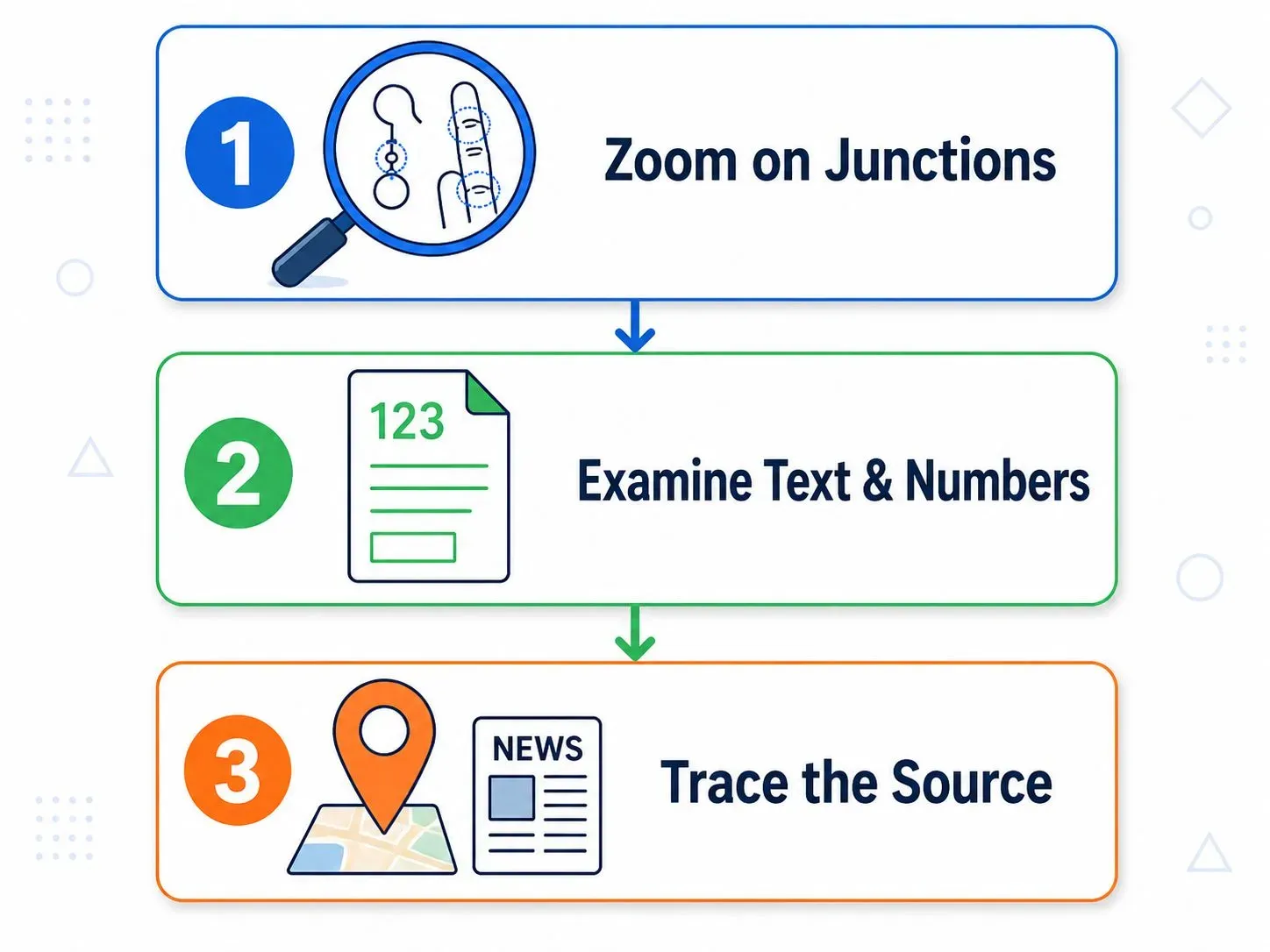
The 3-Step Verification Checklist for Everyday Browsing
When evaluating suspicious posts, photos, or clips online, use this straightforward three-step filter:
- Zoom in on the Junctions: Check where two objects meet—earrings on ears, hands holding cups, glasses touching the nose, and collar lines against necks. Synthetic media almost always loses structural clarity at junctions.
- Examine Text and Numbers: Read background signs, labels, and table numbers. If letters look like abstract shapes or table totals do not balance, the content is generated.
- Trace the Source: Check whether a claim or image appears on official news wires or verified primary registries. If a startling event exists only on anonymous social media cards, treat it as unverified.





Leave a Comment
Your comment is completely private and secure. We never publish comments publicly on our website. Your message will be sent directly to our team.