


If you noticed a sudden drop in website traffic or social post impressions recently, you are not alone.
Publishing unedited AI drafts used to get clicks. Now, audiences spot artificial text in seconds and scroll away immediately. Platforms like LinkedIn, Google, and Instagram have noticed this shift. When readers bounce or flag posts as automated filler, algorithms reduce your distribution.
Making AI content feel human again is not about fooling automated detectors with sentence spinners. It is about applying intentional human editing, sharing specific examples, and respecting your audience's time.
What Is AI Slop and Why Is It Killing Your Reach?
AI slop is low-effort, unedited text or media generated in bulk by artificial intelligence without human review, original insight, or factual verification.
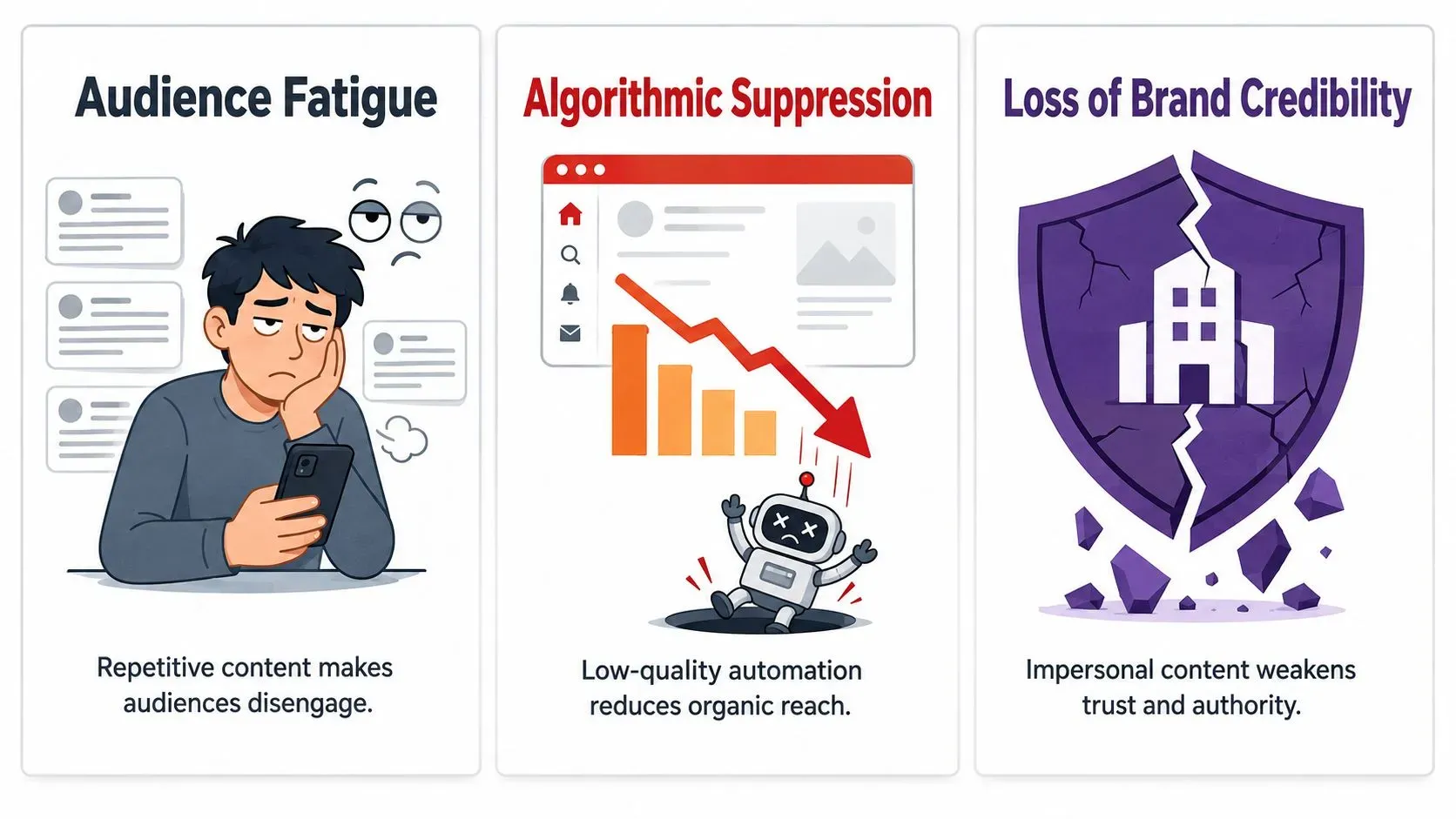
The term describes generic content that restates common facts using overly formal language and predictable structures. When websites and social accounts publish AI slop, they face three major problems:
1. Audience Fatigue
Readers recognize standard AI patterns such as predictable lists, rhetorical intros, and vague advice. When they see them, they leave the page. According to a LinkedIn analysis, specific AI writing patterns like "Here's how" openings and "It's not X, it's Y" lines are dragging post reach down by 4% to 7% versus normal performance.
2. Algorithmic Suppression
Platforms are actively demoting AI slop. LinkedIn introduced a "Seems like AI slop" reporting button in 2026. Within weeks, users clicked it over 1 million times, and LinkedIn reported that posts flagged as AI slop saw a 40% reduction in views. Snapchat also announced it will stop recommending "wholly AI-generated videos" in Spotlight to promote authentic content.
3. Loss of Brand Credibility
Audiences link unmanaged AI output to cost-cutting rather than care. Research shows that 48% of social listening mentions regarding brand-generated AI material express negative sentiment. When trust erodes, rebuilding it takes months.
The 6 Telltale Signs of AI Slop You Need to Cut
Before you can fix robotic content, you must identify what makes text sound artificial. Automated text generators tend to repeat specific linguistic patterns:
| AI Slop Pattern | Why It Fails | Humanized Alternative |
|---|---|---|
| Monotone Sentence Length | Sentences follow identical rhythms (15-20 words each), creating a dull reading experience. | Mix short punchy lines (3-6 words) with longer explanatory sentences. |
| Vague Abstractions | Uses generic claims like "good customer service helps businesses grow." | Add exact details, tools, numbers, or a real scenario. |
| Overly Polite / Corporate Tone | Sounds like an automated corporate memo without emotion or stance. | Write like you are explaining a problem to a colleague over coffee. |
| Predictable Formatting | Always formats answers as a list of 5 bold bullet points with tidy summaries. | Vary layouts: use short paragraphs, callout boxes, direct answers, and contrast points. |
| Empty Fluff and Filler | Pads word count without adding fresh facts or answers. | State the main answer in the first two sentences of the section. |
| Unchecked Hallucinations | States false facts, broken links, or made-up statistics as true. | Manually verify every statistic, date, name, and URL before publishing. |
How to Make AI Content Feel Human: A 5-Step Editorial Framework
You do not need to abandon AI tools completely. Instead, treat AI as a fast first-draft assistant rather than the final publisher. Follow this step-by-step editing process to turn robotic drafts into engaging, human-first articles.
+-----------------------------------------------------------------------------------+
| HUMAN-FIRST EDITORIAL PIPELINE |
+-----------------------------------------------------------------------------------+
| [1. Add Context] --> [2. Vary Rhythm] --> [3. Take a Stance] |
| (Tools, Numbers) (Punchy lines) (Clear Opinions) |
| | |
| v |
| [4. Cut Empty Filler] --> [5. Read Aloud Test] |
| (Remove Fluff) (Catch Friction) |
+-----------------------------------------------------------------------------------+
Step 1: Inject Real-World Context and Specific Details
AI models write in broad generalities because they predict average phrases. To make the draft valuable, add real context that an automated tool cannot guess:
- Name the exact software, version, or platform you used.
- Include concrete numbers: "reduced bounce rate from 68% to 42%" instead of "improved performance."
- Mention specific hurdles you ran into during implementation.
Step 2: Vary Sentence Length and Natural Rhythm
Natural human speech changes tempo. When you read a draft aloud, listen for robotic monotony:
- Break long sentences into two: If a sentence has multiple clauses, split it.
- Add one-sentence paragraphs: Use short sentences to emphasize key points.
- Use simple, everyday words: Swap complex vocabulary for clear, plain English.
Step 3: Take a Clear Editorial Stance
AI outputs try to balance every viewpoint neutrally. Real human experts have opinions based on practical work:
- Tell the reader which option actually works best in practice.
- Point out what common advice is outdated or ineffective.
- Warn readers about hidden traps or unnecessary expenses.
Step 4: Remove Generic Transitions and Empty Phrases
Standard AI drafts rely on predictable transitional markers. Strip away empty transition words that add no meaning:
- Delete phrases that state the obvious.
- Cut introductory filler sentences that merely repeat the question.
- Start sections immediately with the direct answer or practical action step.
Step 5: Run the "Read Aloud" Friction Test
Before hitting publish, read your edited text out loud from top to bottom:
- If you stumble over a tongue-twister phrase, reword it.
- If a paragraph sounds like a textbook, rewrite it using active voice.
- If you find yourself wanting to skip a paragraph, your readers will too—delete it.
Real-World Example: Fixing a Robotic Draft
Seeing the difference side-by-side clarifies how small edits transform the feel of your writing.
The AI Slop Version:
"Content optimization is essential for improving online visibility. It allows creators to effectively engage their target demographic. By ensuring proper alignment with algorithmic parameters, brands can achieve positive outcomes across diverse channels."
Why It Fails: It is full of passive jargon, vague buzzwords, and zero practical guidance. The reader learns nothing actionable.
The Humanized Version:
"If your articles are not getting clicks, check your formatting first. Readers scan on their phones and skip dense walls of text. Breaking your points into clear headings and three-sentence paragraphs keeps people reading longer."
Why It Works: It speaks directly to the reader, identifies a specific user behavior (mobile scanning), and gives a simple, actionable solution immediately.

The Real Story: How One Company Turned Away From AI Content
The shift toward human writing is not just a theory. Real companies are making changes.
FlightStory, founded by Stephen Bartlett, abandoned AI-generated LinkedIn content entirely after noticing audiences were becoming less responsive to automated messaging.
Christiana Brenton, FlightStory's director of business development, explained: "AI mistakes are really noticeable. When the world wobbles to the left, opportunity lies to the right. What will stand out on LinkedIn now more than ever? Real words written by a human."
The company's LinkedIn posts are now written entirely by hand. They even avoid aggressively editing small spelling errors or minor inaccuracies, believing that imperfections help demonstrate authenticity and make content feel more relatable.
The strategy delivered stronger audience engagement and broader reach compared to heavily AI-assisted content.
4 Common Mistakes to Avoid When Editing AI Content
When creators attempt to humanize their content, they often fall into predictable traps:
- Relying on Automated "AI Humanizer" Tools - Many third-party tools merely swap words with obscure synonyms or introduce grammatical errors to trick detection scores. This makes the content harder for real humans to read.
- Ignoring Fact-Checking - Language models generate plausible-sounding claims that are entirely fictional. Always verify dates, quotes, and technical instructions.
- Keeping Unnecessary Introductions - AI loves spending three paragraphs defining basic concepts before answering the user's prompt. Cut straight to the solution.
- Publishing Without Clear Search Intent Alignment - High-performing content answers the searcher's core question immediately. Do not make the reader scroll through 800 words of background to find a simple answer.
The Trust Problem: Why Authenticity Is Becoming the Currency of the Web
The most profound impact of AI slop is not just reduced reach. It is a breakdown of trust.
When your audience cannot tell whether you are a real person or a content farm, they stop engaging. When they stop engaging, algorithms bury you. When algorithms bury you, you lose your audience.
Authenticity becomes the key differentiator. The creators and brands that thrive in 2026 will be the ones who show their work, share their failures, and speak with a genuine voice.








Leave a Comment
Your comment is completely private and secure. We never publish comments publicly on our website. Your message will be sent directly to our team.