


Organic chemistry is tough. You have to memorize reactions, visualize 3D molecules, and push electrons correctly. A good AI tool can help you study, but no single tool fits every task. Some AI models explain concepts clearly. Others predict reaction products accurately. A few even plan full multi-step syntheses. On August 1, 2026, OpenAI released GPT-5.5, which improved its chemistry reasoning by 15%. Meanwhile, ai in education policy news today shows that 62% of college students now use AI for homework. This guide compares the top tools for students and researchers. We tested each one on real organic chemistry problems.
Why Organic Chemistry Needs AI (More Than Other Subjects)
The Three Big Problems AI Solves
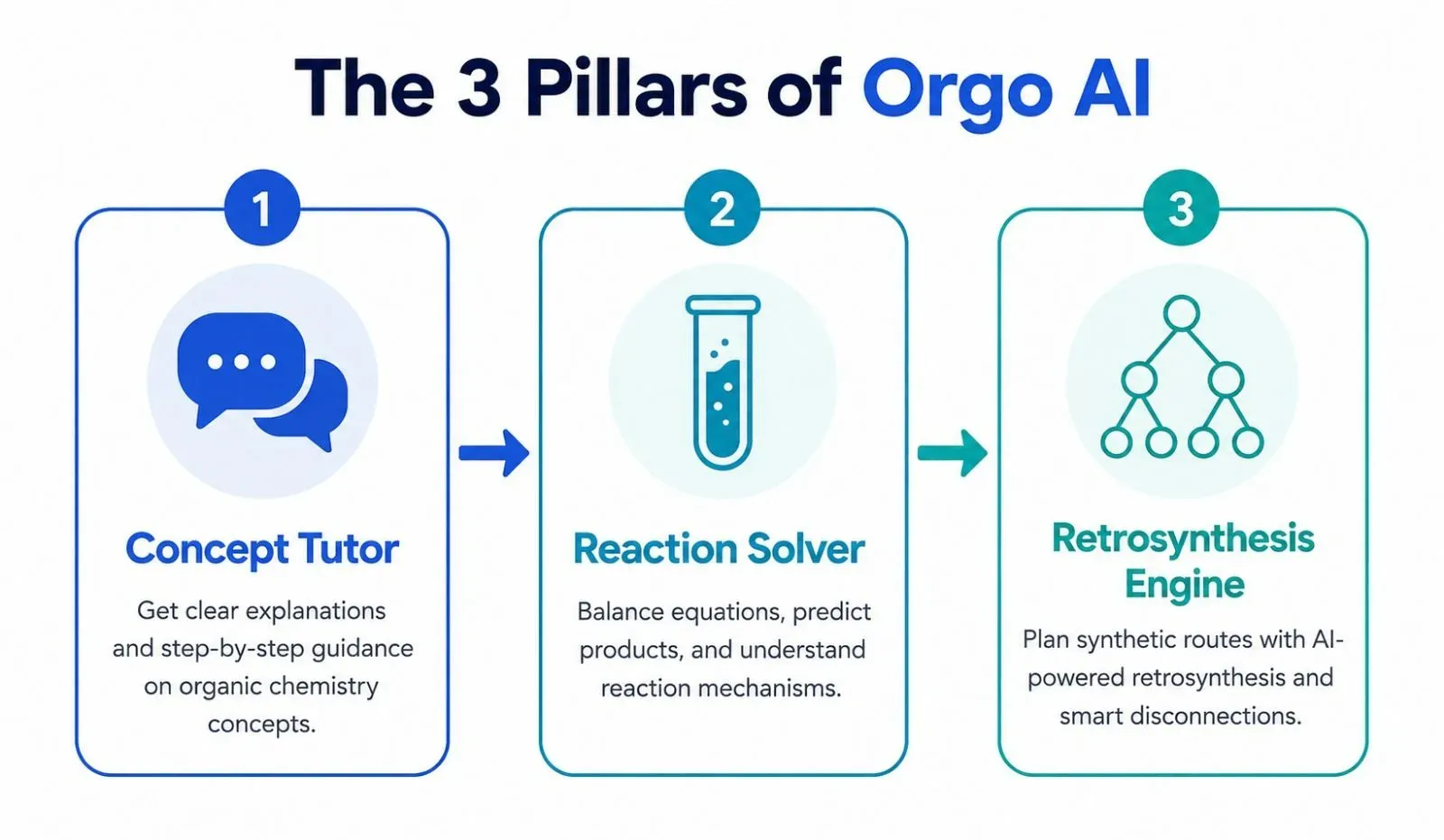
Organic chemistry asks three very different questions. First, "Why does this reaction happen?" This rewards clear, conversational explanations. Second, "What is the exact product?" This rewards models trained on massive reaction datasets. Third, "How do I make this molecule?" This rewards specialized search engines built on curated reaction rules. No single AI wins on all three. That is why ai chemistry is growing so fast.
The Reality of AI Accuracy in Chemistry
A 2026 study in the Journal of Chemical Education found that ChatGPT could only predict introductory alkene addition reactions with careful prompting. Without that prompting, it often placed the wrong group on the wrong carbon. However, chemistry-tuned models like ChemLLM now reach 92.3% top-5 accuracy on the ChemBench reaction set. General chatbots struggle, but specialized organic chemistry ai solvers are becoming highly reliable.
The Best AI Tools for Organic Chemistry in 2026
1. ChatGPT (Best Overall Concept Tutor)
ChatGPT is the strongest general choice for most students. You can type a question, upload a reaction scheme, or even provide a photo of handwritten work. Its new GPT-5.5 model handles visual diagrams much better than older versions. It is excellent for explaining SN1 vs SN2, analyzing resonance structures, and generating practice quizzes. However, it does not check its own chemistry. Always verify its answers against your textbook.
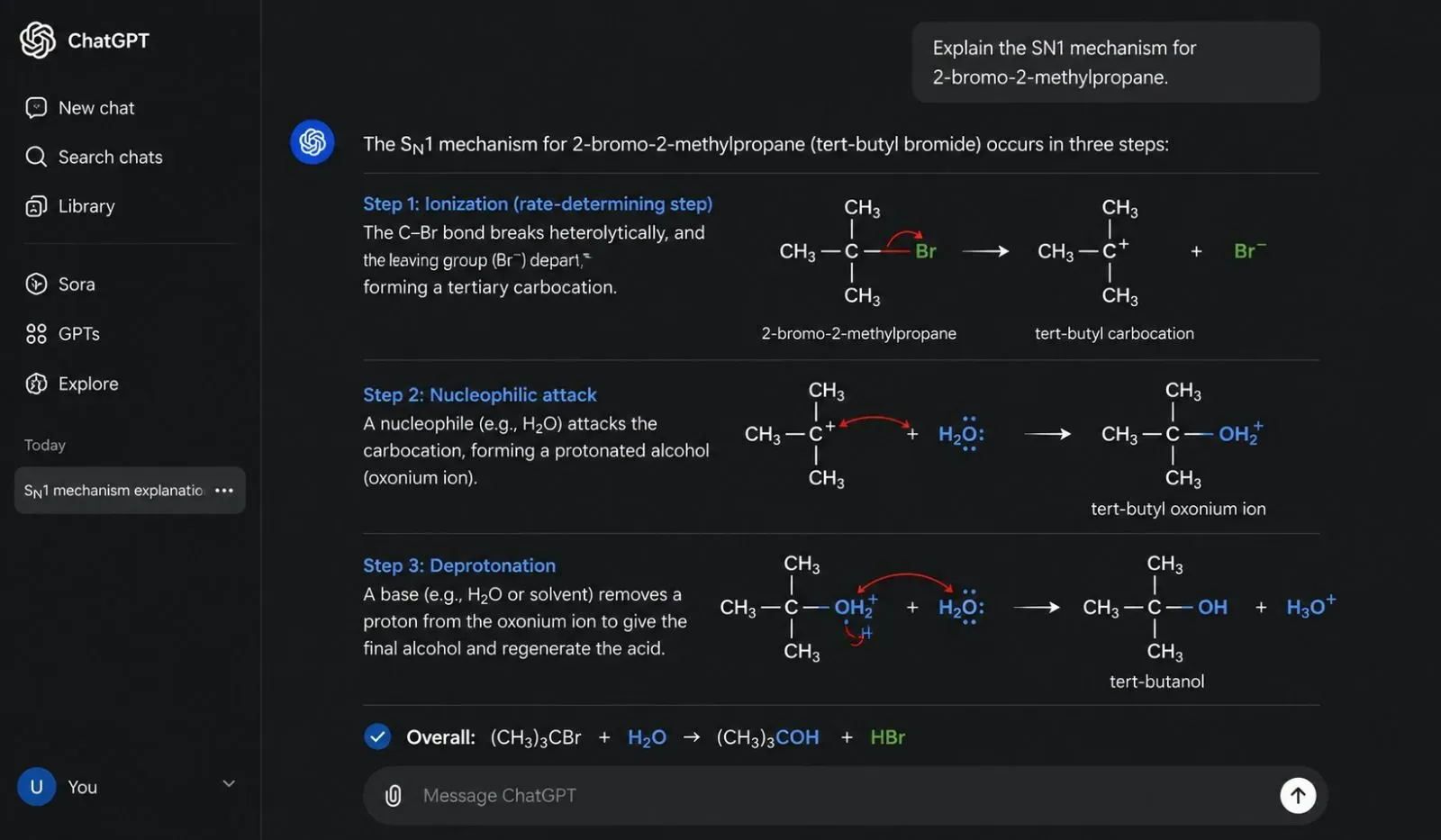
Best for: Explaining concepts, mechanisms, and general tutoring.
Cost: Free; Plus $20/month.
2. Claude (Best for Deep Document Analysis)
Claude excels at reading long lecture notes, lab manuals, and research papers. You can upload a 50-page PDF, and it will extract key reactions, create a concept map, and list all the reagents. Its detailed explanations are patient and clear, making it a great chemistry tutor. But it can hallucinate on complex stereochemistry problems. Use it for understanding the big picture, not for final answers.
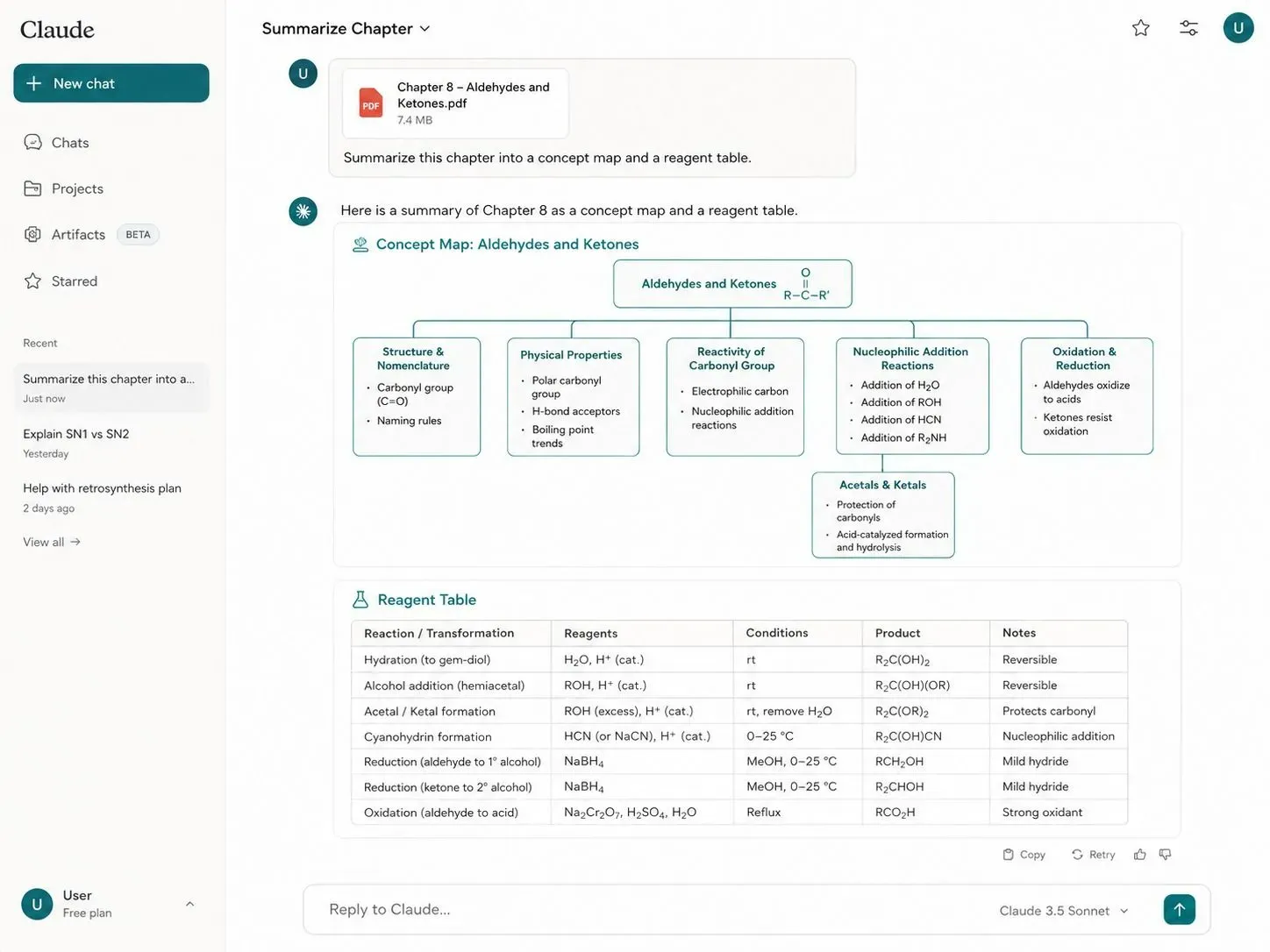
Student: Summarize this chapter into a concept map and a reagent table.
Claude: [Provides a structured concept map and a list of reagents.]
Best for: Long document analysis and study guide creation.
Cost: Free; Pro $20/month.
3. Gemini (Best for Image-Heavy Problems)
Gemini handles images and photos better than any other chatbot. If you take a photo of a whiteboard reaction, Gemini can read the wedge/dash notation and propose a product. It also integrates with Google Drive, so you can pull lecture slides and notes directly into your chat. However, visual recognition does not guarantee chemical correctness. The 2025 benchmark tests showed Gemini struggles with chemistry-specific visual reasoning.
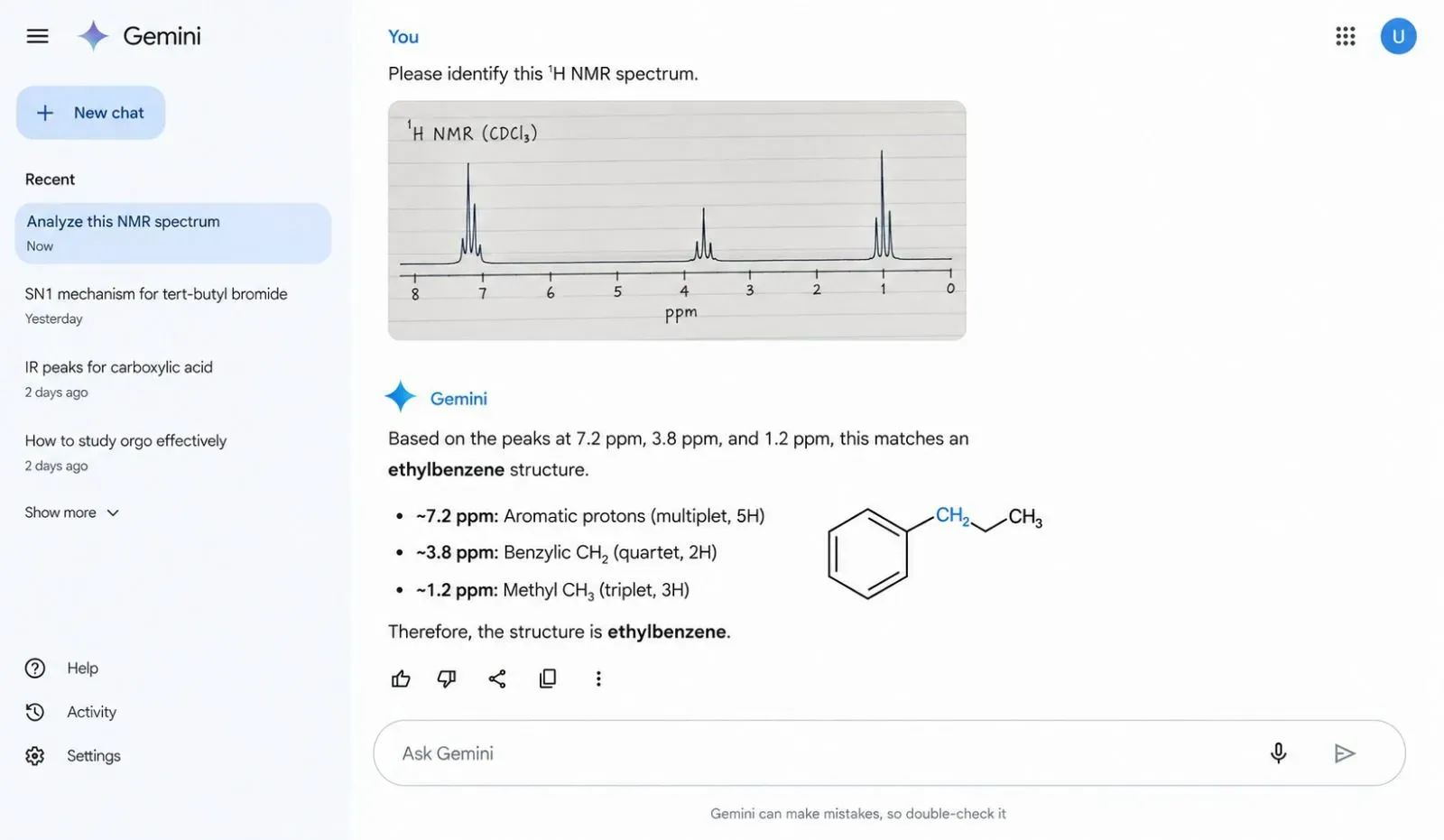
Best for: Analyzing images, diagrams, and Google Drive files.
Cost: Free; Advanced $19.99/month.
4. AskSia (Best Verified Reaction Solver)
AskSia is a dedicated organic chemistry ai solver built for homework and exams. It uses a three-stage pipeline: a language model parses the problem, a symbolic engine checks the chemistry, and a self-checker flags divergent steps. It reports 98% accuracy on standard coursework. For SN1, SN2, E1, E2, addition, and aromatic substitution, it shows intermediates and rate-determining logic rather than a single guessed product.
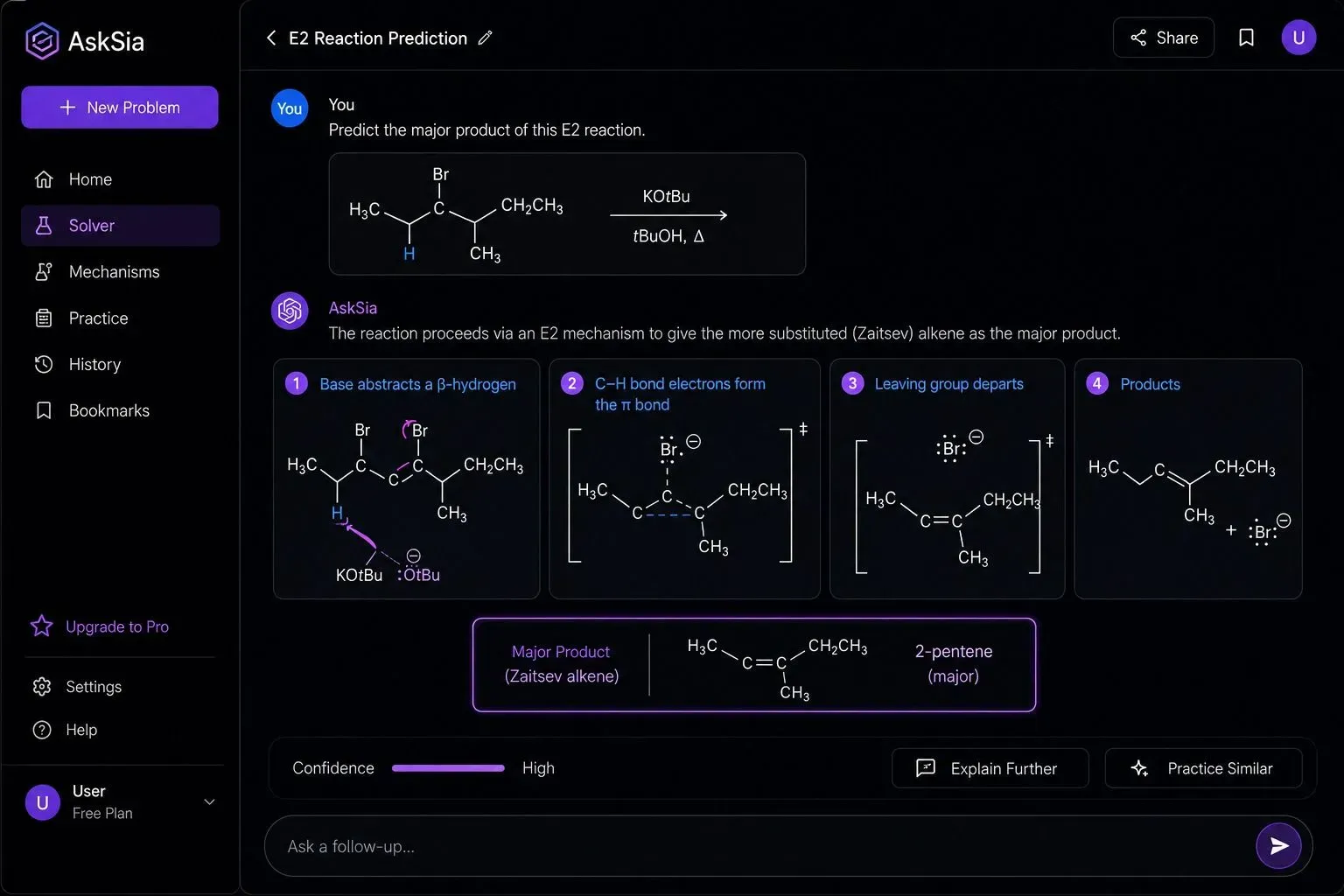
Best for: Trusted homework answers and exam prep.
Cost: Free; $9–$25/month.
5. IBM RXN for Chemistry (Best Retrosynthesis Engine)
IBM RXN is a cloud-based tool trained on millions of real chemical reactions. It does not chat. It predicts reaction outcomes and plans multi-step retrosyntheses. For example, you give it a target molecule, and it maps out a synthetic route from commercially available starting materials. It is overkill for weekly homework, but it is essential for research projects.
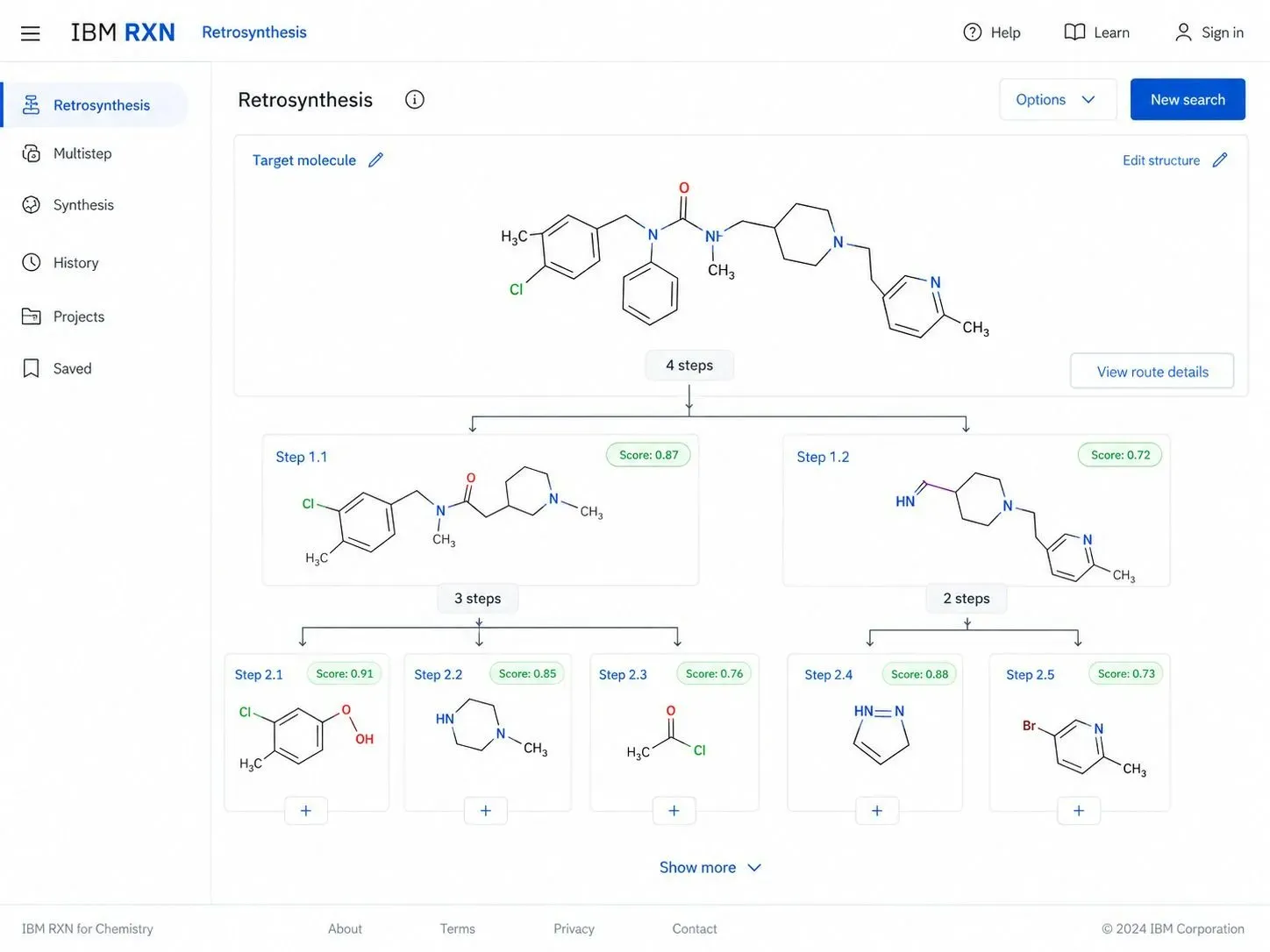
Best for: Research, total synthesis, and advanced projects.
Cost: Free (account required); Enterprise pricing for API access.
6. DeepChem (Best Open-Source & Custom Models)
DeepChem is an open-source Python library. It allows researchers and developers to build custom machine learning models for molecular property prediction and drug discovery. It is not a chatbot. It requires coding skills. But it is completely free and runs on your own computer. For researchers wanting to train a model on proprietary data, DeepChem is the ultimate ai chemistry platform.
import deepchem as dc
tasks, datasets, transformers = dc.molnet.load_tox21()
print(datasets)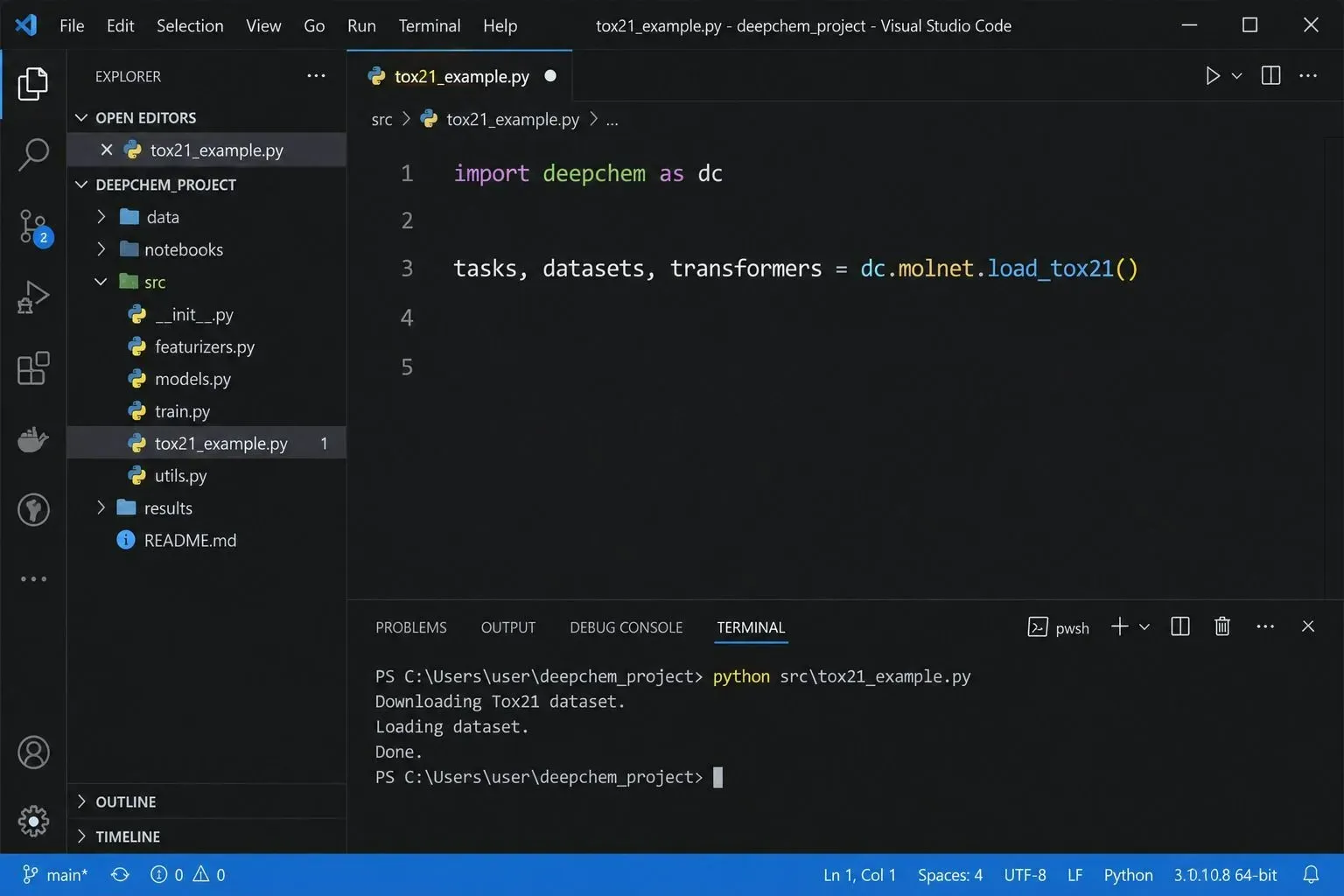
Best for: Researchers, developers, and custom model building.
Cost: 100% Free (Open Source).
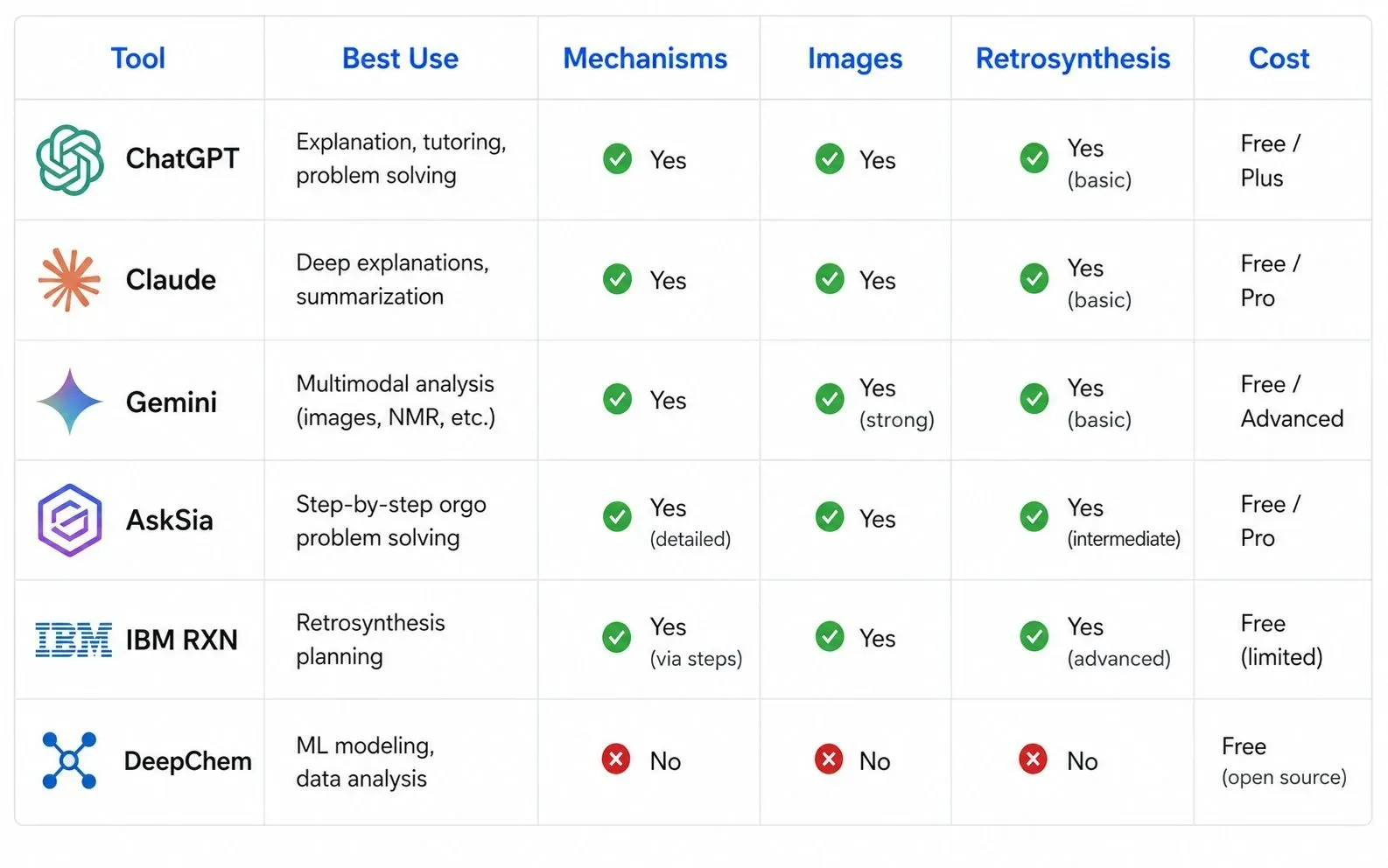
Quick Comparison Table: Which Organic Chemistry AI is Right for You?
Real-World Case Study: How a Student Used AI to Ace O-Chem
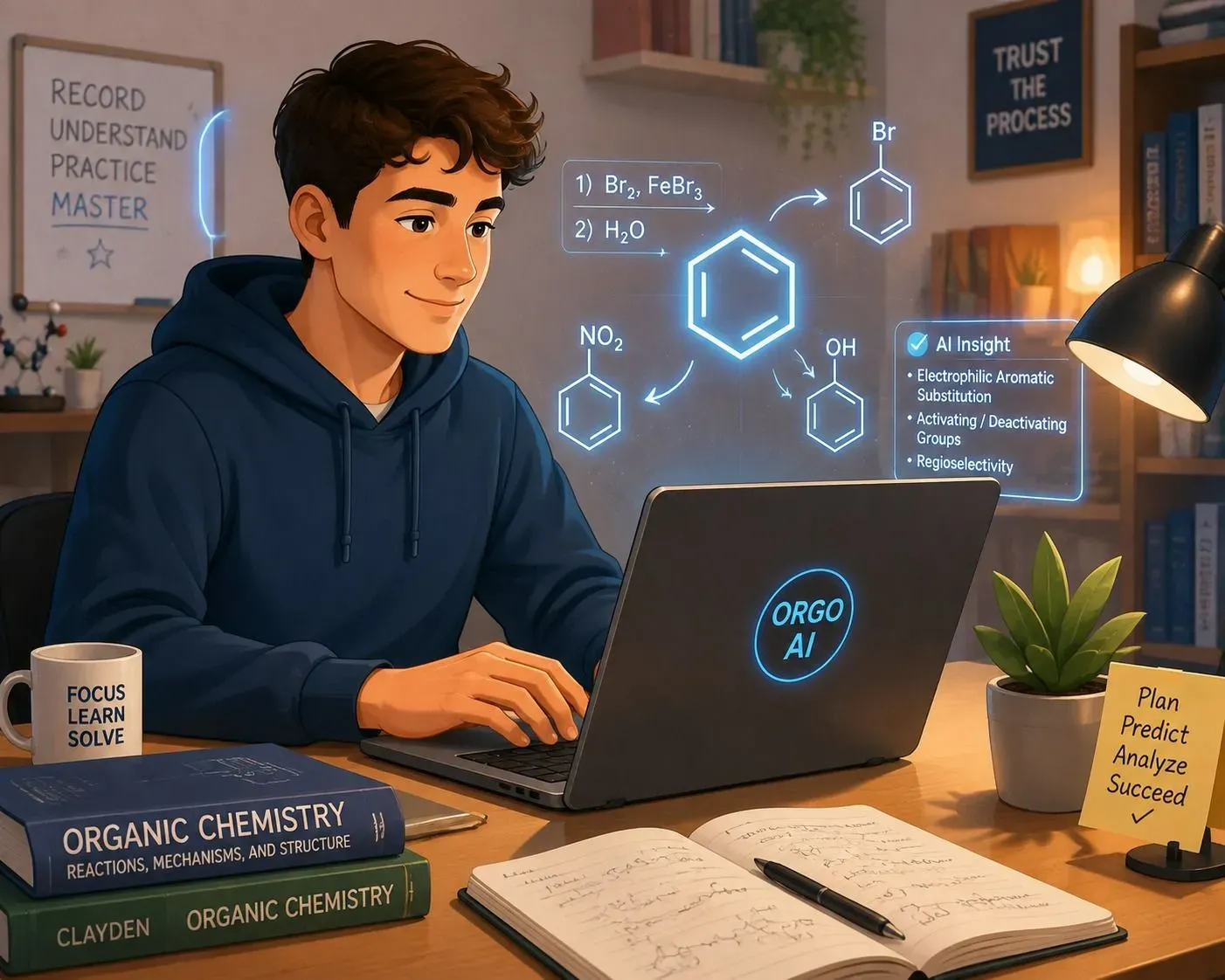
"I went from a C to an A in one semester."
Marcus Chen, a sophomore at the University of Texas at Austin, struggled with organic chemistry. His professor moved too fast through mechanisms, and his textbook was dense.
"Before finals, I was lost on E1 vs E2 eliminations," Marcus said. "I used ChatGPT to explain the concepts. Then I used AskSia to verify my practice problems. I would type 'Predict the major product of this E2 reaction,' and it would walk me through every step with electron arrows and formal charges."
Marcus studied 1 hour a day for 3 weeks using this workflow. He scored a 91% on his final exam. He now uses IBM RXN for his undergraduate research project on synthesizing new polymers.
How to Get Better Answers from Any Chemistry AI
Use the "Step-by-Step" Prompt Template
General chatbots like ChatGPT and Gemini drift without a strong prompt. Always use this template:
"Analyze this organic chemistry reaction step by step. First, identify the substrate, functional groups, and reagents. Then predict the major product. Explain every electron movement, formal charge, intermediate, and stereochemical outcome. Check atom conservation and list any uncertainty."
This forces the AI to show its work. You can immediately spot where the ai might have made a mistake.
The "Hallucination Check" Checklist
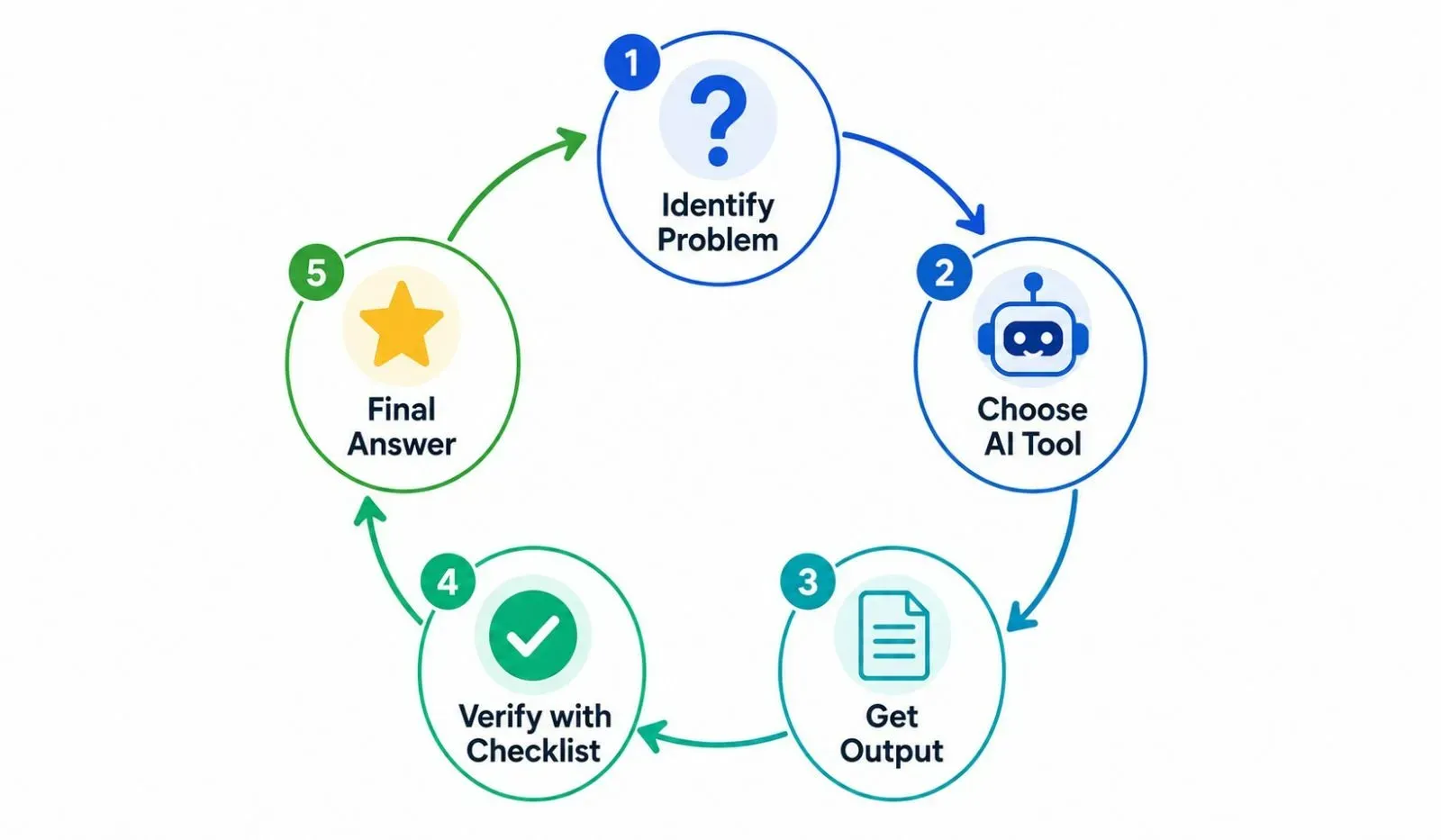
Never trust an AI's final answer blindly. Run this quick 5-point checklist:
- Does the electron flow start from a nucleophile to an electrophile?
- Are all formal charges neutralized at the end?
- Does the stereochemistry (wedge/dash) match the reaction mechanism?
- Is the solvent polarity appropriate for the reaction type?
- Does the AI cite a specific textbook rule (e.g., Zaitsev's Rule, Markovnikov's Rule) to justify its answer?
Use the Right Tool for the Right Task
Match your problem to the right chemistry ai solver. If you need a mechanism explained, use ChatGPT. If you need to check a homework problem, use AskSia. If you need a synthesis plan for a lab, use IBM RXN.
AI in the Chemistry Lab: What Researchers Use in 2026
For professionals, the landscape is different. Biotech ai news and pharma ai news are dominated by platforms like Schrödinger and ChemCopilot. Schrödinger combines physics-based simulations with machine learning for high-accuracy drug discovery. ChemCopilot focuses on scaling reactions from the lab to industrial manufacturing, optimizing for yield, safety, and cost. These tools are not for homework. They are for designing real molecules that become medicines. Meanwhile, ai compliance news is evolving rapidly as regulators seek to govern AI-designed drugs and materials.


Leave a Comment
Your comment is completely private and secure. We never publish comments publicly on our website. Your message will be sent directly to our team.