


Developers and engineering teams choosing between xAI's Grok 4 family and Anthropic's Claude 4 Opus face a fundamental tradeoff: real-time speed and data velocity versus deep reasoning and multi-file precision.
Both platforms rank among the most capable models available, but they are engineered for different jobs. Grok 4 provides native real-time access to live social data, fast visual generation, and cost-effective API pricing. Claude 4 Opus delivers high-precision complex reasoning, sustained multi-file coding, and an enterprise-grade agentic ecosystem built around Claude Code and the Model Context Protocol (MCP).
This comparison breaks down benchmark performance, coding tasks, context handling, API cost structures, and real-world developer use cases.
Quick Verdict: Grok vs Claude at a Glance
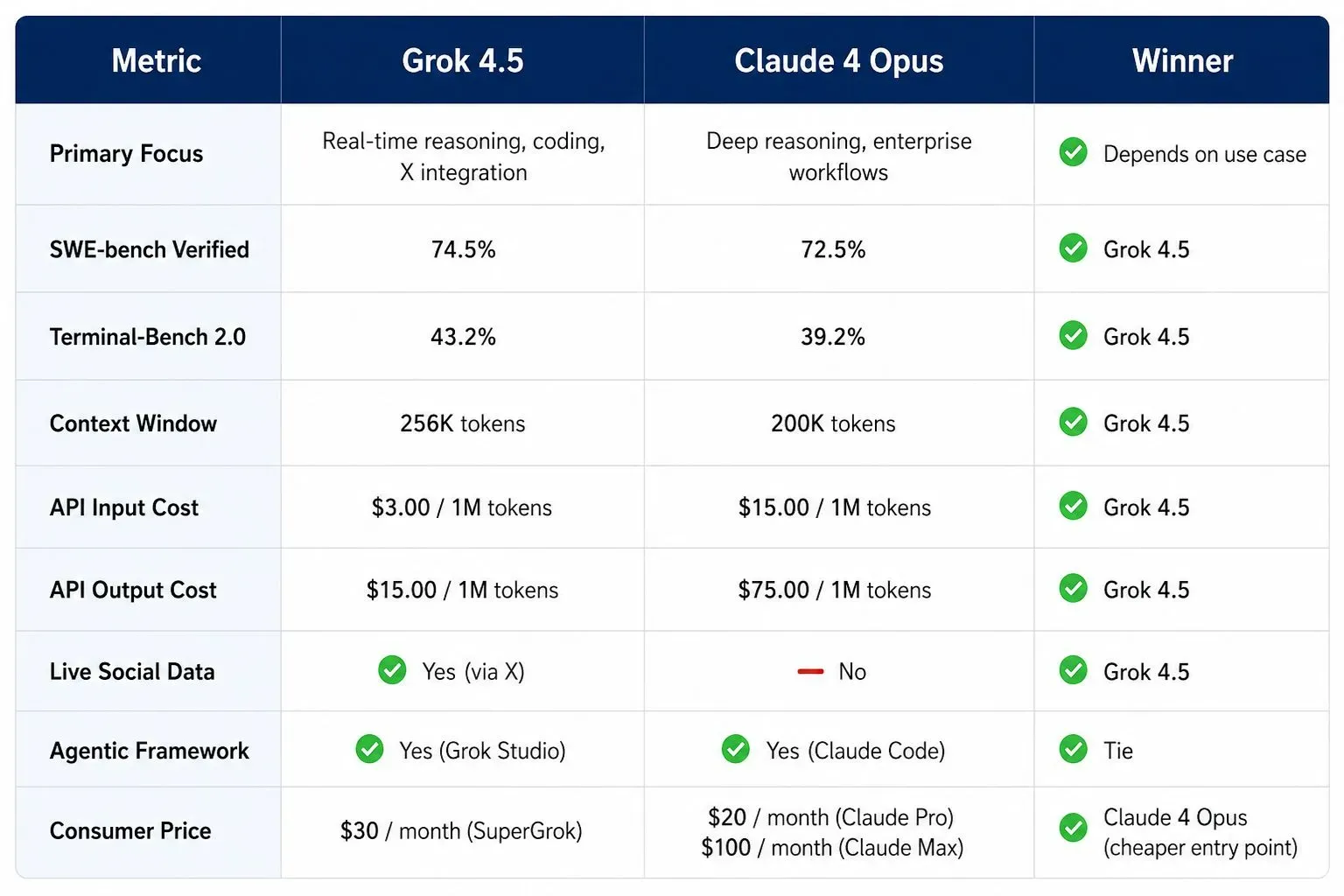
If your priority is production software engineering, multi-file refactoring, long document analysis, or enterprise compliance, choose Claude 4 Opus. Its reasoning depth, low hallucination rate, and 1M token context window make it the superior flagship model for complex tasks.
If your priority is real-time news tracking, social sentiment analysis, rapid UI prototyping, or high-volume API execution, choose Grok 4. Its direct access to live X platform posts, cheaper token costs, and multi-agent terminal execution give it a distinct speed advantage.
Benchmark Performance: Reasoning and Complex Tasks
Evaluating model capability requires looking past single-prompt answers and testing how each AI model handles complex multi-step reasoning.
High-Level Reasoning Benchmarks
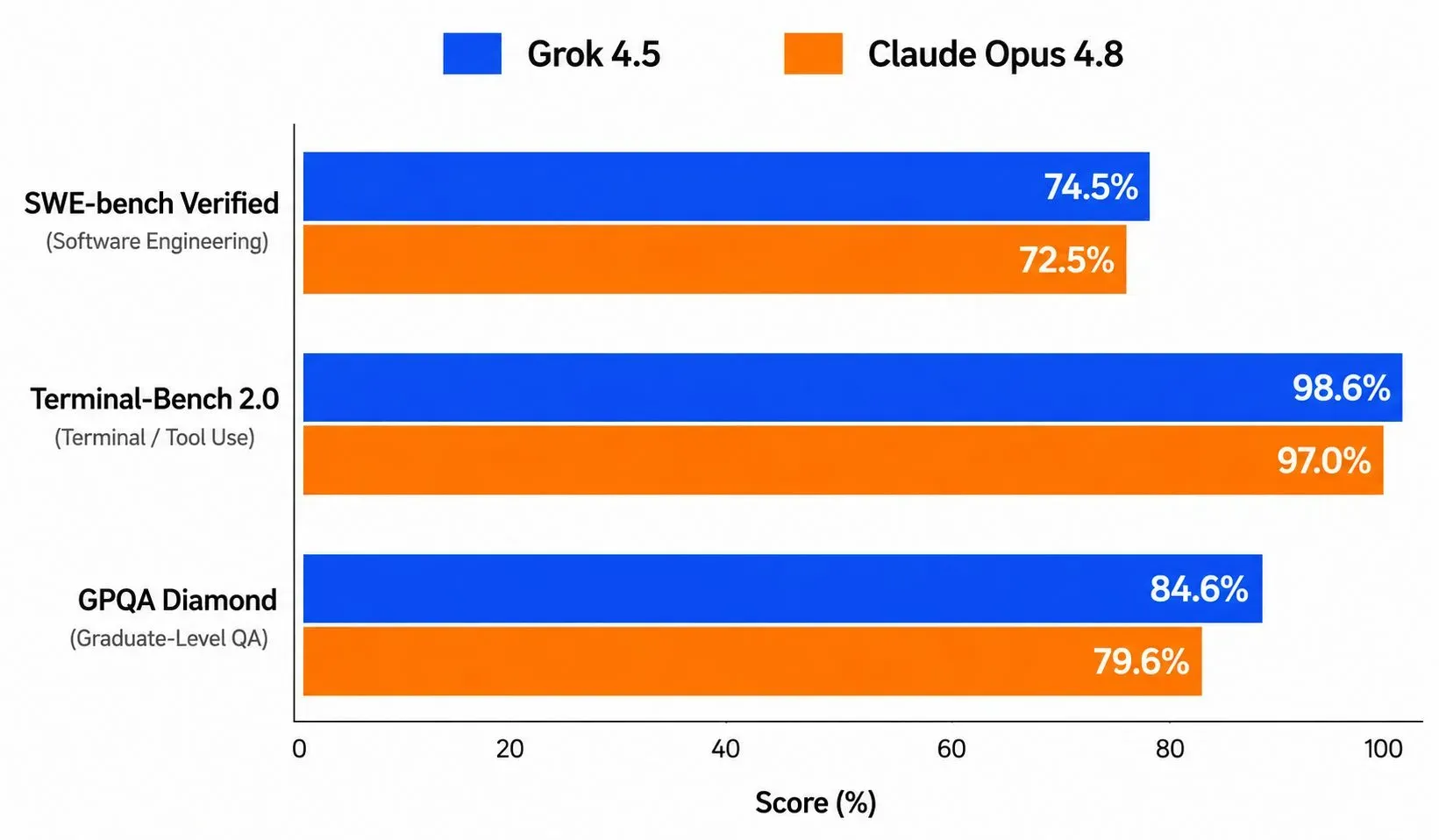
On general intelligence indices such as MMLU-Pro and GPQA Diamond, Claude 4 Opus holds a consistent edge over Grok 4. On GPQA Diamond—which tests graduate-level STEM problem solving—Claude 4 Opus scores 88%, compared to Grok 4's 84%.
When presented with abstract logic puzzles or novel multi-step inference tests, Claude Opus breaks problems into clear logic trees with fewer assumptions. Grok 4 reaches accurate conclusions on most standard reasoning tasks, but its chain-of-thought explanations can drift when solving edge-case logic constraints.
ARC-AGI and Frontier Intelligence
xAI highlighted Grok 4's performance on the ARC-AGI benchmark, where it became one of the first models to cross key reasoning thresholds. Elon Musk positioned Grok 4 as a model capable of matching high-level human problem solving across academic subjects.
In practice, Grok's reasoning strength shines in scientific calculations and mathematical deduction. However, Anthropic's Constitutional AI training gives Claude models superior consistency on long-form analytical research, policy analysis, and legal document review.
Coding Benchmarks & Agentic Workflows: Grok 4 vs Claude 4 Opus
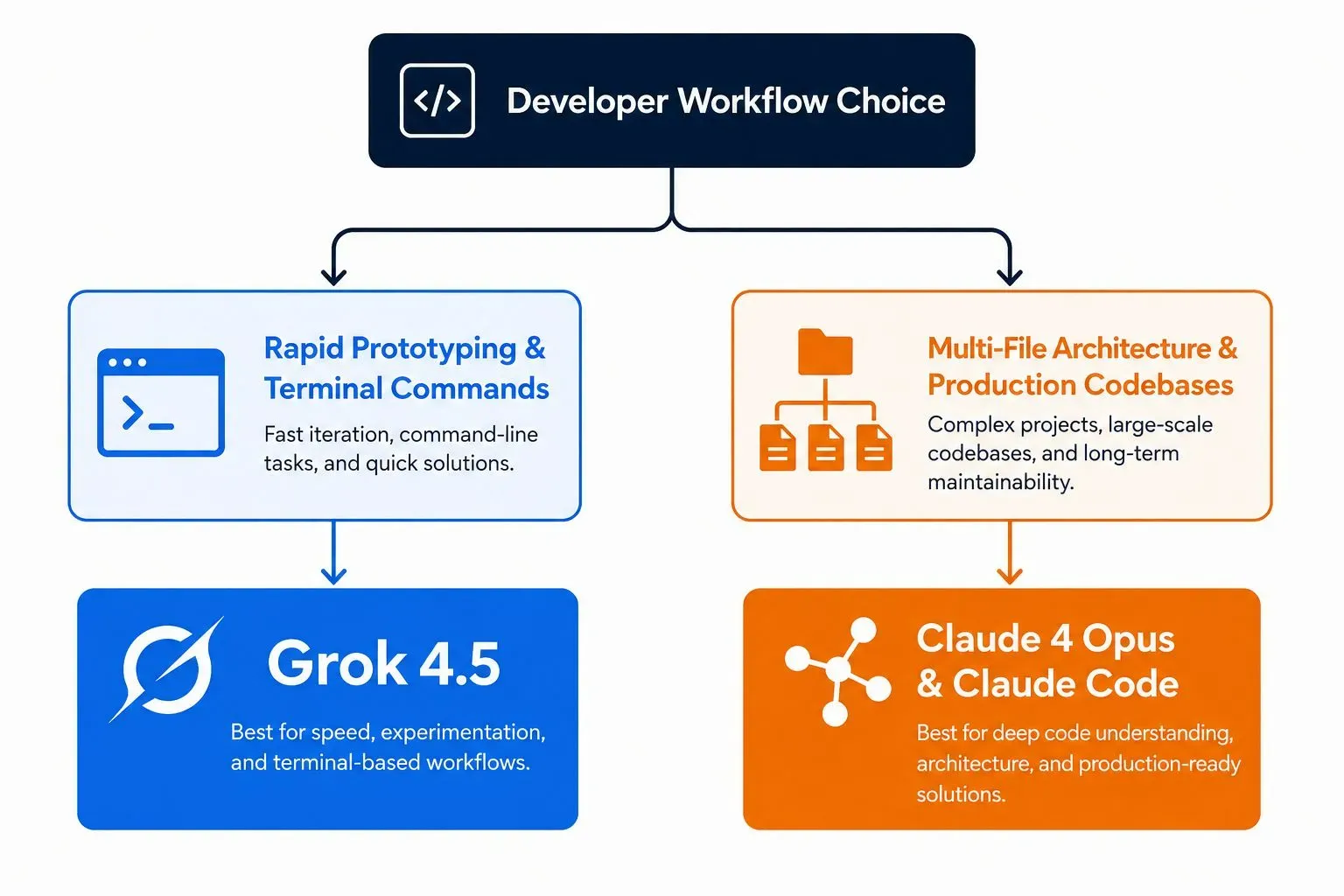
For software development, choosing between grok vs claude depends on whether your project requires rapid single-file prototyping or multi-file codebase maintenance.
SWE-bench Verified vs Terminal-Bench 2.0
In software engineering evaluations, the models trade top positions based on task structure:
SWE-bench Verified (Codebase Refactoring): Claude 4 Opus leads with 88.6% versus Grok 4 at 86.6%. Claude excels at navigating existing repos, modifying multiple files simultaneously, and maintaining project architecture without breaking dependent modules.
Terminal-Bench 2.0 (Agentic Terminal Tasks): Grok 4 wins with 83.3% over Claude Opus 4 at 74.6%. Grok utilizes a four-agent architecture that executes terminal commands, installs dependencies, and resolves environment errors in parallel.
Real-World Developer Testing
1. Figma Design Clone to Next.js (UI Generation)
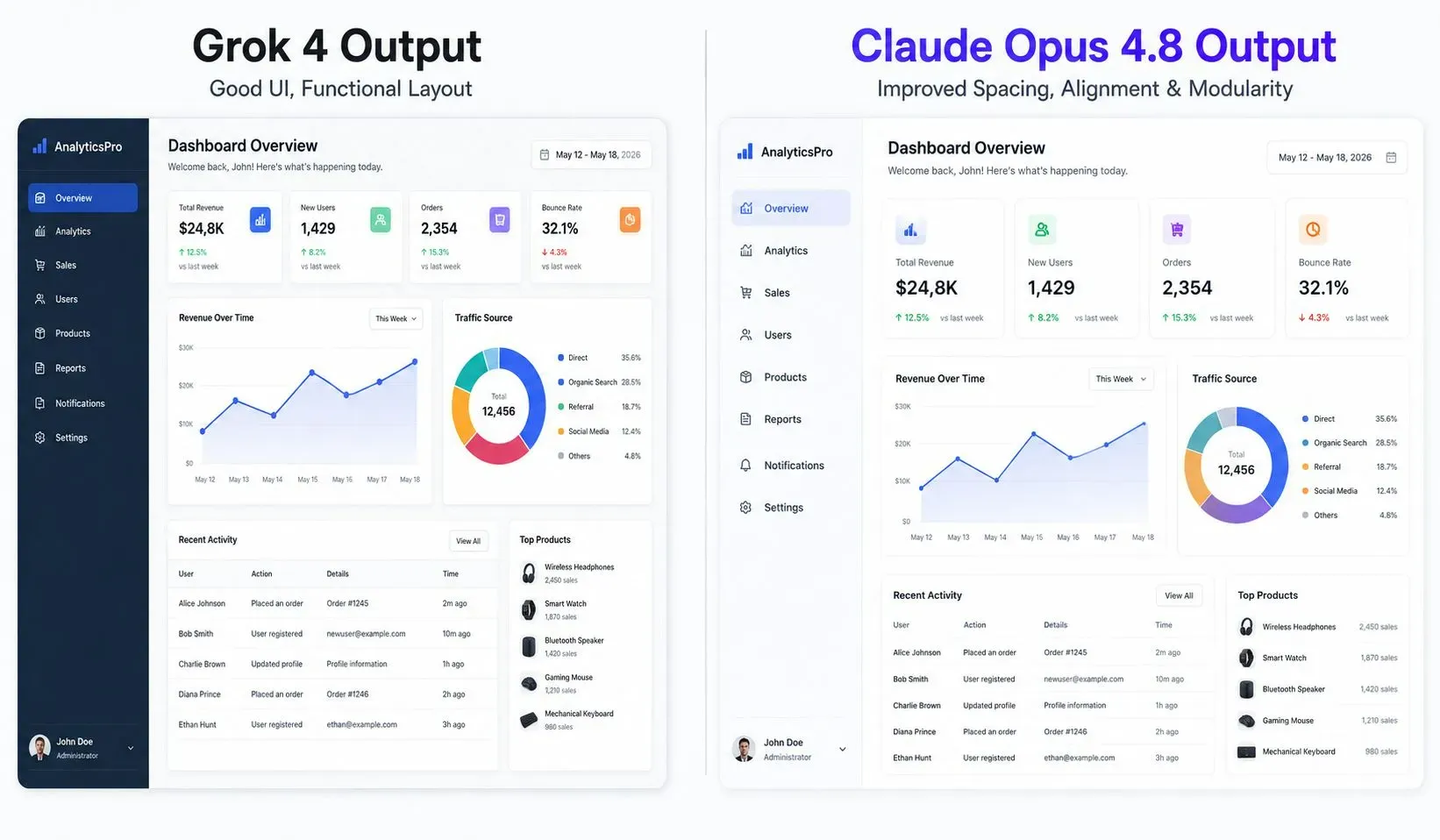
When given a complex Figma layout to replicate in Next.js using Tailwind CSS:
Grok 4 generated clean, visually accurate JSX within four minutes. It achieved 99% accuracy in tool calling for UI assets. However, it placed most layout logic in a single file rather than breaking it into modular components.
Claude 4 Opus produced a slightly tighter visual implementation with better icon positioning and cleaner component abstraction.
Gemini models struggled with the same agentic design prompt, proving that Grok and Claude remain the two dominant choices for front-end ui generation.
2. Three.js 3D Shader Animation
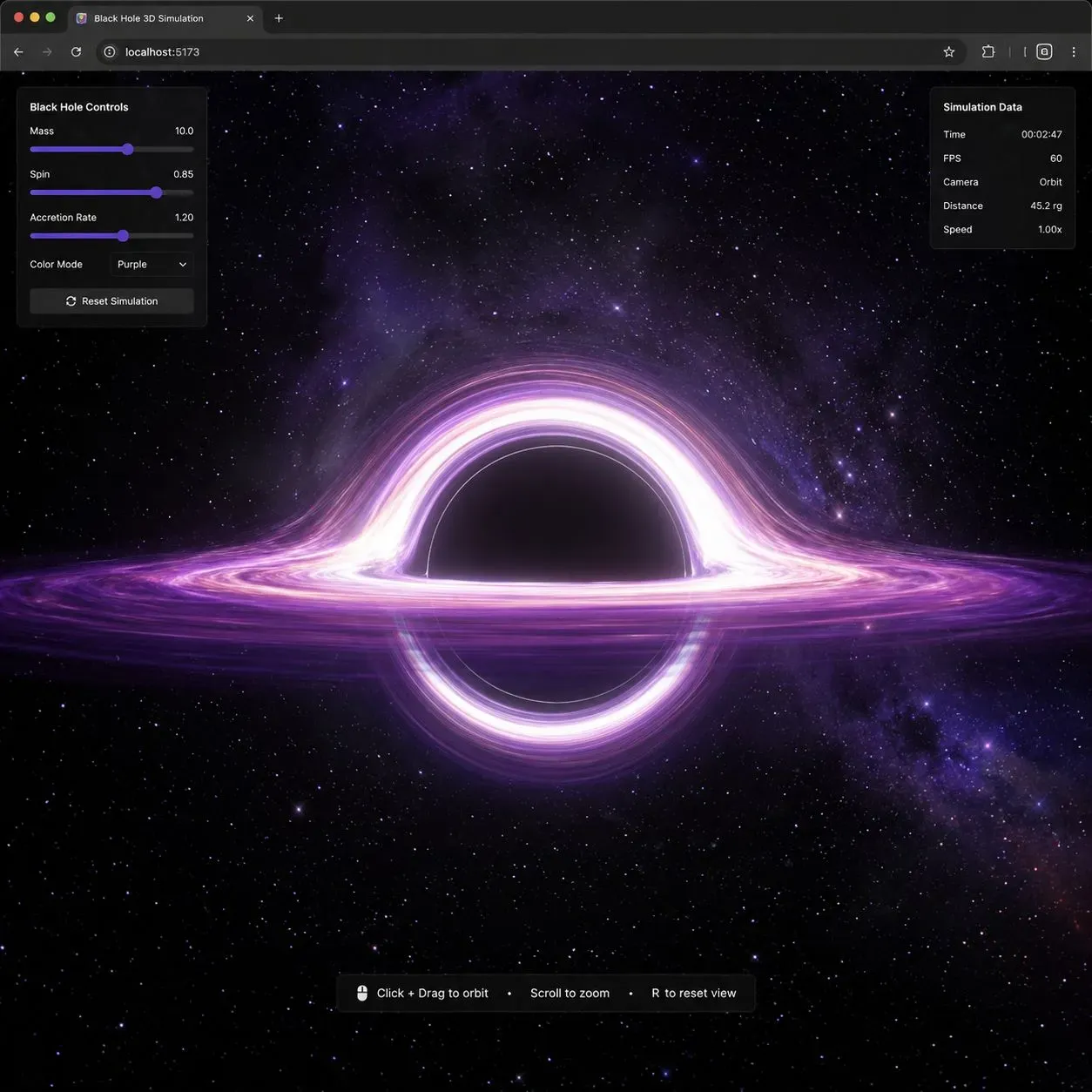
When asked to write a 3D black hole visualization using Three.js inside a single HTML file:
Grok 4 rendered a fluid, high-performance gravitational lens animation with proper WebGL shader setup. It resolved local CORS asset issues autonomously after a single follow-up prompt.
Claude Opus 4 matched Grok's visual fidelity while proactively embedding interactive Dat.GUI control sliders for physics parameters without being asked.
3. Agentic Coding with Claude Code and MCP
Anthropic provides a distinct advantage through Claude Code—a CLI tool that allows Claude to execute terminal commands, read git logs, and run test suites directly inside local project environments. Combined with the Model Context Protocol (MCP), Claude connects natively to databases, GitHub repositories, and local development tools.
While Grok 4 functions as an exceptionally fast pair-programmer, claude code offers a full agentic coding environment for long-running engineering work.
Real-Time Data Access and Trending Topics
Data freshness is the clearest structural difference between xAI and Anthropic.
Native X Data Pipeline vs Web Search RAG
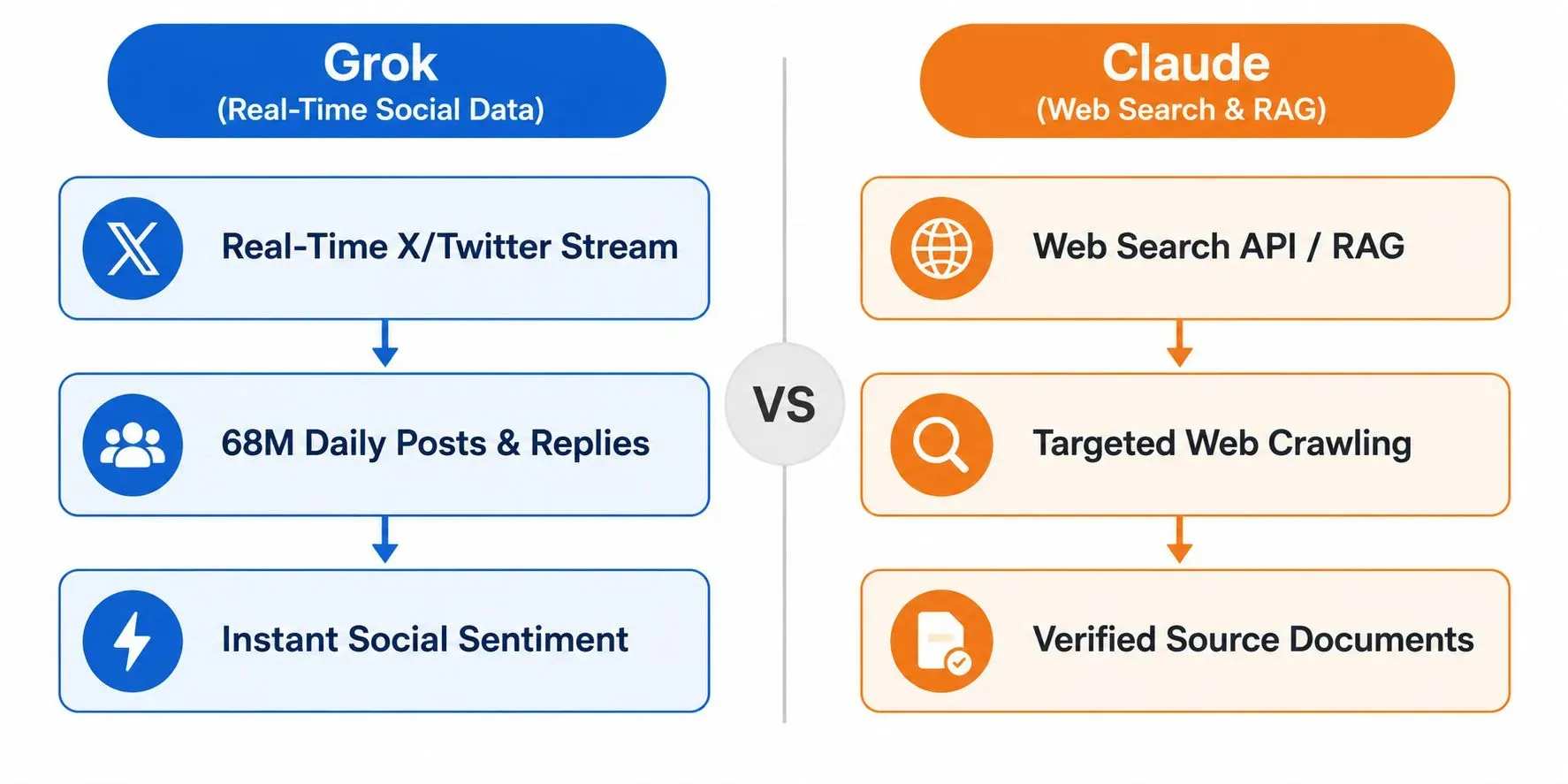
Grok 4 has direct access to xAI's real-time data pipeline, pulling from an estimated 68 million daily posts, replies, and trending topics on X (formerly Twitter). It does not rely solely on standard web search indexes; it processes live conversation streams as events unfold.
Claude 4 Opus accesses live information through web search tools on paid plans or API integrations. This approach works well for static articles, documentation, and news sites, but it cannot match Grok's velocity when tracking live social sentiment or breaking industry stories.
Unfiltered Outputs vs Constitutional AI
xAI designs Grok for direct, unfiltered responses with fewer content restrictions. Users working on political analysis, satire, or controversial topics encounter fewer guardrails on Grok.
Claude operates under Anthropic's Constitutional AI framework. It prioritizes safety, refusal transparency, and risk mitigation, making it the preferred choice for enterprise compliance, legal work, and corporate policy analysis.
Context Window & Memory: 128K/256K vs 1M Token Context Window
Handling large volumes of text requires a stable token context window.
Long-Context Capacity
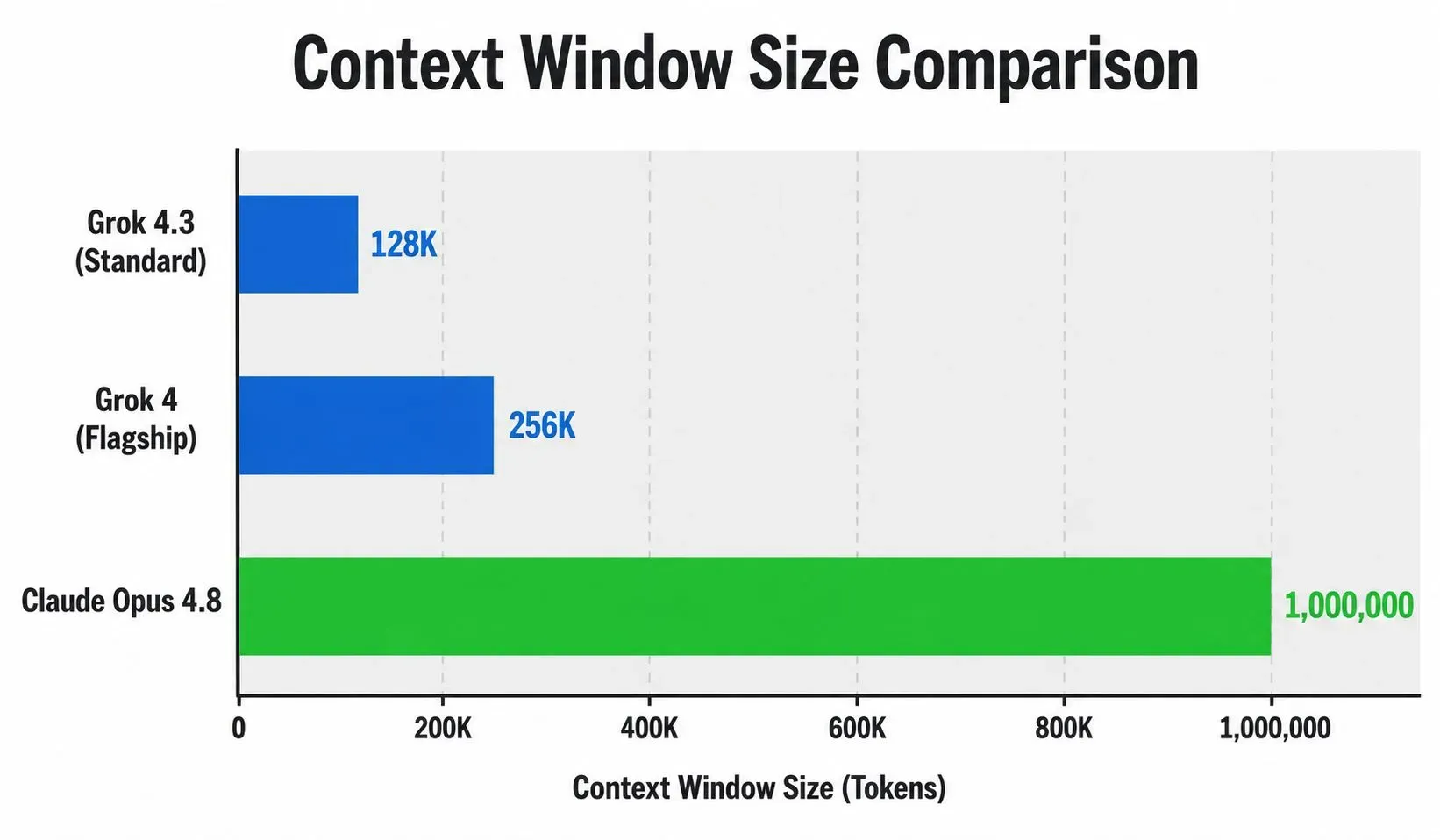
Claude 4 Opus: Features a 1m token context window (roughly 750,000 words). It allows developers to load entire codebases, multi-hundred-page technical manuals, or full legal archives into a single session without truncating text.
Grok 4: Standard API models operate with a 256K context window, while lightweight variants like Grok 4 Fast extend up to 2M tokens. Standard Grok 4.3 setups run on 128K to 131K token limits.
Needle-in-a-Haystack Retrieval
Having a large context window is only useful if the model can retrieve specific details accurately. Claude 4 Opus achieves near-100% recall accuracy across its entire 1M context. It retains fine-grained constraints in long documents, whereas grok 4 vs Claude comparisons show Grok occasionally dropping minor formatting instructions when context lengths exceed 100K tokens.
Cost Breakdown: API Pricing & Consumer Plans
API expenses accumulate rapidly when deploying agentic workflows at scale. The cost breakdown reveals a significant price gap between xAI and Anthropic.
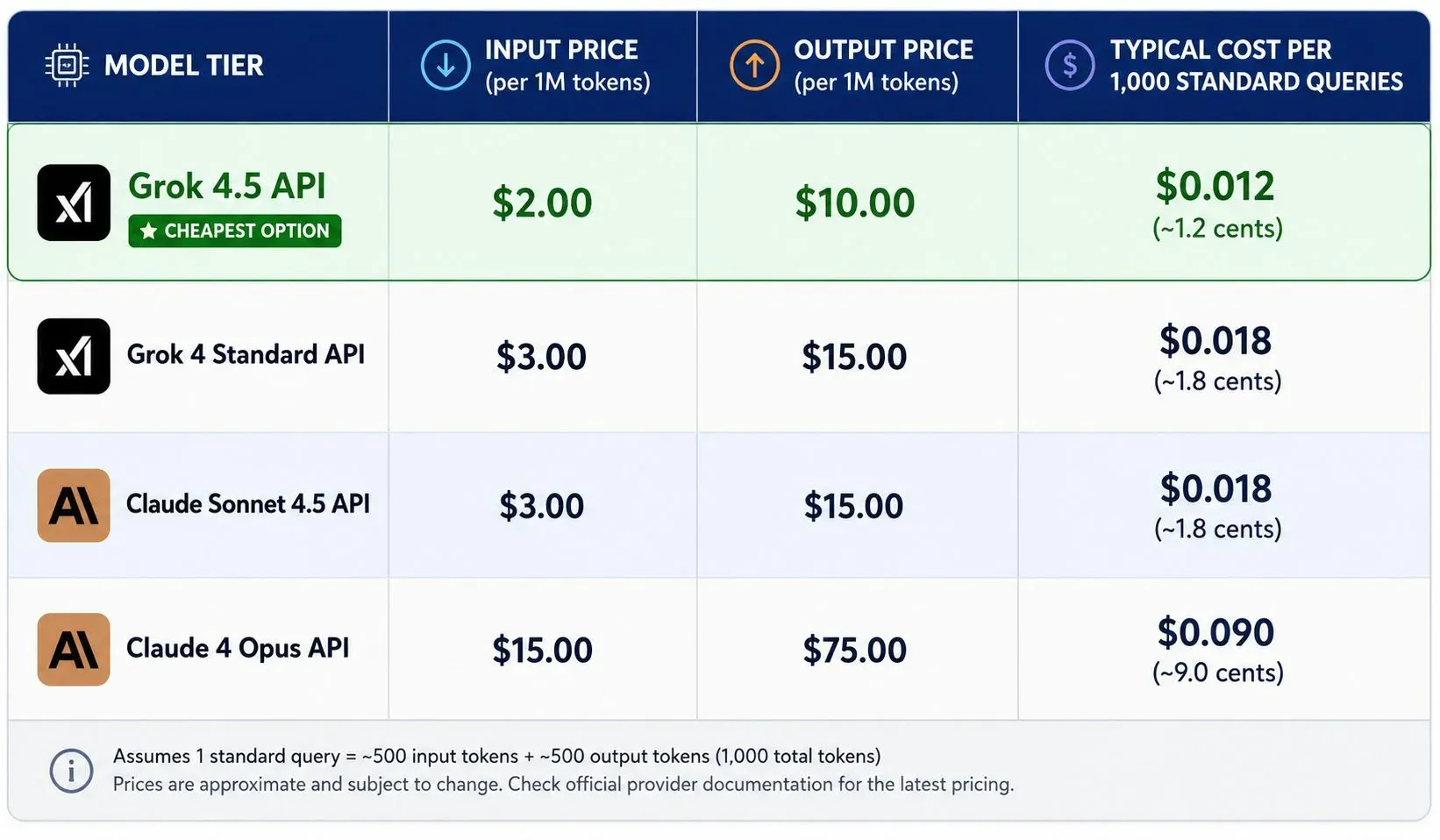
Grok's API pricing is significantly cheaper than Claude Opus. Running 10 million input tokens and 5 million output tokens monthly costs approximately $95 on Grok 4, compared to $187.50 on Claude Sonnet 4.5 and $387.50 on Claude 4 Opus.
Consumer Subscriptions
Claude Pro: $20/month. Grants access to Claude 4 Sonnet, Claude 4 Opus, project knowledge bases, and artifact sharing.
SuperGrok / X Premium+: $30/month for SuperGrok on grok.com, or $40/month via X Premium+ (includes Grok 4, live X search, and Aurora media generation). Higher tiers like SuperGrok Heavy run up to $300/month for heavy computational workloads.
Model-Routing Architecture: How to Use Both Models
High-volume engineering teams do not need to choose a single provider. The most efficient approach is a hybrid model-routing architecture that uses each model where it excels.
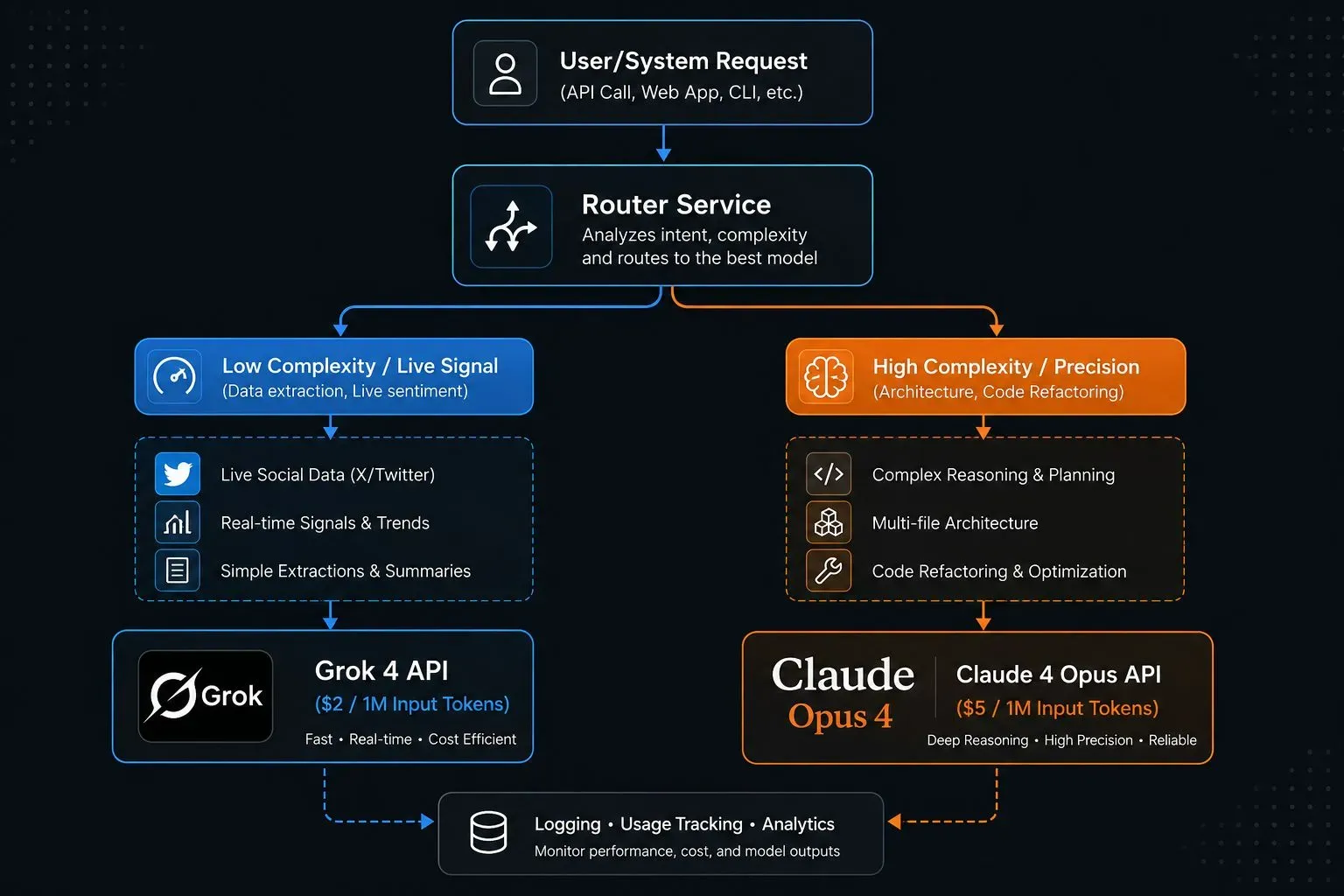
Suggested Routing Strategy
Route to Grok 4: Use Grok for initial classification, log processing, live sentiment analysis, rapid prototype generation, and terminal command execution. This keeps high-volume traffic on a low cost-per-call model.
Route to Claude 4 Opus: Pass multi-file code refactoring, complex logic validation, legal compliance checks, and final output reviews to Claude.
By routing peripheral tasks to Grok and reserving Claude for critical reasoning nodes, development teams reduce overall API expenditures by 40% to 70% while preserving high output quality.
Leave a Comment
Your comment is completely private and secure. We never publish comments publicly on our website. Your message will be sent directly to our team.