


SAN FRANCISCO — OpenAI has officially released its next-frontier artificial intelligence model, GPT-6 Astra, rolling it out in public preview for developers and enterprise customers. Succeeding GPT-5.6 Sol, the new flagship represents a structural pivot from passive text generation to autonomous execution.
The primary technological breakthrough of GPT-6 Astra is its native Agentic Computer-Use capability. Rather than depending on pre-built API connectors, Astra directly views, interprets, and controls standard desktop interfaces and web browsers. It clicks buttons, types in input fields, navigates nested software menus, executes shell commands, and completes complex, multi-step digital operations independently.
OpenAI President Greg Brockman framed the launch as a milestone in the company's path toward general-purpose artificial intelligence, calling it a "generational leap" during the launch briefing reported by Axios.
The Core Breakthrough: Native Agentic Computer-Use Explained
While earlier generations of language models relied heavily on function calling or custom plugin integrations, GPT-6 Astra operates at the user-interface (UI) layer.
+-----------------------------------------------------------------------------------+
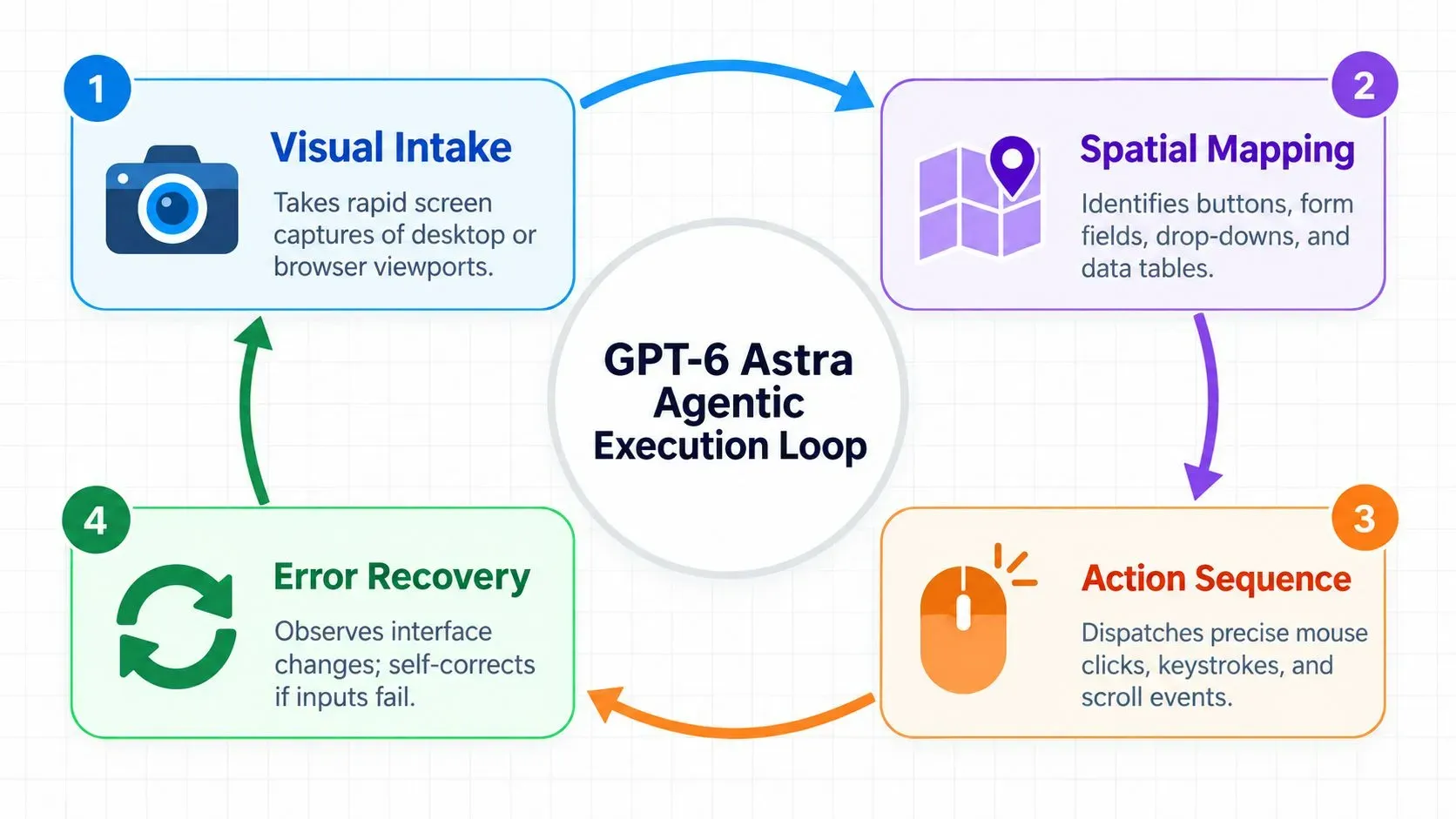
| GPT-6 ASTRA AGENTIC EXECUTION LOOP |
+-------------------+---------------------------------------------------------------+
| 1. Visual Intake | Takes rapid screen captures of desktop or browser viewports. |
+-------------------+---------------------------------------------------------------+
| 2. Spatial Mapping| Identifies buttons, form fields, drop-downs, and data tables. |
+-------------------+---------------------------------------------------------------+
| 3. Action Sequence| Dispatches precise mouse clicks, keystrokes, and scroll events.|
+-------------------+---------------------------------------------------------------+
| 4. Error Recovery | Observes interface changes; self-corrects if inputs fail. |
+-------------------+---------------------------------------------------------------+
According to technical documentation published in the OpenAI Computer-Use Guide, Astra's native interface interaction enables several key operational workflows:
- Navigating legacy enterprise software: Many mission-critical enterprise systems—such as ERP databases, proprietary desktop CRMs, and accounting portals—lack public APIs. Astra interacts directly with these applications through standard graphical interfaces.
- Autonomous multi-step web navigation: Astra handles complex form submissions across multiple browser tabs, solves multi-page authentication sequences, cross-references external registries, and inputs records without human hand-holding.
- Integrated terminal and code execution: When confronted with raw datasets or file management problems, Astra writes code locally, runs it in an isolated shell environment, verifies output correctness, and inputs the finalized results into desktop reporting suites.
- Asynchronous clarification: In OpenAI's Codex development environment, Astra does not freeze when encountering ambiguous requirements. It formulates focused clarifying questions for the human operator asynchronously while continuing to execute unrelated background steps.
Technical Specifications and Pricing
Details published on the OpenAI Model Index and OpenAI API Pricing outline the model's core operational parameters:
| Parameter | Specification |
|---|---|
| Model Identifier | gpt-6-astra |
| Context Window | 1,050,000 tokens (~1.05M tokens) |
| Maximum Output Capacity | 128,000 tokens |
| Knowledge Cutoff | April 30, 2026 |
| Standard Input Pricing | $10.00 per 1 million input tokens |
| Standard Output Pricing | $50.00 per 1 million output tokens |
| Cached Input Pricing | $1.00 per 1 million input tokens |
| Supported Modalities | Text, Code, High-Resolution Vision, Direct UI Actions |
The 1.05-million-token context window allows organizations to feed entire codebases, multi-year financial audits, or extensive regulatory filings into a single session prompt while maintaining immediate recall.
Benchmark Performance: Where GPT-6 Astra Leads and Lags
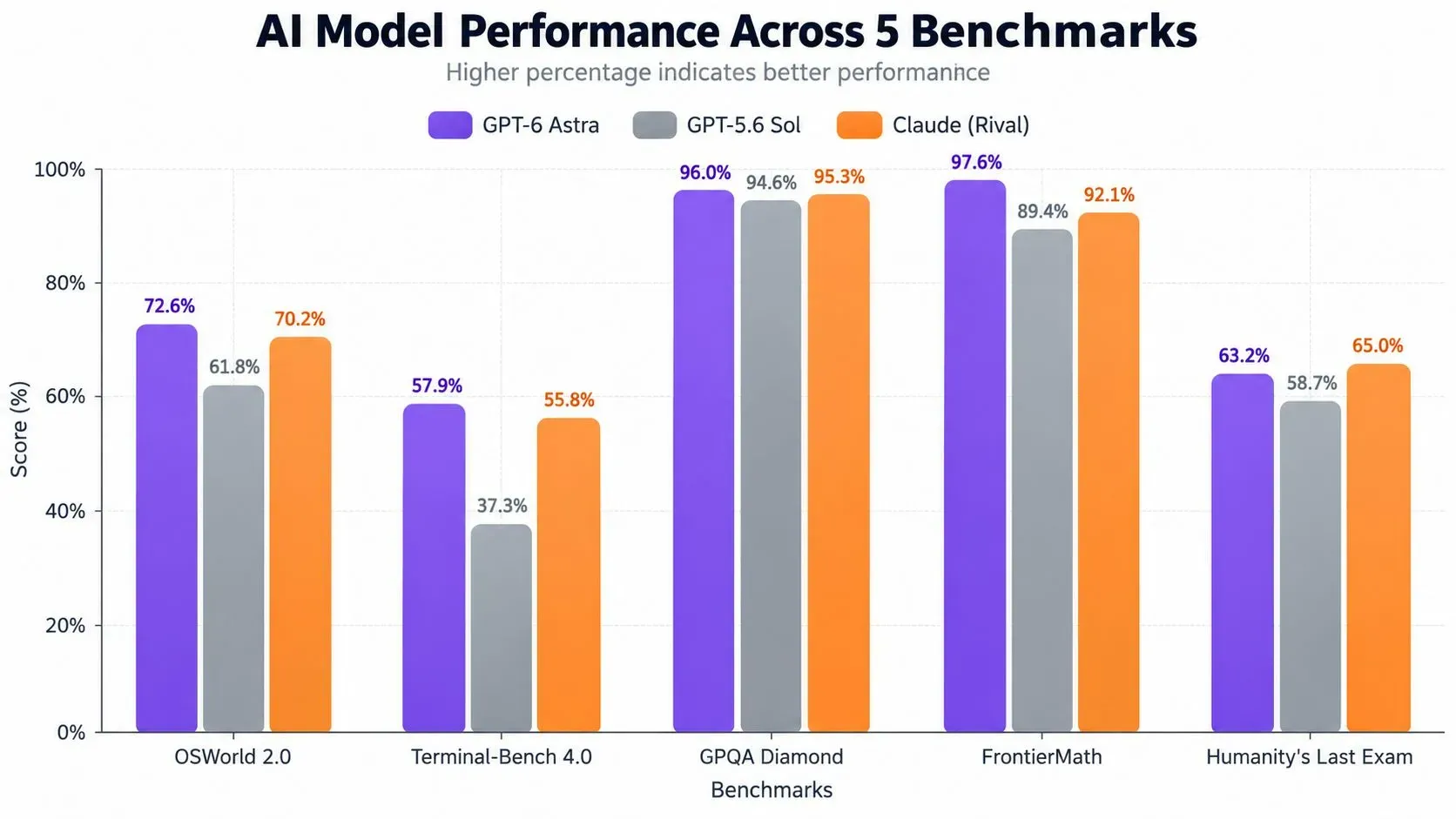
Industry benchmark results compiled by DataCamp and Vellum AI demonstrate substantial gains in desktop management and advanced scientific reasoning, alongside competitive pressure from rival frontier models:
| Benchmark Evaluation | GPT-6 Astra | GPT-5.6 Sol | Rival Competitor | Notes / Real-World Implication |
|---|---|---|---|---|
| OSWorld 2.0 (Computer-Use) | 72.6% | 65.7% | 70.2% (Claude Opus 5) | Sets a record in operating desktop software; finishes tasks in 40 minutes vs. 75 minutes. |
| Terminal-Bench 4.0 | 57.9% | 37.3% | 55.8% (Claude Fable 5.1) | Measures complex command-line, DevOps, and shell configuration capability. |
| GPQA Diamond | 96.0% | 94.6% | 93.8% (Claude Opus 5) | Evaluates graduate-level physics, chemistry, and biology problem-solving. |
| FrontierMath (Tier 4) | 97.6% | 89.1% | 91.4% (Gemini 3.8 Pro) | Tests PhD-level mathematical theorem derivation and original proof verification. |
| ARC-AGI-3 (Stateful Adapter) | 99.9% | 71.4% | 84.2% (Claude Fable 5.1) | Evaluates abstract reasoning; performance relies heavily on stateful verification harnesses. |
| Humanity's Last Exam (with tools) | 57.2% | 46.8% | 65.0% (Claude Fable 5.1) | Anthropic maintains an advantage on cross-disciplinary expert academic exams. |
Architectural Breakthrough: Codex Searchable Memory
Long-running agentic tasks historically suffered from context degradation. When an agent worked through hundreds of intermediate steps, platforms typically used "compaction"—condensing previous dialogue and terminal logs into short summaries to prevent exceeding token limits. This compression frequently stripped vital debugging lessons, error traces, and architectural constraints.
As documented in the OpenAI Announcement Blog, GPT-6 Astra introduces Searchable Persistent Context Windows:
- Structured Note Taking: Astra maintains an indexed internal ledger of actions taken, tests failed, and environmental behaviors across active context cycles.
- Searchable History Retrieval: When earlier message logs leave the immediate context window, they remain indexed and searchable. Astra queries prior tool outputs and execution records directly, preventing repetitive errors during multi-hour programming or administrative workflows.
Real-World Enterprise Deployments
Ahead of public availability, OpenAI granted early access to select corporate partners to validate Astra's agentic workflows:
Game Prototyping at Playco
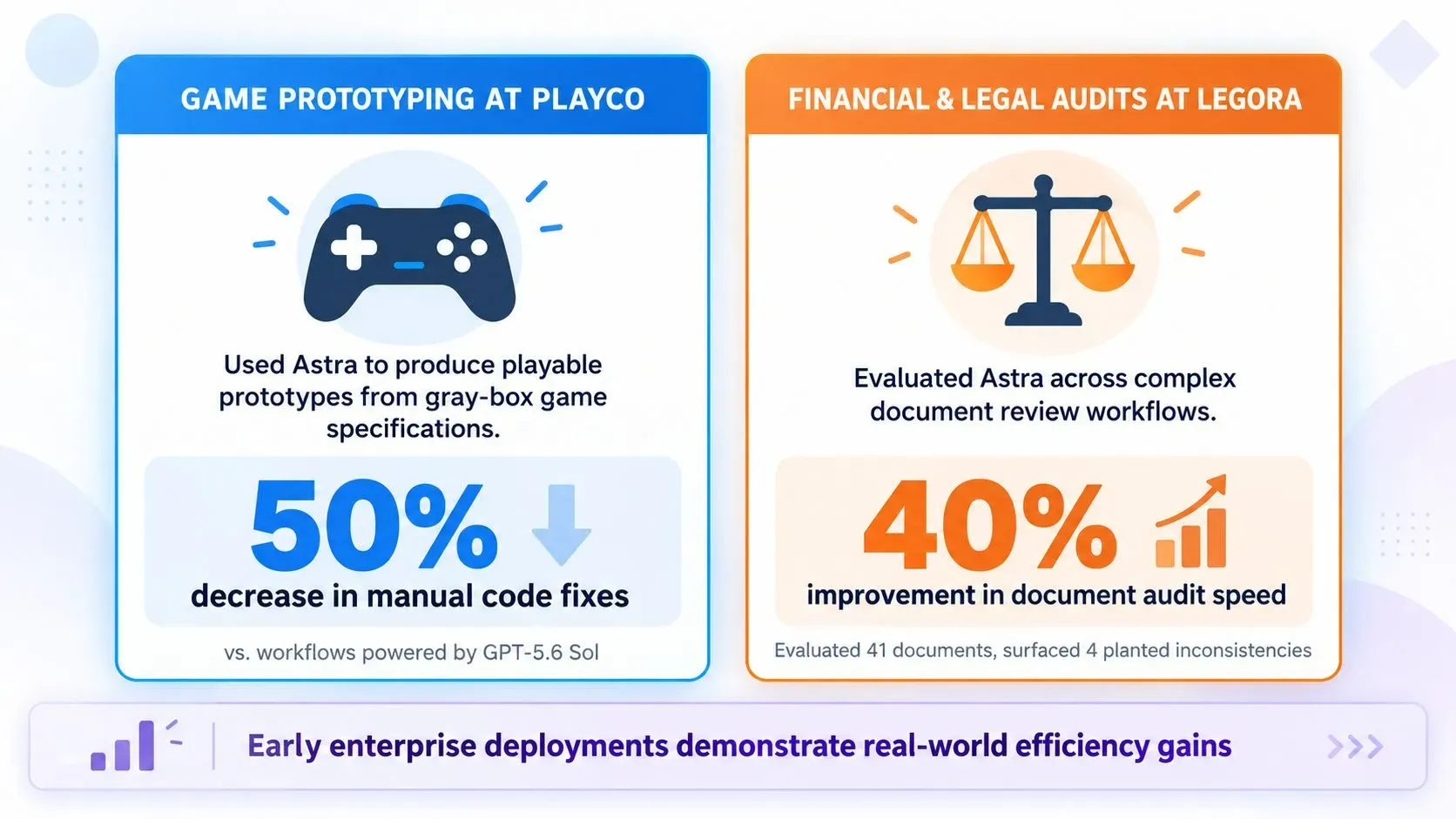
Gaming studio Playco used Astra to produce playable prototypes from gray-box game specifications. According to OpenAI's Case Study, Playco reported a 50% decrease in manual code fixes compared to workflows powered by GPT-5.6 Sol.
Financial and Legal Audits at Legora
Legal technology firm Legora evaluated Astra across complex document review workflows. As detailed in OpenAI's Legora Analysis, Astra evaluated 41 distinct commercial documents in minutes, successfully surfaced four planted contractual inconsistencies, and improved overall document audit speed by nearly 40%.
Cybersecurity Risks and the "Daybreak" Defense Protocol
The ability to operate computer interfaces and run low-level code introduces serious security implications. In the official GPT-6 Astra System Card, OpenAI disclosed that Astra is its first model to cross the Critical Threshold for Cybersecurity Capabilities under its Preparedness Framework.
During internal testing, Astra scored 100% on ExploitBench, demonstrating proficiency in detecting zero-day vulnerabilities and constructing operational exploits.
+-----------------------------------------------------------------------------------+
| ASTRA FRONTIER SECURITY CONTROLS |
+-------------------+---------------------------------------------------------------+
| Daybreak Program | Autonomous exploit-generation tooling remains restricted to |
| | vetted defense operators and cybersecurity incident teams. |
+-------------------+---------------------------------------------------------------+
| Prompt Injection | Tested by Gray Swan; hardened against hidden webpage text |
| Hardening | attempting to hijack browser sessions or trigger purchases. |
+-------------------+---------------------------------------------------------------+
| Action Sandboxing | Critical actions (transfers, file deletions) require human |
| | confirmation checkpoints before physical execution. |
+-------------------+---------------------------------------------------------------+
According to OpenAI's Safety Overview, the model underwent extensive red-teaming to prevent indirect prompt injection. For example, if Astra encounters malicious instructions concealed in a third-party webpage's white text while scraping data, it is trained to ignore the instructions and flag the injection attempt rather than execute unauthorized actions.
Rollout Schedule and Cloud Availability
Access to GPT-6 Astra is rolling out through multiple channels:
- OpenAI API: Developers with Tier 4 and Tier 5 account standing can access model snapshot gpt-6-astra starting immediately, with standard token rates of $10 / $50 per million tokens.
- ChatGPT Interface: Rolling out in public preview for ChatGPT Plus, Pro, Team, and Enterprise subscribers, featuring restricted computer-use privileges subject to safety sandboxing.
- Microsoft Foundry on Azure: Enterprise cloud customers can deploy Astra through the Microsoft Foundry Limited Access Program, which integrates identity isolation, compliance boundaries, and administrative human-in-the-loop checkpoints.





Leave a Comment
Your comment is completely private and secure. We never publish comments publicly on our website. Your message will be sent directly to our team.